Here’s what WA state auditors found about Benton sheriff’s 13,000 rounds of ammo at home
READ MORE
Sheriff Hatcher Legal Troubles
A look at the legal troubles faced by former Benton County Sheriff Jerry Hatcher
Expand All
The Benton County Sheriff’s Office’s internal inventory and monitoring system was so inadequate there’s no way to determine whether ammunition has gone missing, according to a new state report.
A county-based software system was used in 2019 to manage “small and attractive assets” — like pistols, rifles, safety equipment, cameras and radios.
But when it came to ammo, supervisors down the line to deputies could request “varying amounts” for either training or duty, and never had to account for if and how each round was used.
The issue of how the county law enforcement agency tracked certain items was the focus of an accountability audit report released this week by the Office of the Washington State Auditor.
“The Sheriff’s Office has no requirement that officers return unused ammunition because the expectation is that eventually, it will be used,” the report said. “The Sheriff’s Office considers ammunition a consumable asset and therefore does not track it.”
So when 13,700 rounds were recovered from the garage at Sheriff Jerry Hatcher’s former Kennewick home, there was no record showing exactly when he was issued the ammunition.
The cases of ammo were seized as part of a 2019 order in Hatcher’s divorce case that he surrender all weapons, since his estranged wife had accused him of domestic violence.
Shipping labels on the boxes connect them to purchases made in 2015 and 2016 by the sheriff’s office for the jail corrections division. Hatcher was the undersheriff at the time, and the two departments then were both run by the sheriff.
The audit report did not address the allegations of the three Benton County commissioners that Hatcher stole the county-owned property.
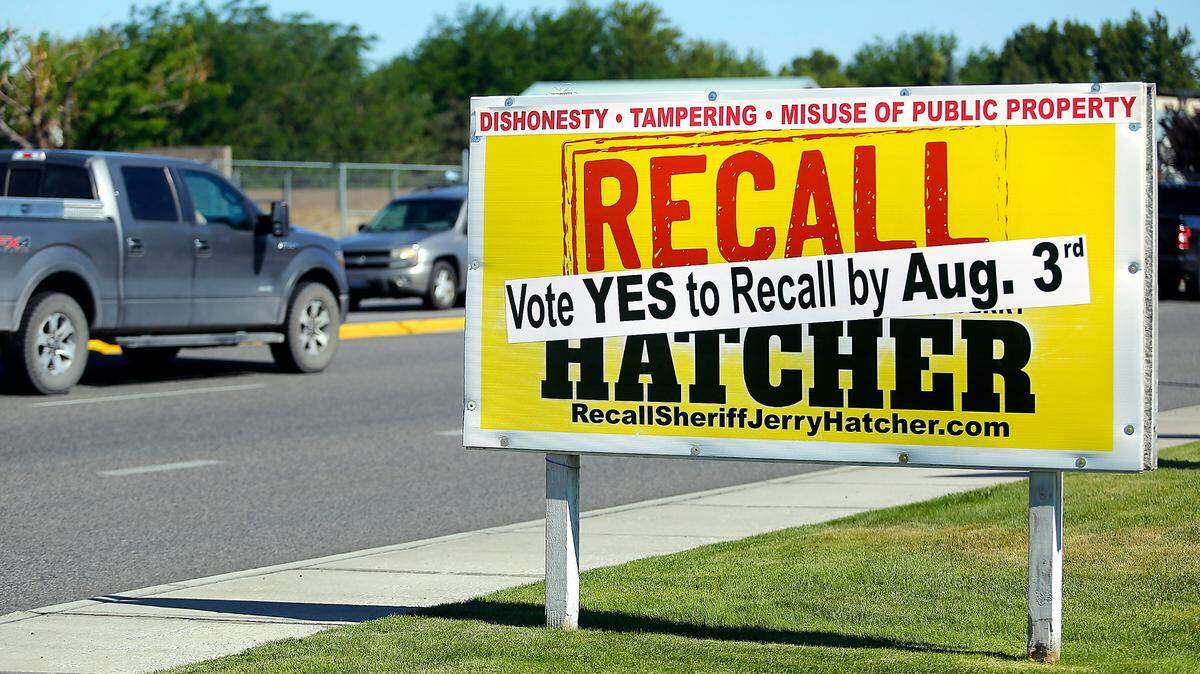
The ammunition stockpile issue is prominent in the eight charges against Hatcher — supported by a majority of his employees and approved by the state Supreme Court — in an effort to oust him from office.
Voters will decide Aug. 3 if the sheriff should be recalled.
Calls for investigation
Benton County commissioners, the Benton County Deputy Sheriff’s Guild and the Washington Fraternal Order of Police have called for a criminal investigation into the huge stash of county-owned ammunition seized.
Upon hearing about the cache’s discovery, the local union described it as “extraordinary” and “somewhat mindboggling.” It also said the amount represents “a quantity that is greater than the entire (amount) deputies would be provided for years of training.”
Requests made of the Washington State Patrol, the state Attorney General’s Office and the Kennewick Police Department to look into the stockpiled ammo were declined.
The sheriff, as an independent elected official, has said he is the only one who can authorize an investigation into himself.
He has not taken that step because he’s repeatedly said he did nothing wrong, that there was no ill intent in having the stash and it was there for convenience so he could go practice shooting whenever he wanted.
Hatcher has said there is no evidence to indicate he was stealing the ammunition, selling it or giving it to people. He’s also claimed that he shot all six of the different calibers found in his home, even though most of them are not used by his agency.
Reports state that a majority of the recovered ammunition appeared to have not been touched for quite some time when it was picked up by Kennewick police.
Of the nearly 14,000 rounds recovered from the garage, 500 were .45-caliber practice ammo that had been sent to the home of a then-employee of the county jail. Investigators in a previous administrative review said they didn’t know how that ammo ended up with Hatcher.
Lack of oversight
The three county commissioners, in their response to state auditors included in the report, said the 14 cases of ammunition at the sheriff’s personal home “would qualify as a misappropriation of county resources.”
The seized ammo is worth about $2,825.
But the audit report stopped short of addressing the theft allegations since the report covers only the period between January and December 2019.
County officials reportedly learned of the ammo cache in January 2020 in a court filing by the sheriff’s estranged wife, Monica Hatcher.
The audit report focused instead on the fact the sheriff’s office “lacked proper oversight over the issuance, usage, disposal and tracking of training firearms and ammunition at the county.”
County commissioners asked state auditors in 2020 to look into the inventory and tracking of weapons and ammunition as part of their annual audit review.
Jerome Delvin, the board’s current chairman, could not be reached Thursday by the Tri-City Herald about the audit findings.
Annual audit cycle
In an accountability audit, state officials look at whether the agency’s management are “ensuring compliance and adequate safeguarding of public resources from fraud, loss or abuse. This includes the design, implementation and maintenance of internal controls relevant to these objectives.”
Benton County is on an annual audit cycle, so the state will follow up on the status of the finding.
Kathleen Cooper, spokeswoman for the Washington State Auditor’s Office, also told the Tri-City Herald that anything that came up during the recent 2019 audit for the 2020 period could be considered in the next audit.
“We are aware that there is a high degree of concerned members of the community about certain aspects of this, and we just hope that our audit report will provide a good factual basis for the community to continue having conversations about its elected positions,” said Cooper.
She added that auditors “wanted to take care to offer a series of recommendations that would provide the transparency ... that the public would expect when it comes to things like ammunition, but also not being overly burdensome on any government to do.”
The auditor’s report notes that since there was no process in place in the sheriff’s office to inventory and track the issuance of ammunition, they were unable to determine if ammo was safeguarded and used properly.
The report also said two training firearms and four training firearm parts could not be found, and that two training firearms and seven training firearm parts were not included in the software system’s inventory.
“Inadequate tracking and monitoring increased the risk that the sheriff’s office would not be able to identify misappropriation, misuse or loss of its small and attractive assets in a timely manner, if at all,” the report said.
Auditors recommended the office:
- Strengthen its internal controls to ensure an annual inventory of all training firearms and ammunition is performed and documented.
- Implement a policy and procedure that establishes internal controls over the tracking of inventory for training firearms and monitoring the issuance of ammunition.
- Inquire with the Washington State Patrol regarding the reporting of missing training firearms and parts.
They also thanked the county for its commitment to resolving the issues and emphasized the importance of having “effective policies and monitoring procedures over small and attractive assets, including ammunition.”
“However, to clarify a reference made in the county commissioner’s response, we did not identify misappropriation of public resources in the course of the audit,” the report said.
Changes implemented
While the auditor’s office asked for a combined response from the county board and sheriff, the two responded separately.
Hatcher said he did not agree with the finding about the ammunition “because we feel strongly that you cannot have a finding when there is no stated rule, guideline or requirement that was identified or violated.”

The sheriff said his office has never tracked practice ammo as an asset, and added that it does not meet the criteria for items to be tracked in a review of all state and county guidelines.
Ammunition is considered a consumable item, he said.
However, Hatcher said “due to the desire to maintain accountability and transparency to the taxpayers,” the office implemented a new policy in October 2020 with standard tracking procedures.
“All practice ammunition is now being tracked from the point of purchase through the point of issuance,” he wrote in his response to state auditors. “An inventory will be performed annually, measuring current stock, purchases and the issuance of ammunition.”
The system does not track how much ammunition is used by each deputy or require them to return any unused ammo in their possession at the end of each year.
As for the guns, Hatcher placed the blame on the bureau/division commander, saying it is their responsibility to report any lost or damaged property directly to the sheriff.
That was not done, he wrote.
Hatcher said to ensure compliance with department policy, all training firearms are now stored in a single case to be transported by the firearms instructor.
That instructor takes inventory prior to the training and at the conclusion to make sure each pistol is accounted for, he said.
People can follow the status of an audit by using the “Tracker” tool, and entering the agency name, on the state Auditor’s Office website.
This story was originally published July 9, 2021 at 5:00 AM.