Embrace winter: Where to go near the Tri-Cities for snow shoeing, skiing and more
By Paul KrupinSpecial to the Herald
The warmer temperatures at the lower elevations combined with the rain have melted the snow near Tri-Cities, making it fun to get outside this winter.
You have to drive toward the mountains or to higher elevations to find the snow at about 1,000 feet to the west or at 2,000 feet to the north and southeast.
You’ll hit snow when you get to Yakima or head north of Moses Lake or south east of Walla Walla.
The ski resorts are open and are reporting good conditions for skiing.
All the ski resorts had up to 3 inches of new snow Friday with more predicted over the weekend. Check out the most current conditions at each resort online.
White Pass — 75-inches base, packed powder 100 inches at the summit.
Mission Ridge — 29-inch base, machine groomed 48 inches at the top.
Bluewood — 55-inch base, machine groomed 53 inches at the summit.
Anthony Lakes — 60-inch base, machine groomed 60 inches at the summit.
Mt. Spokane — 92-inch base wet snow 92 inches at the summit.
Courtesy Paul Krupin
Snow shoeing & cross country skiing
Snow conditions are pretty good in the back country for cross-country skiing, snow shoeing and snowmobiling.
There are dozens of snow areas within two hours of Tri-Cities.
The best way to find out the conditions where you are going is to use the most recent snow data from the ski resorts and the Snotel Network.
Recent data from the remote, automated Snotel collection sites is showing the snow depth shrinking with the warmer temperatures and rain.
In the Cascades you can check Satus Pass, Green Lake, Bumping Ridge, Cayuse Pass and Lost Horse.
Snotel stations for East White Pass and Morse Lake, two critical stations along the Cascade Crest west of Yakima, are out of service.
In the Blue Mountains you can check Emigrant Springs, High Ridge and Milk Shakes in Oregon and Touchet, Spruce Springs in Washington.
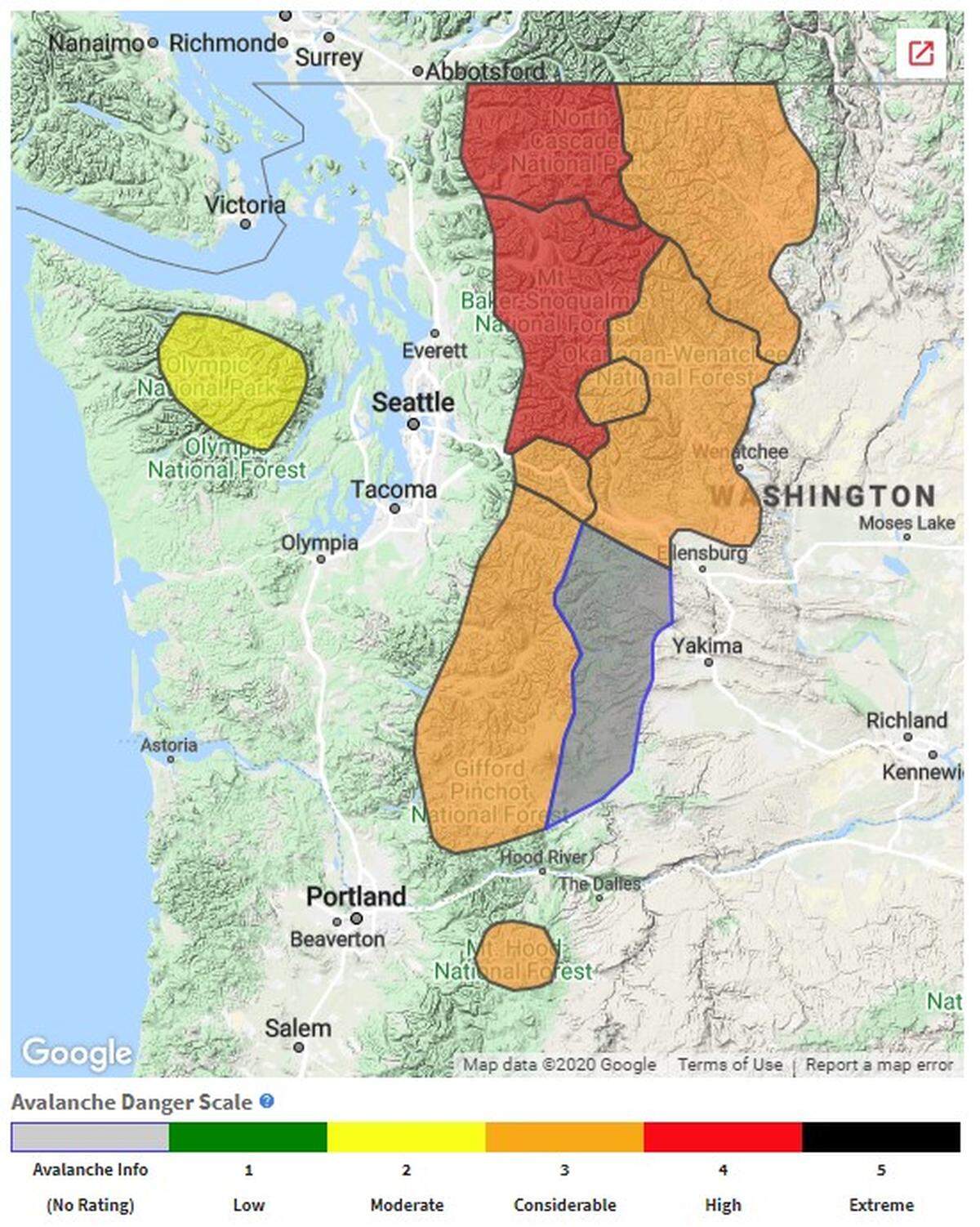
The latest reports from the Northwest Avalanche Center www.nwac.us rate the Avalanche Danger to be Considerable to High throughout most of the Central Cascades. Courtesy Northwest Avalanche Center
Avalanche conditions and hazards
The latest reports from the Northwest Avalanche Center www.nwac.us rate the avalanche danger to be “considerable” to “high” throughout most of the Central Cascades.
Don’t forget the essentials when you’re heading outdoors: clothes for the temperature and conditions, a day pack, gators to keep your ankles and lower legs from getting wet and cold, a hat, gloves, plenty of water, plenty of snacks, sunscreen and sunglasses.
Dress in layers and wear breathable, synthetic fabrics that you can take off if you get warm.
To prevent sliding and slipping while walking, bring along a pair of microspikes or cleats you can slip onto the bottoms of your boots.
Trekking poles with snow baskets are really helpful so you can keep your balance while walking, especially on steeper slopes or in deeper snow.
To walk on or through the snow, you need proper foot gear for the conditions. You need to wear snowshoes if the snow is deep enough that your foot sinks in when you step on it.
Paul Krupin is an avid local outdoor enthusiast and a member of the Intermountain Alpine Club (www.IMACNW.org). He can be reached at pjkrupin@gmail.com.
Get one year of unlimited digital access for $159.99