What’s driving the ballooning growth in Tri-Cities local government budgets?
Throughout election season the common refrain local officials kept going back to was concern over budgets growing out of control.
Why exactly have local government budgets in the Tri-Cities area, and across the state, increased by a huge margin over the past 10 years?
As cities and counties grow, their budgets do too. However in the past few years, the strain has become increasingly worrisome as revenues fail to keep up with the booming population.
Benton County’s general budget increased by 43% from 2013-24 to its 2023-24 budget. That’s a $50 million jump for their biennial budget.
The proposed 2025-26 budgets looks to be coming in at about $10 million higher than that at around a whopping $185 million.
Across the river, Franklin County leaders are trying to hammer out a new single year budget, from a starting point of about $1.7 million in the red. Their general budget increased by 83% in the past decade, jumping from $27 million to $49 million.
The general budget doesn’t include road funds, which can nearly double total budgets.
Why are budgets growing like this?
The simple answer to the mystery behind these ever growing budgets is people.
When more people move to the county, the county in turn needs more staffing and as wages grow over time the county has to try and keep up.
The majority of county budgets pay for law enforcement and courts. The bulk of the increases that counties in the Tri-Cities see can be found in those crime and court budgets.
Benton County 2013-14 to 2023-24 comparison
- Sheriff Patrol: $13.9 million to $18.6 million
- Corrections: $32.9 million to $42.3 million
- Office of Public Defense: $5.1 million to $7.5 million
- Prosecutor’s Office: $8.7 million to $13.1 million
- Superior Court: $5.3 million to $13.1 million
- District Court: $6.7 million to $10.2 million
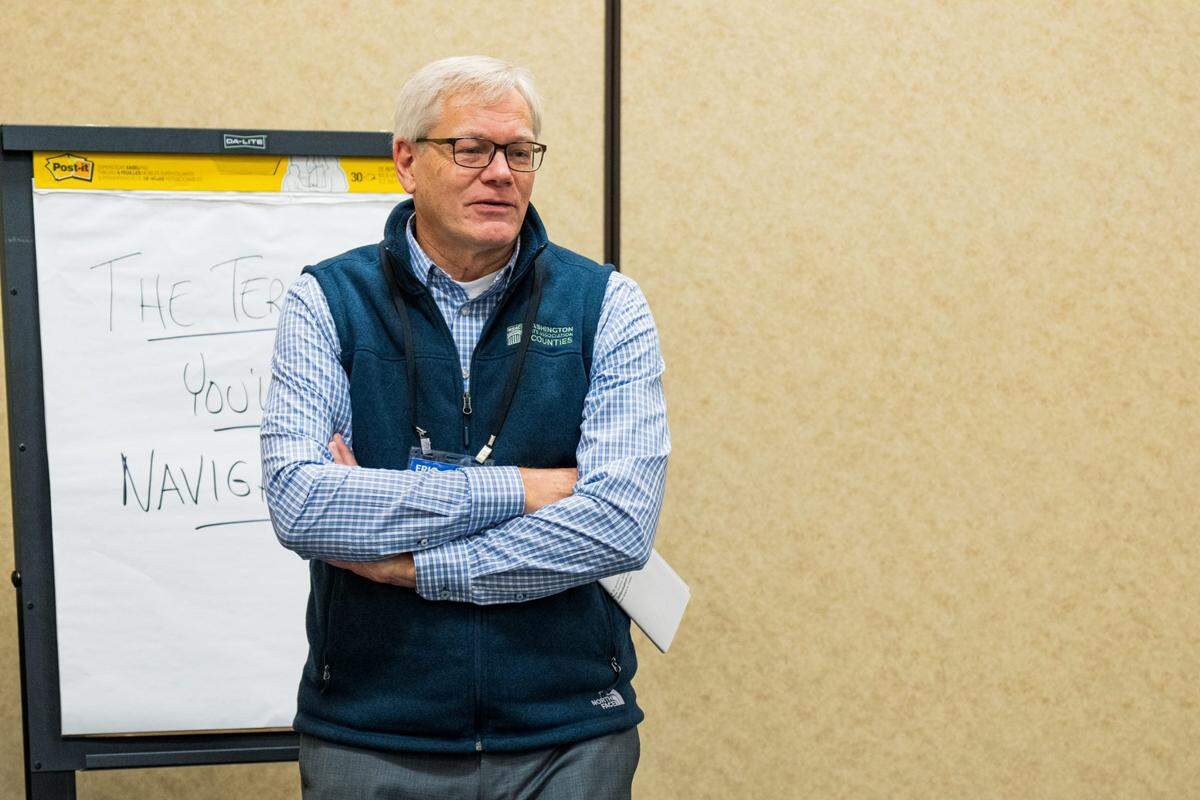
Franklin County Interim Administrator Eric Johnson has seen first hand how these costs have accrued over the years as the former executive director of the Washington State Association of Counties.
“The courts, the clerk, the prosecutor, and the big one is public defense. The increased cost only continues to grow,” Johnson said. “All of those elements are, depending on the county, as high as 60 to 70% (of the budget). You look at the jail, it’s already high risk, high liability, you want them properly staffed, you don’t want to cut corners.”
County jails also have to meet certain state and federal staffing mandates, meaning their growth is required. The same can be said for the office of public defenders because of statewide caseload limits.
.JPG "SHi_j0222(29).JPG")
Wages are the biggest portion of those costs, with inflation and ever-climbing cost of living having to be factored in.
Johnson said another area that has seen a staggering increase is insurance rates.
“The cost of liability insurance in a county, if you look at costs 10 years ago to today, it’s almost doubled,” he said.
Johnson said counties pay into an insurance pool in order to offset the costs of major claims, so that they end up paying only a small percentage. Still, if a county is responsible for 2% of a $1 million claim, that’s $20,000 out of their general fund.
Additionally, the cost of capital projects has seen an especially sharp rise as the cost of building materials went up during the COVID-19 pandemic and subsequent global supply chain crisis.
Lumber prices increased nearly 85% between 2019 and 2021 and steel mill products rose by about 90%, and remain 65% higher than in January 2020, according to the National Association of Home Builders. The lumber prices leveled out at more than 22% higher than before the pandemic.
Fuel prices over the past decade have also played a big factor.
“When you spend half a million dollars on fuel, it could hit $4.50 a gallon and all of a sudden you’ve got a 30-40% increase in the price of fuel,” Johnson said.
How does it get paid for?
Most local governments attempt to operate on a balanced budget, meaning they only spend as much as they anticipate they’ll bring in through revenues.
Those revenues haven’t really kept up with growth, though.
State and federal aid during the pandemic helped buoy budgets, but it also created something of a trap for leaders who weren’t careful with spending. Those who tried to put the money into wages, like many school districts, are finding themselves having to now layoff staff.
Most counties put the money toward capital projects and initiatives that would produce long-term results in their communities, Johnson said.
Franklin County invested a significant amount of money in repairing and expanding the HAPO Center’s heating and cooling systems. Benton was able to invest a significant amount into the Columbia Valley Center for Recovery, which is expected to be completed by the end of next year.

Both counties also recently put some of their last bit of funding into upgrading 911 communications infrastructure.
That money had to be spent by the end of this year though, so shortcomings in budgets are more apparent going into the 2025 cycle.
The primary revenue sources for counties are property tax and sales tax.
Property tax growth is capped by the state’s levy limits, which only allows governments to collect 1% over their prior year’s allotment. This can range from a few thousand dollars to a few hundred thousand. Franklin County estimates it will be around $100,000 this year.
Property tax revenue from new construction comes in over that 1% limit, so when counties bring in new rooftops and businesses, it can make a big impact.
Amazon paid about $3 million in property tax while its massive Pasco warehouses sat empty.
Franklin County is estimating they won’t get about $300,000 in revenues from new commercial construction in Pasco’s Tax Increment Finance areas, which includes the Broadmoor Development and the Port of Pasco’s industrial area that includes the new $600 million Darigold plant. Instead that property tax money will be used to offset infrastructure costs for the projects.
Pasco and Franklin County are banking on the Broadmoor development’s envisioned retail to bring their sales tax revenue more closely in line for a community of their size. Historically, Pasco has lost a lot of sales tax revenue to shopping districts across the river in Kennewick and Richland.
A study commissioned by Franklin County earlier this year showed they were behind both Grant and Chelan county in retail sales. Their assessed values were also significantly lower, despite being the fastest growing city and county in the state.
Johnson said the shift toward tighter budgets is due to a number of factors beyond just growth. He pointed to lost revenue from car tabs that the state never truly replaced, as well as the property tax compression issues.
Fire districts in the region have been especially hard hit by the levy compression limitations because their tax bases are inherently smaller. That means any levy lid lift request, to bring their compressed rate back up, results in a disproportionately large tax bill increase that many voters just can’t stomach.
“It’s just a combination of things on the revenue side, but there are counties that find ways to make it work and it gets thinner and thinner every year,” he said. “Expenditures generally grow faster than revenues.”
Johnson said continually having to bend that curve on expenditures to stay aligned with revenues eventually leads to erosion of services.
While this budget cycle has the potential to be fairly painful for Tri-Cities governments, Johnson said it’s not a problem unique to the region.
Experts have said that proposed changes to Washington’s public defender case limits have the potential to triple Office of Public Defense budgets over the next few years, which could leave nearly every county in the state in crisis if the Legislature doesn’t step in to help offset some of the cost.
Cities and counties across the state will continue to hammer out their new budgets through November, with final approvals coming by mid-December.
This story was originally published December 1, 2024 at 5:00 AM.