
Murray, union leaders warn of layoffs under Trump proposed Hanford budget
AI-generated summary reviewed by our newsroom.
- Trump administration proposes cutting Hanford budget by about $400 million.
- Boosting the next Hanford budget could be particularly difficult for Sen. Patty Murray.
- Layoffs, slowed progress and ultimately higher costs could result, say union leaders.
For years Sen. Patty Murray has used her considerable clout in Congress to wring more money from fellow lawmakers for the cleanup of the Hanford nuclear site than requested in nearly every president’s budget proposal.
But for fiscal year 2027 she faces a particularly tough task, even given her powerful position as vice chair of the Senate Appropriations Committee and key position as the ranking member of the Energy Appropriations Subcommittee.
The Trump budget proposal calls for a cut of about $400 million for environmental cleanup of the 580-square-mile Hanford site that produced plutonium for the nation’s nuclear weapons program from World War II through the Cold War.
Not only is the proposed cut deep, but it comes in a fiscal year in which the Trump administration is proposing a $1.5 trillion increase for defense, tightening the spending for nondefense projects like environmental cleanup.
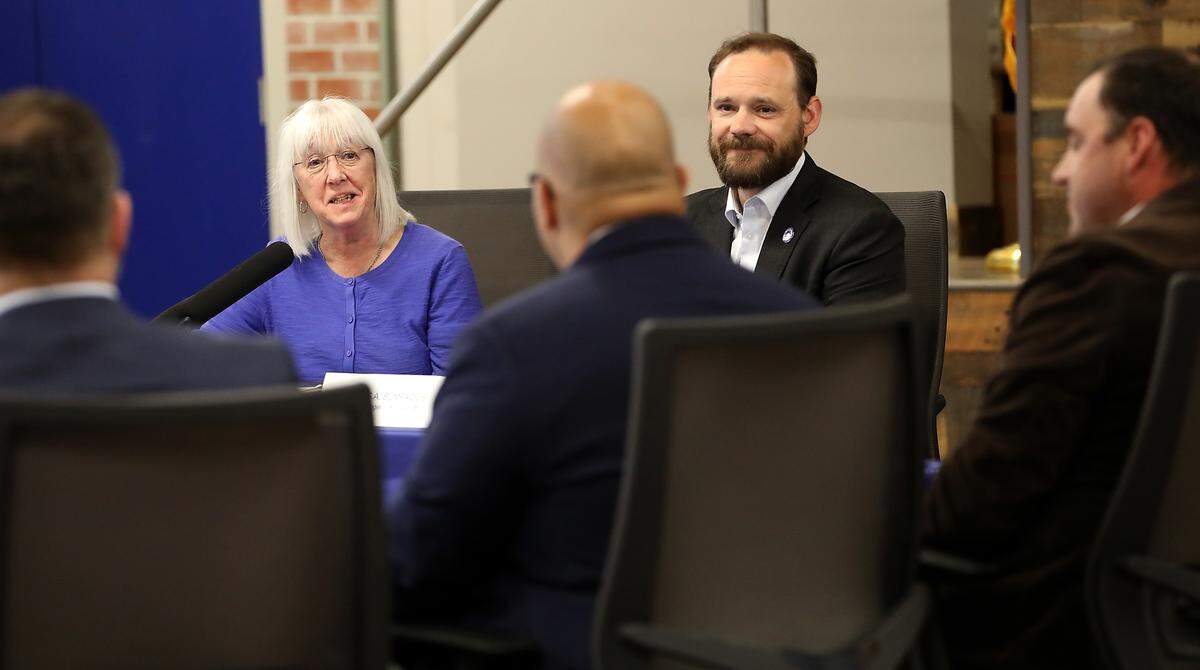
It “is going to cut into everything else,” Murray, D-Wash., said at a roundtable discussion with Hanford union and Tri-Cities development leaders at the Local 598 pipefitters hall in Pasco.
The proposed budget is “woefully inadequate” and she says it is “going to get torn up” as she works with her Congressional colleagues.
The more environmental cleanup work that gets done, the more economic opportunity there is for Eastern Washington, she said.
Proposed clean energy and new nuclear projects in the Tri-Cities area will not move forward if inadequate budgets slow Hanford cleanup, she said.
Budget cut means layoffs
A cut of $400 million from an annual budget high of more than $3.2 billion in the current fiscal year would mean many Hanford job layoffs and a major impact at the Hanford vitrification plant, she said.
And it would result in delays to clean up, potentially causing increased harm to the environment or human health, and increase the cost to environmental cleanup as costs continue to rise, she said, with her comments echoed by union officials.
Workers who are at risk of losing their jobs may not wait for a layoff notice but will leave for cities like Portland or Boise where more secure jobs are available, and they won’t be coming back to Hanford, said Seth Worley, vice president of the Central Washington Building and Construction Trades Council.
Hanford work is complex and takes “a consistent, highly skilled workforce,” said Thomas Carter, business representative for the electrical workers’ union Local 112. ” ... This isn’t plug-and-play labor. This is something where continuity matters.”
Planning work becomes more difficult and the work slows down as highly-skilled and experienced workers leave, and new workers have to be hired and trained for specialized, Hanford-specific work, he said.
“If we hire a guy today it is going to be six to eight weeks before they can even enter the worksite,” he said, even if the worker had previously been employed at Hanford.
Slowing work at Hanford now just means spending more money on it next year or in the next decade, said Nick Bumpaous, business manager for Local 598.
Barry Shoemake, business agent for the Hanford Atomic Metal Trades Council, said he’s a third-generation Hanford worker.
“I don’t want another generation out there,” he said. ... “Let’s put a bow on it. The end is in sight.”
The reduced budget proposal comes just as for the first time Hanford has reduced its radioactive waste, Murray said.
Vitrification of radioactive waste started in October, a major step to allow the eventual disposal of 56 million gallons of radioactive waste left in underground tanks, some of them built during World War II and prone to leaking.
Targeted Hanford projects
Hanford cuts proposed by the Trump administration include funds for the vitrification plant’s High Level Waste Facility that is under construction as the Department of Energy faces a federal court deadline to treat radioactive waste by 2033.
However, DOE Hanford Manager Ray Geimer assured members of the Hanford Advisory Board at a recent meeting that work would continue at the High Level Waste Facility with money budgeted for the project but not yet spent.
“There’s no way you can do that work by cutting the budget, by laying off employees, by losing the incredible knowledge there,” Murray said.
In the past carry-over money has been needed when funding is delayed and during government shutdowns, said union officials.
Additional work that would be paused or delayed under the proposed budget reduction includes:
▪ Work on cleanup of a spill beneath the 324 Building just north of Richland near the Columbia River would be put on hold. The decades-old spill is so radioactive that it would be lethal to a worker in direct contact within two minutes.
▪ Environmental cleanup work would be paused at the site of the K West Reactor, the last of eight plutonium production reactors to be cocooned, or put into long-term storage, to allow some of their radioactivity to decay over coming decades.
▪ The long-awaited resumption of shipments of containers filled with debris contaminated with plutonium would not start next year. The waste is scheduled to be sent to a national repository in New Mexico for transuranic waste, after waste from other sites was given priority.
Geimer told the Hanford Advisory Board that conditions at both the 324 Building and work at the K West Reactor area are stable and can be put on hold given Trump’s other budget priorities.
Shipping Hanford’s transuranic waste to the Waste Isolation Pilot Plant in New Mexico might not be able to start as expected next year for reasons unrelated to the budget, he said. DOE is facing pressure to dispose of transuranic waste at the Los Alamos National Laboratory in New Mexico rather than Hanford waste, Geimer said.
Geimer also discussed money-saving steps at Hanford, including the possible use of artificial intelligence to prepare work packages for what he called the site’s “incredibly complex system of planning work.”
“I think AI is going to turn out to be revolutionary in helping us,” he said.
Hanford now has 70 administrative workers for every 30 craft workers in the field, when it should be just the opposite, he said.
More budget cut concerns
Sen. Maria Cantwell, D-Wash., and the Washington state Department of Ecology also have raised concerns about the proposed budget cut.
The state Department of Ecology, a Hanford regulator has pointed out that the proposed budget is nearly $3.8 billion less that what is needed to keep the federal government on track to meet legal requirements and deadlines for Hanford cleanup.
But when Cantwell asked Energy Secretary Chris Wright about the administration’s budget proposal at a recent hearing, Wright said “the cuts are modest.”
Cantwell replied that he’s the latest in a long line of energy secretaries who said they could do Hanford nuclear site cleanup on the cheap but failed.