
‘Monumental step.’ Industrial-scale processing of Hanford radioactive tank waste begins
A new era at the Hanford nuclear reservation has started.
The first industrial-scale processing of radioactive tank waste to prepare it for disposal has begun, site officials announced Wednesday.
Early on Jan. 26, the Tank Side Cesium Removal System, or TSCR, began pretreating Hanford tank waste.
It is an initial step toward turning the waste into a stable glass form at the $17 billion Hanford vitrification plant.
“This is a win for the entire Tri-Cities community,” said Washington Gov. Jay Inslee in a video shown at the announcement.
“For decades, millions of gallons of dangerous waste has threatened the Columbia River and the health of everyone in central Washington and ... the Tank-Side Cesium Removal system is a major leap towards making our communities safer,” he said.
The 580-square-mile Hanford site adjacent to Richland in Eastern Washington has 56 million gallons of radioactive waste stored in underground tanks, some of them prone to leaking.
The waste is left from operations from World War II through the Cold War to produce nearly two-thirds of the plutonium for the nation’s nuclear weapons program.
When construction started on the Hanford Waste Treatment Plant, or vitrification plant, in 2002, it included a facility that stands the equivalent of 11 stories high to separate tank waste into low-activity radioactive and high-level radioactive waste for separate treatment and disposal.
But after technical issues were raised about that and about another vit plant facility that would handle high level waste, Hanford officials changed course and came up with a much smaller system that could do part of the massive building’s work.
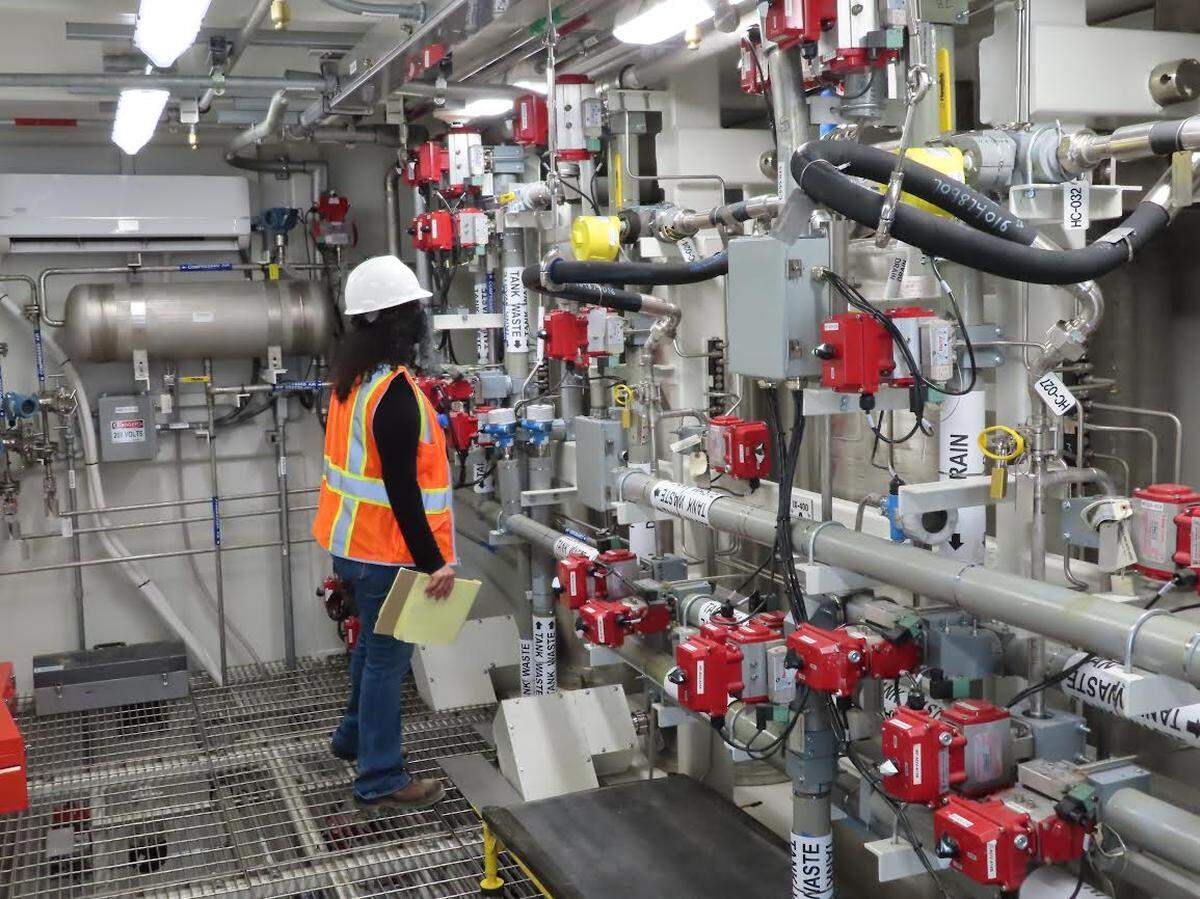
Hanford technology
“It was only three years ago that the Tank Side Cesium Removal System, or TSCR, was only a conceptual drawing,” said John Eschenberg, president of Washington River Protection Solutions, the tank farm contractor at Hanford.
Similar technology has been used at two other Department of Energy nuclear cleanup sites and in Japan after the Fukushima disaster.
Hanford bet on the same technology as a way to allow the vitrification plant to start treating some of its least radioactive tank waste by a federal court deadline of the end of 2023.
The TSCR system separates low-activity radioactive waste out of tank waste, so that waste can be vitrified as Hanford also works toward preparing to vitrify high level tank waste by a deadline in 2033.
It uses two technologies.
A filtration system removes waste solids, which are high level waste. And an ion exchange system removes radioactive cesium, which is a high level waste that is dissolved in liquid tank waste.
Much of the cesium from tank waste was previously removed to help control a buildup of heat in the tanks.
The entire TSCR system fits in three enclosures placed near one of Hanford’s underground waste tanks. The largest enclosure is the size of a land-sea shipping container.
1 million gallons
In the first week of operations, TSCR prepared 50,000 gallons of tank waste for treatment as low-activity waste at the vitrification plant.
“It is a monumental step forward as we drive towards vitrifying some of the tank waste,” Eschenberg said.
DOE set a goal of having 1 million gallons of low-activity waste pretreated and stored for vitrification in one of Hanford’s newer underground tanks by the end of this year.
Because the vitrification plant can glassify waste faster than TSCR can prepare it for the plant, the stockpiled waste will not only allow vitrification to start but will also allow operations there to continue.
Up to 90% of tank waste is expected to be low-activity rather than high level waste, once pretreated.
Work the first week at TSCR was slow and deliberate as operations started, Eschenberg said.
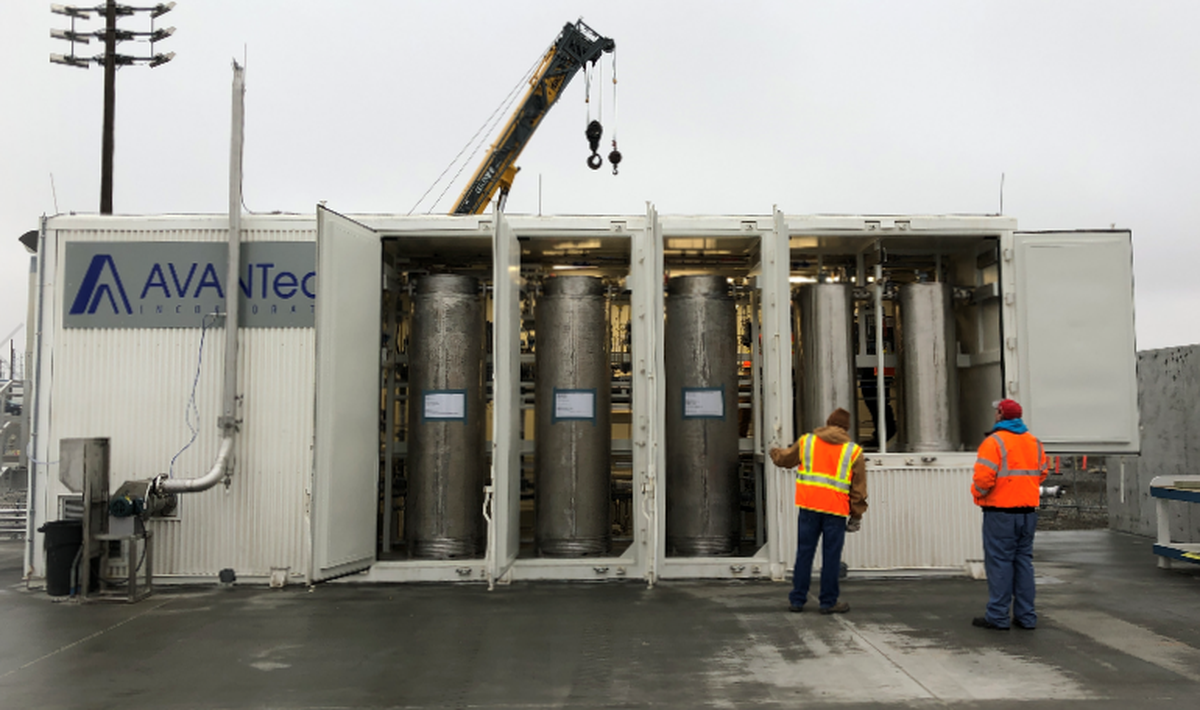
The system is expected to operate for about 3 1/2 more weeks, pretreating waste at a rate of about five gallons per minute, before its initial ion exchange columns need to be changed out.
Then the system will shut down for about three weeks as columns packed with cesium are removed to a nearby storage pad and fresh columns are put in.
Discussions continue on how that waste will be disposed of, but one option is vitrifying the cesium once high level radioactive waste treatment begins at the vitrification plant.
Cost of Hanford system
The TSCR system and upgrades to the tank farms where it sits outside the vitrification plant cost about $130 million, Vance said.
It is planned to operate for at least five years at a cost of roughly $175 million to $200 million, including the cost of $1 million each for about 150 ion exchange columns it will use.
DOE is very encouraged by the initial operations of TSCR and could consider using it or similar systems at other locations at Hanford or expanding it, said Brian Vance, the DOE Hanford manager.
He called the startup of TSCR “an important new chapter of our cleanup mission.
No decision has been made on the future of the full-size Pretreatment Facility at the vitrification plant, where construction has halted, as closed-door negotiations between DOE and its Washington state regulators continue on tank waste treatment, including how to pretreat high level waste.
Officials in Washington, D.C., offered their congratulations to Hanford workers in videotaped remarks on Wednesday.
“Getting this system online is an engineering feat,” said Sen. Maria Cantwell, D-Wash.
Sen. Patty Murray, D-Wash., called TSCR “a massive step” toward immobilizing tank waste and protecting the environment.
Ahead for waste treatment
Rep. Dan Newhouse, R-Wash., said he was looking forward to additional progress this year as more work is done to start treating waste at the vitrification plant.
One of the next steps should be startup of the first of two melters at the vitrification plant’s Low Activity Waste Facility that will turn waste and glass forming material into a stable waste form for disposal.
Once that happens, the melter must run continuously through its life span of at least five years.
Although the plant may still be close to two years away from regular operation, the first melter at the plant must be up and running for commissioning of the plant in 2022, initially using a nonradioactive simulant to test and practice operations.
This story was originally published February 2, 2022 at 4:26 PM.