
Federal judge refuses to overturn Hanford, PNNL COVID vaccine mandate
A federal judge has refused to overturn a COVID-19 vaccination requirement that covers Hanford nuclear reservation and Pacific Northwest National Laboratory workers in Richland.
A lawsuit filed by 292 Tri-Cities area federal and federal contractor employees had asked the court to halt the enforcement of President Biden’s executive order requiring COVID-19 vaccinations.
Department of Energy employees for the Hanford site and PNNL were required to be fully vaccinated or have an exemption approved by Nov. 22, with contractor employees facing a federally mandated deadline of Saturday Jan. 18.
But Judge Thomas Rice, ruling from Spokane Wash., said that workers had not made their case that workers needed a preliminary injunction or a temporary restraining order to prevent irreparable harm to them.
“Plaintiffs’ beliefs that they face imminent termination if they fail to comply with the vaccine requirements are unfounded and insufficient to demonstrate a genuine threat of imminent harm,” the judge said in his order.
He also questioned the thinking of attorneys in the lawsuit — Nathan Arnold of Seattle and Pete Serrano, a Pasco city councilman and director and attorney for the Silent Majority Foundation in Pasco, which organized the lawsuit.
Ten days before the request for a preliminary injunction was filed by Hanford and PNNL workers, the court had overturned a similar motion by Arnold in a lawsuit challenging the Washington state vaccine mandates.
Yet, Arnold and Serrano failed to correct any of the legal and factual inadequacies in the federal worker lawsuit that had led to Arnold’s earlier motion being overturned, the judge said.
The lawsuit said vaccine mandates violated numerous clauses of the U.S. Constitution.
The judge also questioned why the lawsuit was filed against the executives of Hanford contractors, saying they are private employees of private companies which did not issue the executive order.
The only defendant in the lawsuit against whom a case might be made, based on arguments in the filing, is Biden, he said.
The judge said he would entertain motions for sanctions due to “the egregious deficiencies in this matter.”
The decision not to immediately overturn the vaccine requirement for federal and federal contractor employees does not end the lawsuit, which continues in Eastern Washington U.S. District Court.
“The case is alive and well,” Serrano said. “... The legal landscape bodes in our favor.”
Separate but related cases are being heard by higher courts, he said. Those rulings will help drive how plaintiffs’ attorneys approach the case, he said.
According to DOE, 92% of Hanford workers had been vaccinated or received an accommodation to allow them to remain working while not fully vaccinated.
About 11,000 people work for the federal government, its contractors or subcontractor at the Hanford site, and are covered by vaccine mandates. About 40% of those are teleworking from home.
Feds defend vaccine mandate
Before the ruling the federal government argued that a preliminary injunction to halt the vaccine mandate would go against the public interest and would “dramatically hinder the United States’ ongoing battle against the COVID-19 pandemic.”
The federal government also pointed out that the majority of courts across the nation have resoundingly rejected the constitutional arguments that the workers put forth.
Hundreds of millions of doses of the COVID-19 have been administered, leaving no question that the vaccines are safe and highly effective, the federal government argued.
“Since the pandemic’s earliest days, there has been broad agreement — from public health experts and leaders across the political spectrum — that the pandemic will not end until safe and effective vaccines are broadly administered across the population,” according to federal defendants.
When plaintiffs filed their request for a preliminary injunction, they implied that their exemption requests on medical or religious grounds had been denied, the defendants said.
In reality they remain pending, and employees failed to show they would suffer irreparable harm if the vaccination order were not immediately halted, they said.
But employees not getting vaccinated causes harm to the government, they said.
Requiring federal and contractor employees to be fully vaccinated against COVID-19, with exceptions required by law, improves government efficiency by reducing disruptions from employees out sick or due to exposure to the virus, they said.
Hanford Patrol an issue
The lawsuit alleged that the public faces a significant safety risk if the vaccine order is enforced, causing the Hanford Patrol to risk losing a majority of its officers.
“Setting aside the gross impropriety of making these allegations about the security of the Hanford Site in a public court filing, plaintiffs’ allegations are unfounded,” federal defendants said. “The Hanford site remains secure regardless of the individual plaintiffs’ continued employment status and plaintiff (David) Donovan’s allegations to the contrary are factually inaccurate.”
DOE officials told the judge that plans are in place to keep Hanford secure during any workforce shortage.
The Hanford site adjacent to the Tri-Cities in Eastern Washington was used during World War II and the Cold War to produce nearly two-thirds of the plutonium for the nation’s nuclear weapons program.
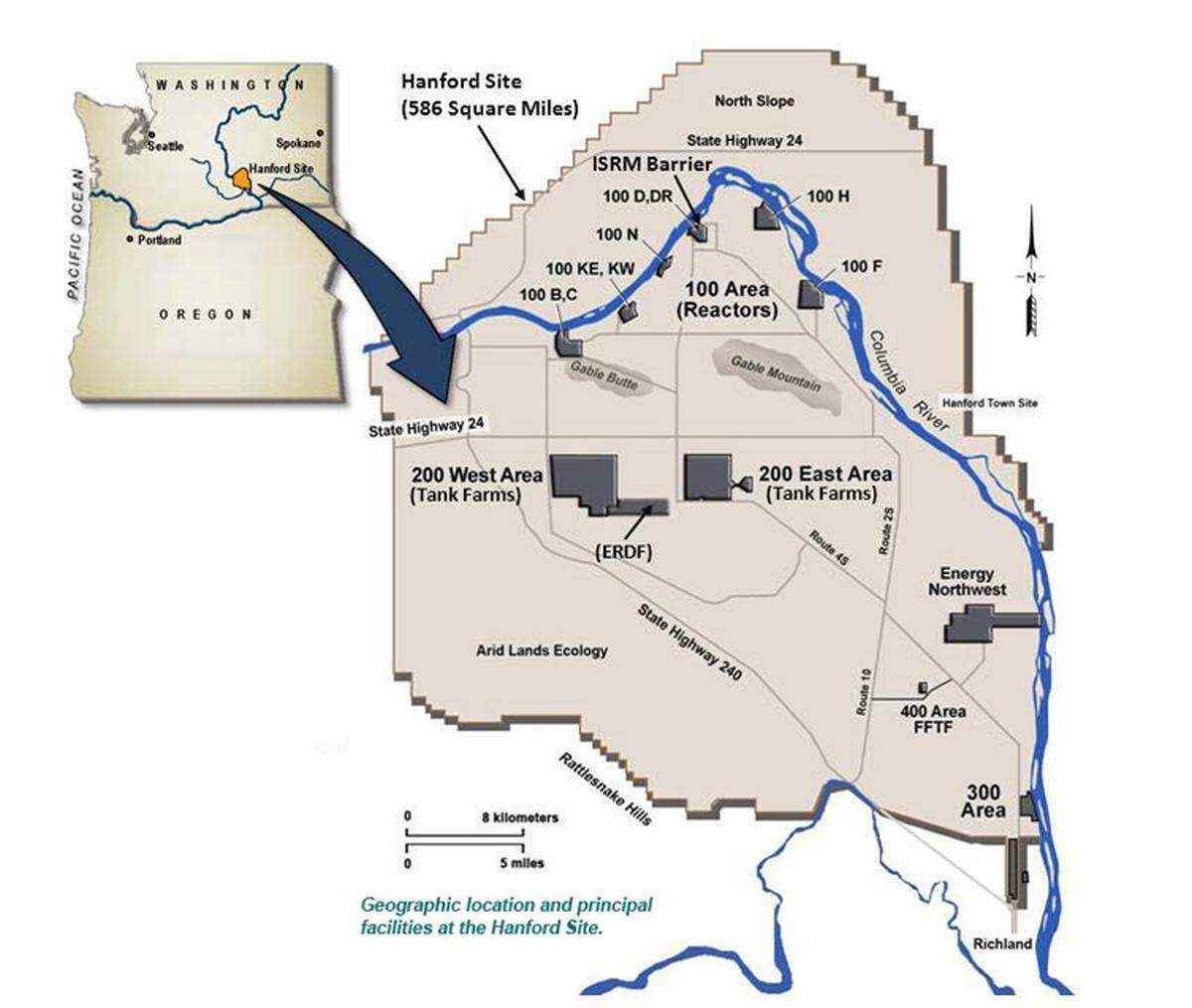
Environmental cleanup is underway now on the radioactive and chemical waste and contamination left from the nuclear reservation’s production years.
Contractor vaccine exemptions
A response to the lawsuit by Hanford contractors gives a glimpse into how many contractor workers, but not subcontractor workers, are vaccinated and how many have requested an exemption on religious or medical grounds:
▪ Bechtel National reported 85 of 87 vaccine exemptions by nonmanual employees had been granted and 70 of 61 requests from manual employees had been granted, with nine decisions pending, as of Dec. 10. Bechtel employs about 1,965 people.
▪ Central Plateau Cleanup Co. reported that 251 of 1,746 employees had requested exemptions by Oct. 22. All but two were approved. The two denied lacked required documentation, but both workers continue to be employed at Hanford.
▪ Washington River Protection Solutions received 365 requests for exemptions from its workforce of 2,155 employees. It approved 340 of the requests, but 16 were denied because the failed to submit required documentation.
▪ Hanford Mission Integration Solutions has processed about 324 requests for accommodations. It employs about 1,885 people.
Of the 292 plaintiffs in the case, 91 are security patrol officers it employs. Initially, the contractor did not approve accommodations for many of them because they come in contact with the public.
However, in late November, the contractor learned it would be able to allow them to wear face masks, get weekly COVID-19 tests and social distance to remain working.
▪ Hanford Laboratory Management and Integration received and granted 39 exemption requests from among its approximately 270 employees.
▪ HPM Corp. employs only one of the plaintiffs in the lawsuit and she has received an accommodation.
▪ Pacific Northwest National Laboratory (PNNL) employs about about 5,300 workers, most on its Richland campus. About 10 of them joined the lawsuit.
The DOE contractor for the lab, Battelle, required staff to be vaccinated by mid November. It reported then that 31 employees retired or resigned in response.
About 311 employees had submitted a medical or religious exemption by then, with about 84% of those approved for a review of temporary accommodations.
All 42 who requested a medical exemption and submitted a doctor’s note were approved. They included some people who had a previous infection of the coronavirus.
Battelle said in federal court filings that it had not fired any employees who applied for an exemption, but has placed some staff members on unpaid leave until the federal mandate takes effect at the end of this week. Battelle will re-evaluate their status then.
Most of the rejected requests cited reasons that did not meet the legal threshold for a religious exemption and therefore did not qualify, according to PNNL.
This story was originally published January 11, 2022 at 12:07 PM.