
‘Doggone exciting.’ Historic treatment to begin on decades-old Hanford nuclear waste
Hanford is close to starting the first large-scale pretreatment of the millions of gallons of radioactive waste stored for decades at the site.
In about two months it could start operating around the clock, preparing waste to be fed to the $17 billion vitrification plant to turn it into a stable glass form for disposal.
Hanford officials say that will be a historic moment.
“Being on the verge of the first use of large scale tank waste treatment on the Hanford site is pretty doggone exciting,” said John Eschenberg, president of Hanford’s tank waste contractor, Washington River Protection Solution.
The Department of Energy announced on Tuesday that construction and the readiness assessment of the Tank-Side Cesium Removal. or TSCR, system at Hanford had been completed.
“What a lot of people don’t recognize is the start of tank waste treatment actually starts when TSCR operations begin, so we will be actually treating waste on the industrial scale in just a few months for the first time in the history of the site,” said Brian Vance, the DOE Hanford manager.
The system, placed next to a Hanford underground waste storage tank, was developed in three years as a workaround to the Pretreatment Facility, which stands 12 stories high and covers an area larger than a football field at the vitrification plant.
The Pretreatment Facility was planned to separate waste into low-activity and high-level radioactive waste streams for treatment, but after possible technical issues related to high level waste were identified in 2012, construction on the building stopped.
DOE changed course, deciding to start treating just low activity radioactive waste first and delay treatment of high level radioactive waste for more than a decade.
It estimates that about 90% of the waste in underground tanks could be treated and disposed of in a lined landfill at Hanford as low activity waste.
The Hanford nuclear reservation adjacent to the Tri-Cities in Eastern Washington has 56 million gallons of tank waste left from the World War II and Cold War production of about two-thirds of the nation’s plutonium for its nuclear weapons program.
The current concern is that some of the underground storage tanks are prone to leaking.
How waste is pretreated
“Treating Hanford’s tank waste is one of the most important elements of the entire cleanup, and the TSCR system is a critical piece of the puzzle,” said David Reeploeg, executive director of Hanford Communities and vice president for federal programs for the Tri-City Development Council.
“We’re glad to see that progress continues to be made on the path toward tank waste treatment,” he said.
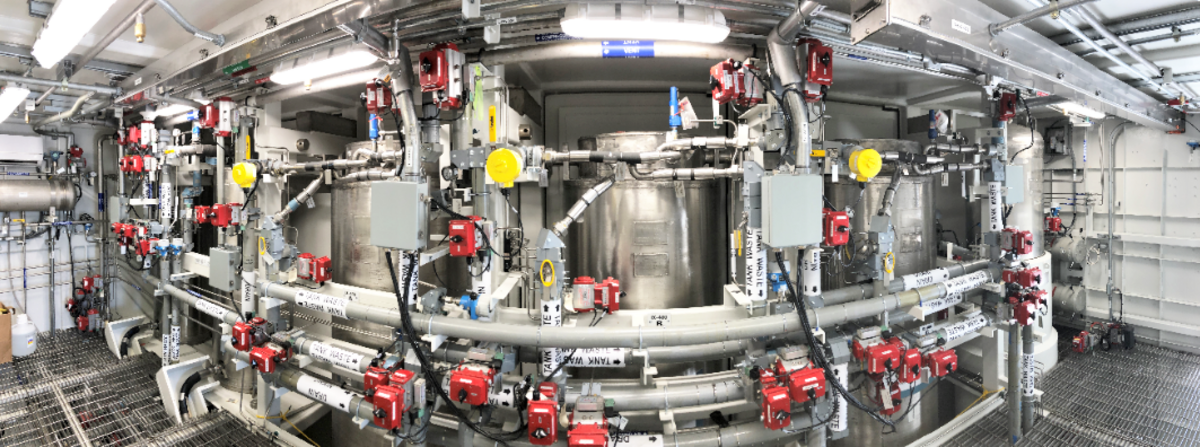
TSCR can take the liquid portion of Hanford waste — the waste also includes sludge and saltcake — and separate out high level radioactive constituents from it.
Low-activity radioactive waste is primarily liquid, but suspended, undissolved solids and radioactive cesium dissolved in the liquids are designated as high-level radioactive waste and must be removed if the waste is treated as low-activity waste.
Much of the cesium was previously removed from tank waste to help control a buildup of heat in the tanks.
The system will filter the liquid to remove solids and use an ion exchange system to remove the remaining cesium.
The system fits in three enclosures placed near a waste tank, the largest the size of a land-sea shipping container.
Eschenberg has no doubts that the small system will work.
“We are all highly confident in the technology and the simplicity of the system,” he said.
He led work to get a nearly identical system operating to prepare radioactive waste for vitrification at DOE’s Savannah River, S.C., site.
And simplified ion exchange systems have been used for a decade in the cleanup of contaminated water after the Fukushima, Japan, nuclear disaster.
Hanford waste is more complex, containing a stew of radioactive and chemical contaminants from different plutonium production methods used over decades at the Hanford site.
Batches of tank waste will need to be extensively surveyed, sampled and characterized to make sure they are compatible with glassification treatment at the vitrification plant, Eschenberg said.
Treatment jump start
TSCR is likely to begin preparing waste for vitrification in January.
Although operations could begin a few weeks sooner, the start of new projects at Hanford is often postponed until after the holiday season to make sure that workers are available and not distracted.
This year there is the added stress of a controversial COVID-19 vaccine mandate, which requires federal contractor workers to be fully vaccinated or have an exemption approved. The deadline for compliance with the mandate likely will be extended from Dec. 8.
The vitrification plant is not expected to start glassifying low activity radioactive waste until the end of 2023.
But work to prepare waste with TSCR to feed the plant will start almost two years earlier.
Hanford’s goal is to have one of its 27 double-shell, underground tanks stockpiled with 1 million gallons of pretreated waste for the vitrification plant when the plant starts operating.
Because the vitrification plant can glassify waste faster than TSCR can prepare it for the plant, the stockpiled waste will help jump start and continue the treatment process.
The 1 million gallons and the waste that TSCR continues to pretreat after the vitrification plant begins operating will keep the plant glassifying low activity waste for its first four years of operation.
TSCR will be evaluated during its first year of operation to help make the decision on whether another TSCR should be added at the Hanford tank farms or a larger treatment capability developed.
The future of the massive Pretreatment Facility at Hanford is part of closed-door negotiations between the state of Washington and the federal government on the future of waste treatment at Hanford, including how to pretreat high level radioactive tank waste.
Oversight officials
The Defense Nuclear Facilities Safety Board raised one concern about TSCR that it said was a significant issue in a weekly report by its inspectors in October.
Hanford workers had found that the threaded connection where waste was fed into the ion exchange system had seized up after friction had damaged the thread and possibly compromised the connection.
The safety board said it was a possible radioactive waste leak hazard.
However, Eschenberg said the contractor determined that the connection issue was caused when workers had set up and disconnected the feed line multiple times during training to prepare for the start of operations.
A re-evaluation of the design and the materials used in the connection found no issues, he said. When the waste feed line is connected to the ion exchange system the focus will be on proper assembly techniques, he said.
The Washington state Department of Ecology, a regulator for Hanford tank waste, has reviewed TSCR documents and inspected TSCR on site, finding it meets state permit requirements, it said.
“We look forward to seeing the Tank-Side Cesium Removal system become an important part of the successful startup and operation of low-activity waste treatment at Hanford,” the agency said in a statement.
Washington River Protection Solutions was able to complete TSCR on schedule, as its workers did much of the work during the COVID-19 pandemic.
The tank farm contractor designed the system and managed the construction and installation by subcontractors AVENTech, Atkins Nuclear Secured, Fowler General Construction and Apollo.
“Completing TSCR construction this year was a top priority for the Department of Energy’s Office of Environmental Management,” Vance said.
“For the first time, we will be able to treat a significant amount of Hanford’s tank waste. This is an exciting and historic time,” he said.
This story was originally published November 16, 2021 at 12:42 PM.