‘Game changing’ plan would fix Richland schools money issues. But there’s a catch

AI-generated summary reviewed by our newsroom.
- Richland unveils a multi‑year, metric‑driven budget framework to rebuild financial health.
- It ties spending to cash days, enrollment buffers, personnel caps and true enrollment.
- Levy renewal on Feb. 10 remains crucial; failure would force up to 310 staff cuts.
Richland School District leaders on Tuesday revealed a new “disciplined” budgeting framework to improve its financial health over the next five years, from a D+ to an A-.
Using OSPI’s financial health indicators model to gage progress, the district will base funding decisions on several metrics, variables and the health of its financial liquidity.
The meticulous strategy is also a departure from the spend-it-to-keep-it mindset that departments, buildings and schools have grown accustomed to. The district serving 13,800 students will instead “embrace a needs-based approach.”
“A budget is not a directive to spend. It is a ceiling, not a requirement,” the framework reads. “This shift places intentionality at the center of financial decision-making. Spending will no longer be viewed as a right to exhaust budget lines, but as a professional judgment rooted in impact, equity and long-term responsibility.”
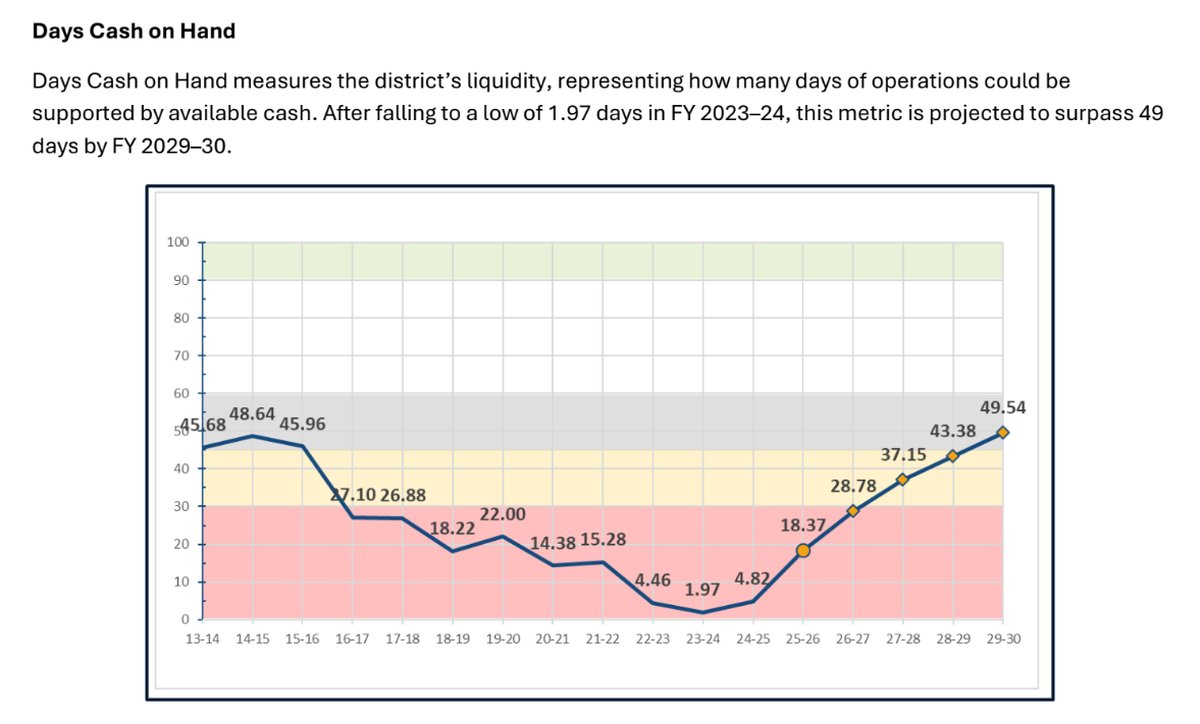
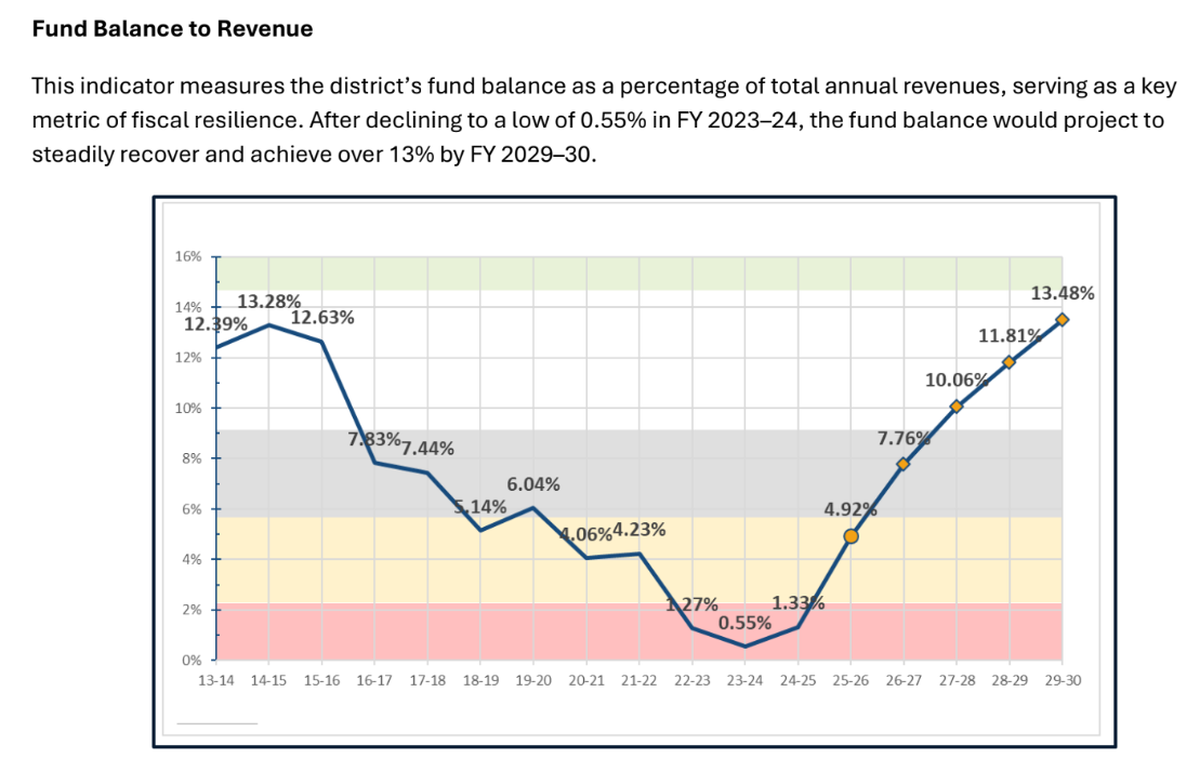
The north star is to restore the district’s general budget reserves to at least 8% and build up nearly 50 days of cash on hand by August 2030. Staff hope to improve the district’s financial GPA “FIT” score, from its 2023 low of 1.33 to a 2030 high of 3.84.
School Board President Katrina Waters called the framework “game changing.”
The blueprint gives the public a clear picture of district health, and will help administrators and the school board make data-driven budget decisions.
“This takes the guess work out of it,” she said.
But leaders say getting back into good financial standing will only be possible with voter support of the four-year, $203 million education programs and operations levy renewal on the Feb. 10 ballot.
Waters says “all bets are off” if the levy fails and if they are forced to cut 310 teachers and staff members. The district will have one more opportunity in 2026 to pass a levy if their February measure fails.
“This is not just about extracurriculars,” she said, noting the tax also funds school enrichment and programs that help students to excel in academics.
The framework — created by Travis Belisle, Richland’s executive director of finance — has also earned praise from financial managers around the state who reviewed it.
Amber Porter, board president of the Washington Association of School Business Officials, called it a “unique and a creative approach to incorporate best practices and recommended benchmarks.”
“It provides a formula driven approach to monitoring operations and beginning discussions about budget,” the Oak Harbor Public Schools finance chief wrote in an email.
It could be a model for some struggling school districts, especially as lawmakers in Olympia debate a bill this session that would require them to have a restricted minimum general fund balance.
Districts larger than 2,000 students would have to maintain at least a 6%, while smaller districts would have to keep at least 8%, according to HB 2593.
“Districts should certainly consider how the framework could benefit their efforts to maintain fiscal stability. Each district will have to determine how such an approach fits their unique situation and school community,” Porter said.
How its financial framework works
Richland’s financial framework is a collection of four components. They’re essentially buttons and levers for spending that leaders will consider using based on its financial reality.
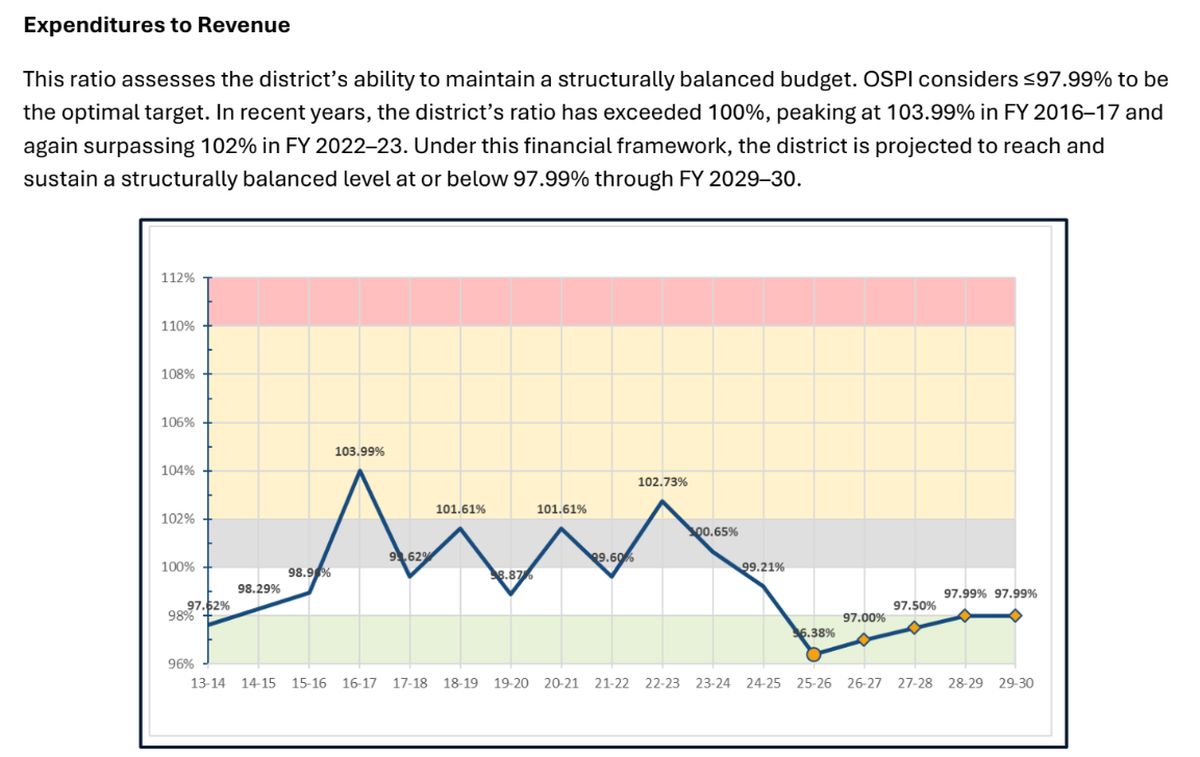
First, the district will slowly increase the spending ratio of funds it receives (the share of its revenues that are being expended) as it accumulates more cash on hand.
With fewer than 15 days cash on hand, it will spend just 97% of its budget. That will increase to less than 99.5% when it has more than 60 days cash.
Then, Richland is also creating a conservative enrollment budgeting standard. It will create planning buffers by basing revenue projections on a comparison of current-year enrollment performance to prior year benchmarks.
Third, the district will also cap personnel costs — the largest and “single most important factor in maintaining fiscal sustainability” — to between 80-85% of expenditures. It will then tie that growth to the rate of revenue increases.
Finally, 10% of unrestricted materials, supplies and operating costs (MSOC) expenditures will be set aside at the start of the budget and labeled as “enrollment-contingent funds.” They will be held in reserve until actual enrollment is verified through fall reporting.
If enrollments match projections — 99% of projection or greater — then the dollars will be fully released. If enrollment is below 97% of projection, then the district will reserve that full 10% for budget flexibility.
It will release half of the contingent funds if they fall somewhere between 99% and 97%.
While Richland’s framework acknowledges that several challenges remain outside its sphere of influence — including state revenues, unfunded mandates, insurance costs, inflation, and labor markets — staff feel that a better health is within reach.
“By embedding structural safeguards and measured budget practices, the district strengthens its capacity to navigate economic uncertainty while continuing to deliver on its educational mission,” the report reads. “We can lead with disciplined management, align spending with student needs, and build a sustainable framework rooted in transparency, stewardship and stability.”
No loan, advance needed this year
Belisle also confirmed this week that Richland will not need to take out an interfund loan to pay its bills.
The district took out $10 million from its capital funds budget last year and repaid it in December. A year ago, it also requested and was approved for a $13.5 million apportionment advance from OSPI.
While Richland is turning the ship on its financial health, it will still have to work through student enrollment that is on the decline due to demographics.
Richland likely budgeted its enrollment this school year by about $1 million over its actual, meaning OSPI will be giving the district less money to “right size” apportionment.
Belisle thinks a lack of communication played a major role in the slow and steady decline of Richland’s health, too.
They should have been throwing up caution flags years ago, and explaining the budget impacts to the board and administration. Belisle, who took the helm a year ago, says that will change.
“Our build back from here, in the future, is very much going to be a team effort,” he said.
A decade of declining health
Richland’s vow to restore budget stability, manage costs responsibly, and ensure dollars go the extra mile for students is also part of a broader goal to regain trust with a community during an especially volatile few years.
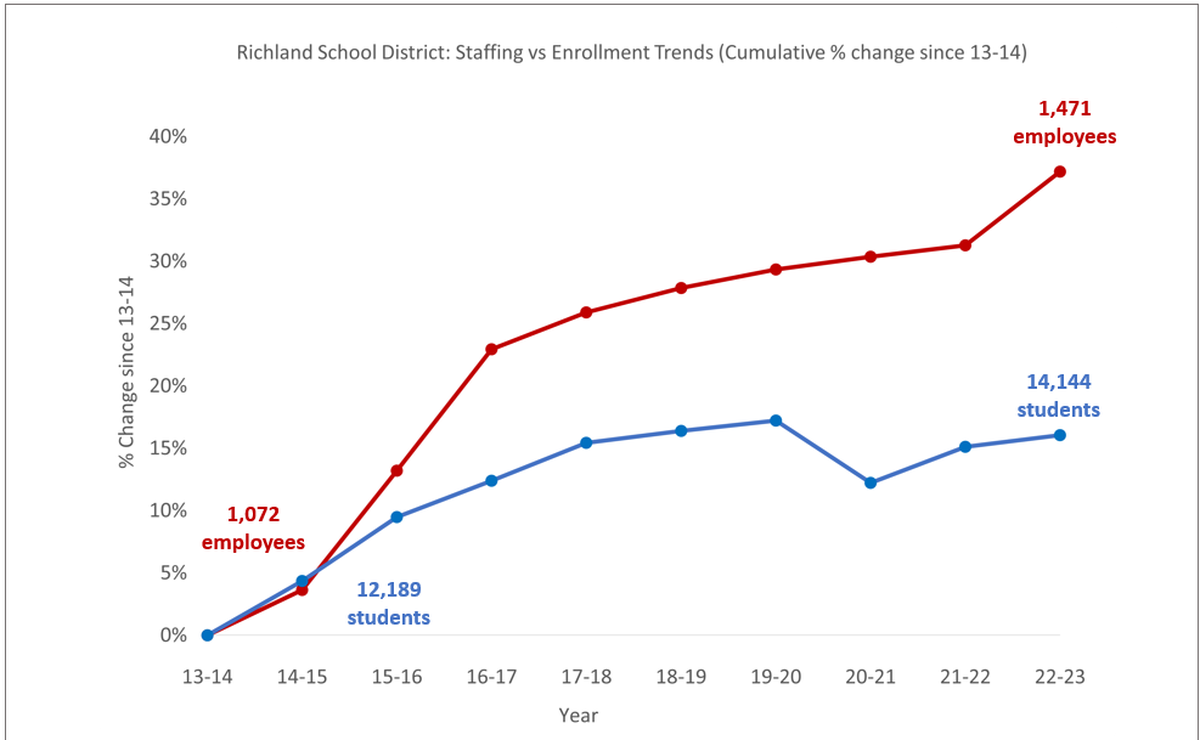
Between 2015 and 2024, the district slowly drained its reserves while increasing the number of teachers and staff on its payroll — even during the COVID pandemic, when student enrollment decreased.
Enrollment is important because the district receives its state apportionment based on how many full-time students it has in seats. District administrators and school board members have acknowledged there has been a lack of budget oversight, scrutiny and public accountability over its spending.
Richland continued to drain its cash during the 2022-23 and 2023-24 school years, when “actual” expenses exceeded revenues by $6.5 million and $1.5 million respectively.
It all came to a head in fall 2024, when the district reported reserves of about 0.55% — less than $1 million — and about two days cash on hand.
The district had also been pummeled by inflated operation costs and wages. OSPI estimates that Washington is providing school districts about $1,000 less per student than it was in 2019, when adjusted for inflation.
A giant $10 million annual reduction in Richland’s state levy match also served a deep blow.
To avert financial catastrophe, Superintendent Shelley Redinger ordered staff adjustments, reduced contracts, operational changes and program modifications. The district also cut millions of dollars worth of vacant positions.