School levies pay $6.4M out of $10M in Tri-City substitute teacher costs
AI-generated summary reviewed by our newsroom.
- Tri-City levies request $485M over four years; subs are one funded item.
- State funds cover limited substitute days; local levies supply 65 cents on each dollar.
- Long-term substitutes restore classroom continuity; Tri-City logged 230,000 sub hours.
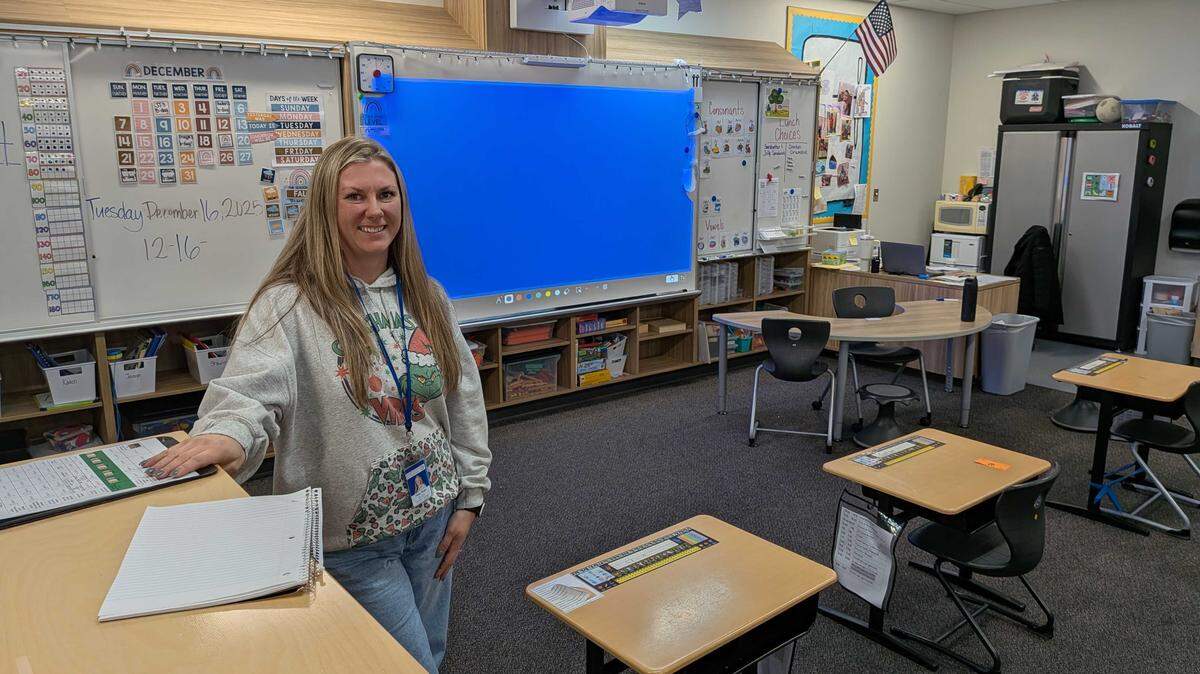
Haley Wood helps the neediest students at Badger Mountain Elementary School.
As a long-term substitute filling in as a supplemental support teacher, Wood helps special education students from various grades by creating a safe, structured and supportive learning environment.
“Every day is different, every day is chaotic,” she said with a smile. “I learn things every single day — I mean, more about my students and how to navigate supporting their needs, really.”
Substitute’s work is heavily subsidized by local taxes that are up for renewal on the Feb. 10 special election ballot.
About 65 cents of every $1 spent on substitute teachers in the Tri-Cities comes from local levies. That’s about $6.4 million of nearly $10 million that the three Tri-City districts spend each year on substitutes.
Kennewick, Pasco and Richland are asking voters to pass operations levies that total $485 million in funding over the next four years on February’s ballot. These are not new taxes.
Making a real difference
One of Wood’s students, a 4th grader, who comes from a traumatic background, was described in sub plans as having incredibly volatile behavior.
But Wood helped him turn things around this fall.
He went from spending almost no time in his general education classroom to spending most of his time there. Most days, Wood only sees him for a 10-minute check in.
“I have the best connection with him,” she said. “He is intelligent as all get out. He is so smart, he is hilarious. He has come out of his shell and has made friends upstairs... It’s just really cool. He’s grown so much.”
Wood’s story is just one example of the hard work that hundreds of K-12 substitute teachers are doing each day to ensure students receive a quality, uninterrupted education — regardless of the program or a student’s ability.
“Subs are an essential piece. They really are part of the team once they’re there,” said Joey Castilleja, Pasco’s executive director of fiscal services.
Even day-to-day subs can establish strong relationships with students and teachers working in the same building, Castilleja said.
But substitutes are one of many underfunded programs for school districts in Washington state. Not only do school districts have to shelter the cost of wages for regular teachers, but they often have to bear the cost of substitutes to ensure classrooms have an adult in them.
Levies cover 65 cents of every $1 spent on subs
Last school year, hundreds of substitutes worked more than 230,000 hours to fill in for Tri-City teachers who were sick, on paternity leave or birth leave, or who were out for a day for professional development.
Washington state typically funds just four days of substitute coverage a year for each full-time certificated teacher, said Katy Payne, OSPI’s chief communications officer. Some Tri-City districts told the Herald they’re allocated just three days.
That pencils out to just a few hundred thousand dollars each for local districts, and not enough to cover the actual number of days that teachers are absent. Last school year:
- Kennewick spent $2.6 million on substitutes, with $2.2 million of that covered by their levy.
- Pasco spent $4.3 million on substitutes, with $1.5 million of that covered by their levy. It spent an elevated $2.6 million on long-term substitute costs last school year.
- Richland spent $3 million on substitutes, with $2.7 million of that covered by their levy. Its overall substitute costs more than tripled between 2019 and 2023, but have since declined.
The chunk the state funds is only for teachers who fall within the state’s definition of “general education,” Payne said. Teachers who work under federal programs, or certificated workers like teacher-librarians, are not provided a state substitute allocation. Neither are classified staff such as custodians, receptionists or paraeducators.
“Superintendent (Chris) Reykdal has continued to request that the Legislature make adjustments to the prototypical model to more adequately align with actual costs,” Payne said in a statement.
“While progress has been made in state funding for school counselors, special education, and MSOC (materials, supplies, and operating costs), the gaps between allocated funds and expenditures are still very large in many districts, and are further straining budgets that are already impacted by inflation and decreasing student enrollment due to declining birth rates,” she continued.
The Washington Legislature is preparing to convene for a short session on Jan. 12. It’s unlikely tweaks to the state substitute funding formula will be a priority for lawmakers dealing with a multi-billion dollar budget gap.
In his budget request, Reykdal asked Gov. Bob Ferguson to double down on more funding for basic education, as well as invest in late-elementary and middle school math instruction where the state is falling short.
Castilleja says substitute funding is just a drop in the bucket when compared with the $200+ million that Pasco, for example, pays in total basic education salaries. About $30.5 million of that is unfunded staff costs that are covered by the levy.
Without local funding, the district would be forced to tighten their substitute programs, he said.
“It makes the world go ‘round for kids in a lot of ways,’” he said.
How much do Tri-City districts pay subs?
There are differences in the roles and responsibilities of day-to-day subs and long-term subs.
Tri-City school districts have a daily fill-rate of less than 90%, which means when a teacher calls out sick on short notice, the school is usually always able to get a day-to-day sub to maintain smooth classroom operations.
In cases when they “fail to fill” a vacancy, the burden of teaching the class falls on a rotating list of building staff, who jump in whenever they’re free — oftentimes during their lunch or prep period — to keep students on track with their assignments.
Richland pays its subs at least $25 an hour. Kennewick pays a daily rate of $175. And Pasco has a sliding scale that pays its substitutes anywhere from $175 to $239 a day.
Long-term subs play a crucial role in covering extended teacher absences, and are paid wages and benefits closer to or matching teacher salaries.
A ‘never-give-up spirit’
Substitute work can also be a vital recruiting tool for districts.
Wood, 30, is pursuing an endorsement to become a full-time special education teacher.
Her work making connections with students in her first year at Badger has received praised from administrators, with Vice Principal Jaianne Pischel saying Wood “brings a bright smile, a can-do attitude, and a never-give-up spirit.”
Wood was inspired to get into the education field a few years ago after volunteering in her twin’s 2nd grade classroom. She bonded with the paraeducators and teachers at Amon Creek Elementary School, who “talked” her into the career field.
“I was a stay-at-home mom, never intended to go back to work,” she said. “I just loved the student growth, and making those connections with the kiddos.”
She started substituting and working as a paraeducator. Then, in December 2024, she completed her bachelor’s degree.
Substitute coordinators had an immediate need to fill the supplemental support class due to an abrupt teacher absence this fall, so Wood — itching to get back into the classroom — jumped into the fray.
Equipped with a half-day plan, some support from neighboring fellow special education teachers, and a bit of courage, Wood found her footing to lead the classroom. The first day was “feral,” Wood said — and it still sometimes is.
Wood comes to school before 7 a.m., and class starts at about 8:30 with a “soft start” of breakfast and choice activities. At 9, they start including students into their general education classrooms for various times. She has about nine students, but still collaborates with certificated staff and case managers to ensure the best for her kids.
Being “consistent with students” is the most rewarding part of her day. Many students come with trauma or are on the autism spectrum. She feels she can provide that peace of mind throughout the day.
“If you put any of these students in a class all day long, that class as a whole would be unsuccessful,” she said. “They need the breaks, they need a smaller setting, they need the one-on-one, they need the small group learning... Coming to school, for some of them, is success.”
Wood said she was told that they had gone through a few long-term substitutes before her. But without someone in her shoes — without someone willing to do the hard work of helping students with various aspects of school — students wouldn’t have the consistency that they need to thrive in the classroom.