
Hospital, clinics hurting as fewer Tri-Cities patients have health care coverage
Tri-Cities health care providers are beginning to see harmful impacts of cuts to federal spending for health care programs with more cuts looming.
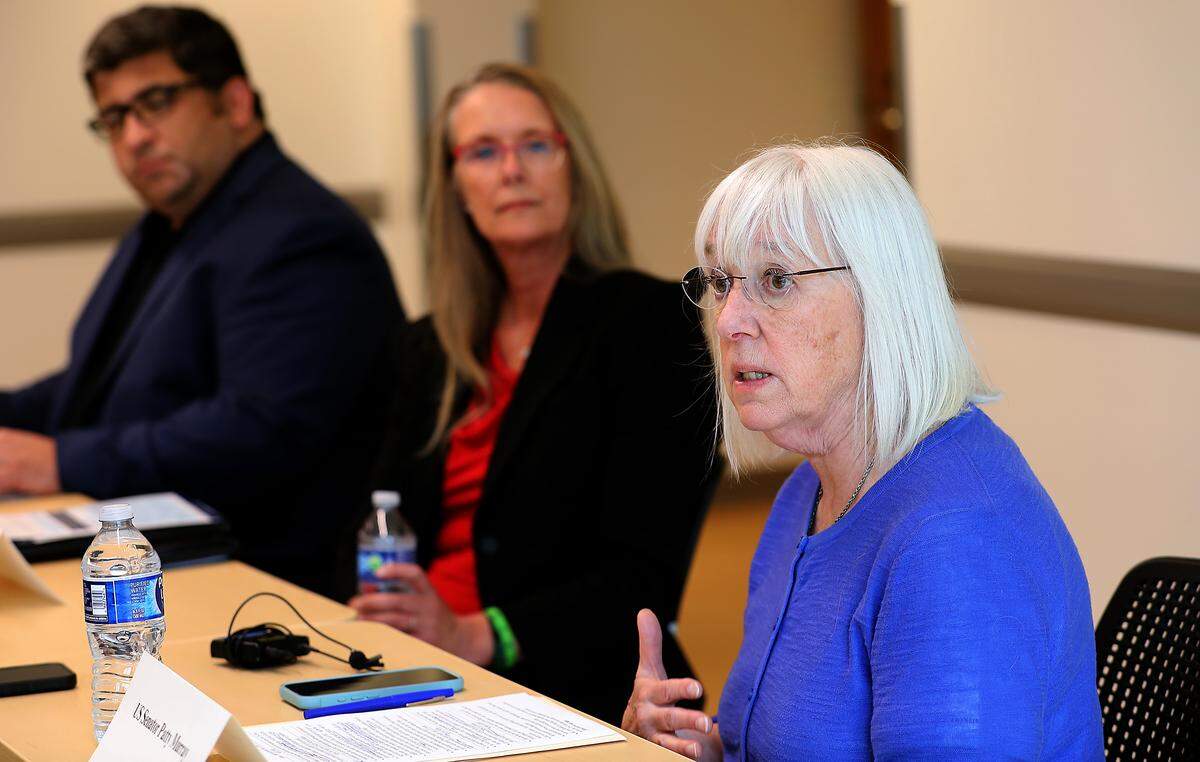
That’s what Sen. Patty Murray, D-Wash., heard when she met with leaders of local health care organizations this week after touring the new Columbia Valley Center for Recovery, a Benton County-owned mental health and addiction treatment center in the former Kennewick General Hospital building.
Last year, the One Big Beautiful Bill was signed into law, cutting more than $1 trillion from Medicaid and the Affordable Care Act over the next decade.
The nonpartisan Congressional Budget Office estimates that the cuts will eliminate health insurance for about 15 million Americans.
“With their Big Ugly Bill, Republicans passed the single largest health care cut in our nation’s history, leaving providers in the Tri-Cities to wonder how they will keep their staff on and their doors open,” Murray said after the discussion.
“If that weren’t damaging enough, Republicans refused to extend the health care tax credits — which millions of people relied on to afford health coverage,” she said.
Congress allowed the enhanced premium tax credits on qualified health plans to expire at the end of 2025, raising the costs for people who relied on the Affordable Care Act or Obamacare to purchase health insurance.
In Washington state, despite increased state subsidies after federal tax credits expired, enrollment in the insurance program dropped nearly 13%. In Benton County the drop was 8% and in Franklin County the drop was 7%.
Other Washington state residents have continued their Obamacare plans, but because of escalating premiums have shifted to a plan with less coverage, sometimes paying more this year than they did last year for a better plan, Murray said.

At the same time, Medicaid, which is called Apple Health in Washington state, has begun requiring re-enrollment every six months.
Work or service requirements for Medicaid begin at the start of 2027, with the federal government not yet issuing key guidance for state policies.
Medicaid changes being felt
Health care leaders told Murray they are seeing more uninsured patients this year and that patients are delaying care.
Some of the impacts of delayed care because patients can’t afford care such as mammograms and colonoscopies may not be seen for five to 10 years, said Dr. Richard Meadows, chief medical officer at Kadlec Regional Medical Center in Richland.
Dr. Veronica Hooper, chief medical officer for the Yakima Valley Farm Workers Clinic, told Murray that new Medicaid requirements will affect about 27,000 of its 200,000 patients, including patients at its Miramar Health Centers in the Tri-Cities.
Medicaid accounts for about 60% of clinic revenue, she said. Patients who lose it will shift to uncompensated care at the clinic.
“We’re still providing all of those services, all of that coverage, but now we’re really threatened by that financial stability for our organization,” she said.
The clinic knows that the administrative burdens of re-enrollment and knowing the required processes will cause some of their patients to lose Apple Care coverage, she said.
It is helping patients with re-enrollment, but there is no extra funding for that additional help.

Community engagement requirements that start next year will be particularly difficult for its patients in rural communities where job and service opportunities are limited or nonexistent, she said.
The clinic’s mission is to provide care to underserved populations, which includes immigrants.
It is not collecting the status of patients, but fear and uncertainty among immigrants is leading them to delay treatment, Hooper said.
As their condition worsens the long-term costs of their care increases. Emergency room visits increase and people are hospitalized for preventable causes, she said.
More patients pay cash
Tri-Cities Community Health is seeing a shift to patients paying cash on a sliding-fee scale for care in recent months, said Rick Evans, director of public affairs for the agency.
Among the agency’s concerns are a possible change to the 340B Drug Pricing Program that helps stretch federal resources.
In one example of the program’s benefits, a grandmother relying on Tri-Cities Community Health faced a $3,000 to $4,000 bill each month for the prescription her grandson needed. With 340B savings the bill was reduced to $120 a month, Evans said.

A proposed switch from receiving money in the program upfront to reimbursements would tie up money that could be used for other programs, he said. Others said it also posed a risk that the increased bureaucracy could mean a reduction in money received.
Jodi Daly, chief executive officer of Comprehensive Healthcare, operator of the new Columbia Valley Center for Recovery, said mental health care service providers are also concerned.
“More people need care and there’s going to be less resources to provide care. That’s it in a nutshell,“ she said.
They are going to wait to seek care until they are in crisis, rather than when intervention can keep their illness from escalating, and they can be treated at a lower cost, she said.
Hospital safety net at risk
Kadlec Regional Medical Center of Richland ends up being the safety net for those who can’t get health care and work in partnership with the other agencies speaking to Murray, Meadows said.
The Richland hospital and its clinics also provide the specialty care for rural communities for hundreds of miles around the Tri-Cities that smaller hospitals and clinics cannot afford or cannot afford around the clock.
If finances get so tight that Kadlec has to cut services, the impacts will ripple from the Tri-Cities through outlying areas, Meadows said.

Already, Kadlec is relying more on donations to its foundation to purchase needed medical equipment, he said.
Kadlec already faces multiple challenges, including rising labor and supply costs, he said.
Health care workers — including doctors, nurses, social workers and pharmacists — are in high demand and short supply driving wages up to attract and retain them.
But it can’t raise prices, which are fixed through private health insurance, Medicare and Medicaid, to cover increased costs, he said.
It also faces an increasing regulatory burden, with new regulations that are well-intentioned but don’t make health care better or safer, he said. Instead, they make the jobs of health care providers more difficult and pull them away from providing care, he said
Kadlec has faced multiple denials as Washington state has been picked for a trial use of the WISeR Medicare program that relies in part on artificial intelligence and machine learning to approve some care, Meadows said.
Even when denials are overturned, the delay has lengthened the time required for patients to get care, causing some to require emergency care and to pay increased costs, he said.
Kadlec also is concerned about the 340B program, which it has used for patients who can’t afford important medications, sometimes even with insurance, such as inhalers and insulin.
“We are very really happy that you are committed to preserving access to affordable care in our community. It is very difficult in our community,” Meadows told Murray.