
Migrating wildlife face a devastating hurdle in the West: thousands of miles of fences
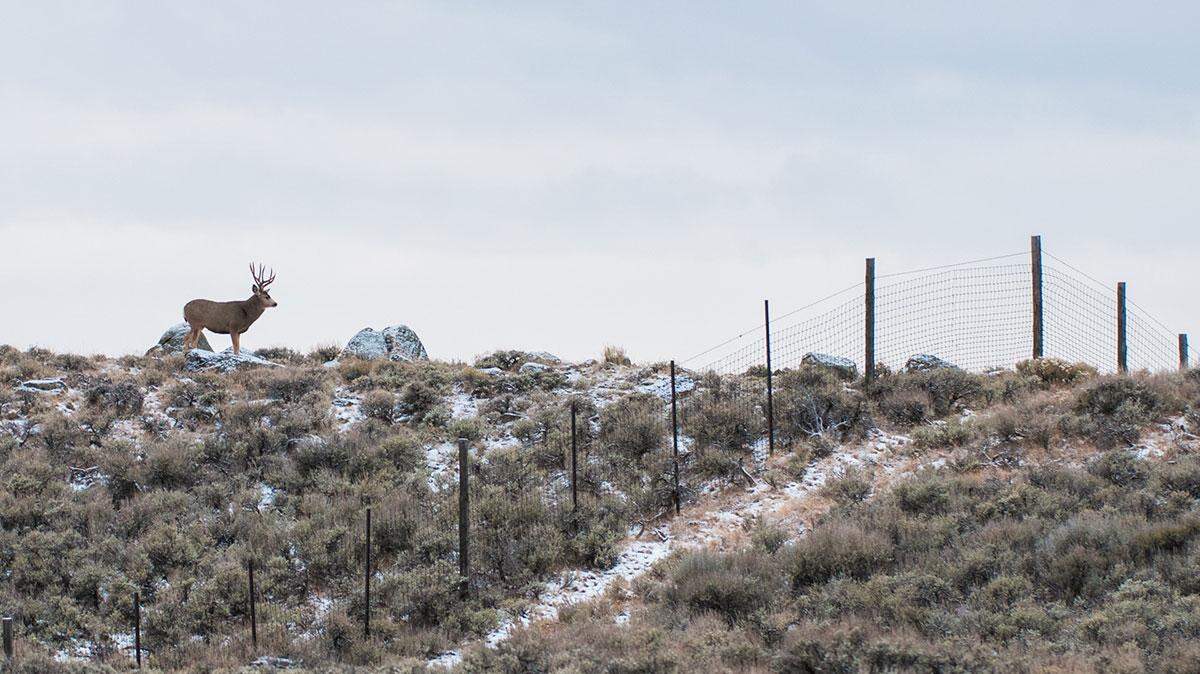
Enough fencing to span the U.S.-Mexico border twice is impacting wildlife migration in the West, a new study reported.
Thousands of mule deer and pronghorn antelope make their way west in Wyoming to spend the summer near Grand Teton National Park. Along the way, they run into more than 3,728 miles of fences.
“The total length of fences is really, really striking, especially with what we know about the different types of wide-ranging animals that live in that area,” Wenjing Xu, a Ph.D. student at UC Berkeley, said in a news release.
The fences can be detrimental to their journey westward, a new study from the University of California, Berkeley, found.
Biologists used satellite images and GPS tracking data to find out how often animals were encountering fences during their short journey west and try to find what fences create a barrier for wildlife.
“We need fences — they help keep livestock safe, can help keep livestock and wildlife separate, and mark property boundaries,” Arthur Middleton, an assistant professor of wildlife management and policy at UC Berkeley, said in the news release. “So, the question becomes, how do you identify which fences are really important, and which are problematic from a wildlife standpoint, and then seek some way to mitigate the impacts?”
The animals can have different reactions to the fences, researchers said. In some cases, they will leap over the fence and continue on their journey. Sometimes, however, animals will pace along the fence or turn around and walk away.
Knowing how widespread the problem is can help find a solution, researchers said. In an average year, a mule deer will come head-to-head with a fence about 119 times, Xu found. Pronghorn antelope will encounter a fence about 248 times a year.
The fence changes the animal’s behavior about 40% time, according to researchers.
“Anybody who’s spent time in the West knows you’ll find a lot of fences,” Middleton said. “But, seeing such frequent encounters, 40% of which result in a failure to cross, is kind of mind-blowing — especially when you multiply those numbers across whole populations and landscapes.”
Fences — both wooden and metal, some with barbed wire — are often used by ranchers to keep livestock safe. Some fences, however, are inactive from the days when sheep farming was popular in Wyoming, Middleton told UC Berkeley.
Replacing the fences takes time and money. In a recent project, Wyoming officials spent more than $10,000 per mile of fencing to make it less restrictive to pronghorn, researchers said.
“There is such a strong need for this kind of data,” Xu said. “Modifying fences is really, really expensive, and the amount of fencing that might need to be fixed is just so large. [Wildlife managers] really want to find ways to prioritize their resources.”
This story was originally published January 12, 2021 at 1:01 PM with the headline "Migrating wildlife face a devastating hurdle in the West: thousands of miles of fences."