
Time for one last Hanford Reach salmon before Halloween
It is early October on the Hanford Reach and I battle seaweed (i.e., milfoil) and moss that tangles my gear.
Tired of watching fall Chinook salmon ignore a two-rod tandem consisting of a sardine-wrapped Kwikfish and a Spin-n-Glo with cured roe, I opt for dragging a spinner along the bottom. The tactile nature of casting keeps my interest longer than trolling.
I’m fishing solo. One fishing buddy recovers from knee surgery, another is helping his girlfriend move, and a third can’t leave his 2-month old Labrador retriever by itself for more than an hour.
I didn’t check with friends who pretend to work remotely from home. A positive aspect is I decide when, where, and how long to stay on the water.
I turn the kicker motor off and drift with the current. Cirrus clouds streak across the sky. The musty odor of decaying filamentous algae wafts in the air.
Bank anglers line the cobble shoreline at Ringold, watching their rod from the comfort of canvas chairs. A trio of gulls scraps over fish guts where a guide boat left a pile of carcasses.
My boat rocks and twists sideways when another angler passes at full throttle. His wake violates my social distance.
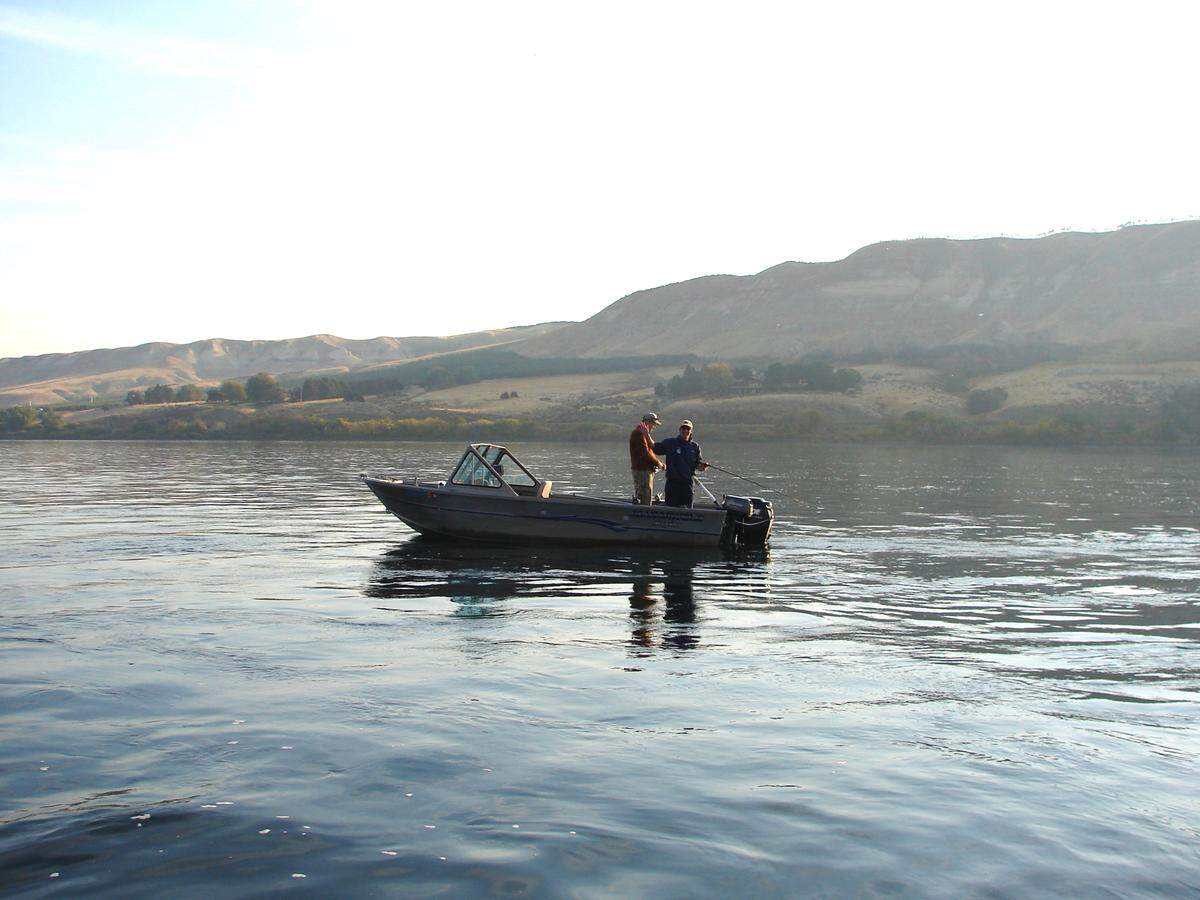
I spool out line until my spinner ticks the bottom, and watch the sonar screen for changes in depth. Boulders and rock mounds often attract salmon that seek temporary relief from their migration journey. These same features can also snag your gear.
Then it happens. Whether reward for hard work or due to divine intervention, the rod is almost ripped out of my hand. I set the hook on a fast-moving salmon while my reel sings “halleluiah” on fast-forward.
What follows is a series of head shakes following by a second long run. Five minutes later I recover most of my line, but the fish swims back and forth without regard to whatever pressure I apply.
I float past a boat that holds position along a current seam. Two downriggers out suggest they are fishing Superbaits. A highly effective technique for salmon, but not my favorite. “Glad to see someone caught one,” one angler shouts. “We’ve had two take downs.”
I yell back, “I haven’t caught this one yet!”
The battle continues for another 100 yards downstream before the ghostlike form of a large salmon is revealed. The source of its aggravation, my lucky no. 5 red-and-white Mepps spinner, flutters from the tip of its hooked jaw.
I work the fish into range, but it turns to boil the water surface and dives under the boat. Back and forth we go for several minutes. I am reminded of the country western tune, “One step forward.”
Two failed passes later I move the rod to my left hand and lead the tired salmon to the net held in my right hand. Ambidextrous I am not. The 12-pound buck has a splash of red on its flanks but will “cut good.”
According to WDFW creel census reports, catch rates in the Reach ranged from 11 to 18 hours per salmon over the past five weeks, with peak harvest occurring during the week ending Sept. 27.
With still over 1,000 salmon entering the Reach daily, ample opportunity remains to come up with a fishing story of your own.
Upriver brights typically become more aggressive as water temperature cools and spawning time nears. Crowds have thinned which means less competition for good water.
The Hanford Reach remains open through Oct. 31 for a two-adult salmon harvest downstream of the Wooden Powerline crossing at the Old Hanford townsite.
Check the daily flow at http://waterdata.usgs.gov/ for USGS 12472800 (Columbia River below Priest Rapids Dam) to improve your success (and possibly save a prop).
As for me, I intend to set autumn chores aside and fire up my outboard for one more last salmon to put in the smoker.