
Shad fishing on the Columbia River is family fishing
The first rule of fishing with youngsters is you must catch fish or they get bored. And if there’s one thing I have learned over the years, it’s that bored youngsters are dangerous.
However, nothing gives me more satisfaction than watching the smile on a young child’s face when they reel in a fish.
First on a my list of preparations for a day on the water with my four grandkids is plenty of snacks, including some not allowed at home (Grandpa’s revenge).
Cheetos make a mess, though as I found in a recent fishing trip with a friend and his two young sons, M&Ms can also lead to trouble.
I recall a trip when I rewarded my grandkids half a dozen M&Ms for each trout they landed. This led to a sugar high of huge proportions and me wanting to jump out of the boat.
Over the next few weeks, large numbers of American shad will migrate upstream to area waters.
There is no better time than late June and early July for a family fishing opportunity.
Tri-Cities area
Close-by locations for reeling in a cooler-full of this big-eyed herring include the Columbia River downstream of McNary Dam, the lower Snake River downstream of Ice Harbor Dam, and the lower Hanford Reach.
One popular method is to tie a #2 Dick Nite spoon on four feet of 8-pound monofilament leader to the back end of a Magnum Wiggle Wart with the treble hooks removed.
Let out 50 feet of line, and troll slowly along the shoreline at a depth from 10 to 20 feet.
The “Mag Wart” imparts fluttering action to your lure and acts as a diver to present it 15 feet or so deep. If shad are around, expect to get whacked inside of five minutes.
Another easy set-up consists of a three-way swivel connected directly to the main line.
Use a 2-foot long dropper with a 1- or 2-oz lead ball and attach your jig or spoon to 4-feet of leader. This rig can be fished from a rod holder or worked along the bottom until a sharp tap signifying the strike of a shad is felt.
Downriggers can also be used to get your lure close to the bottom.
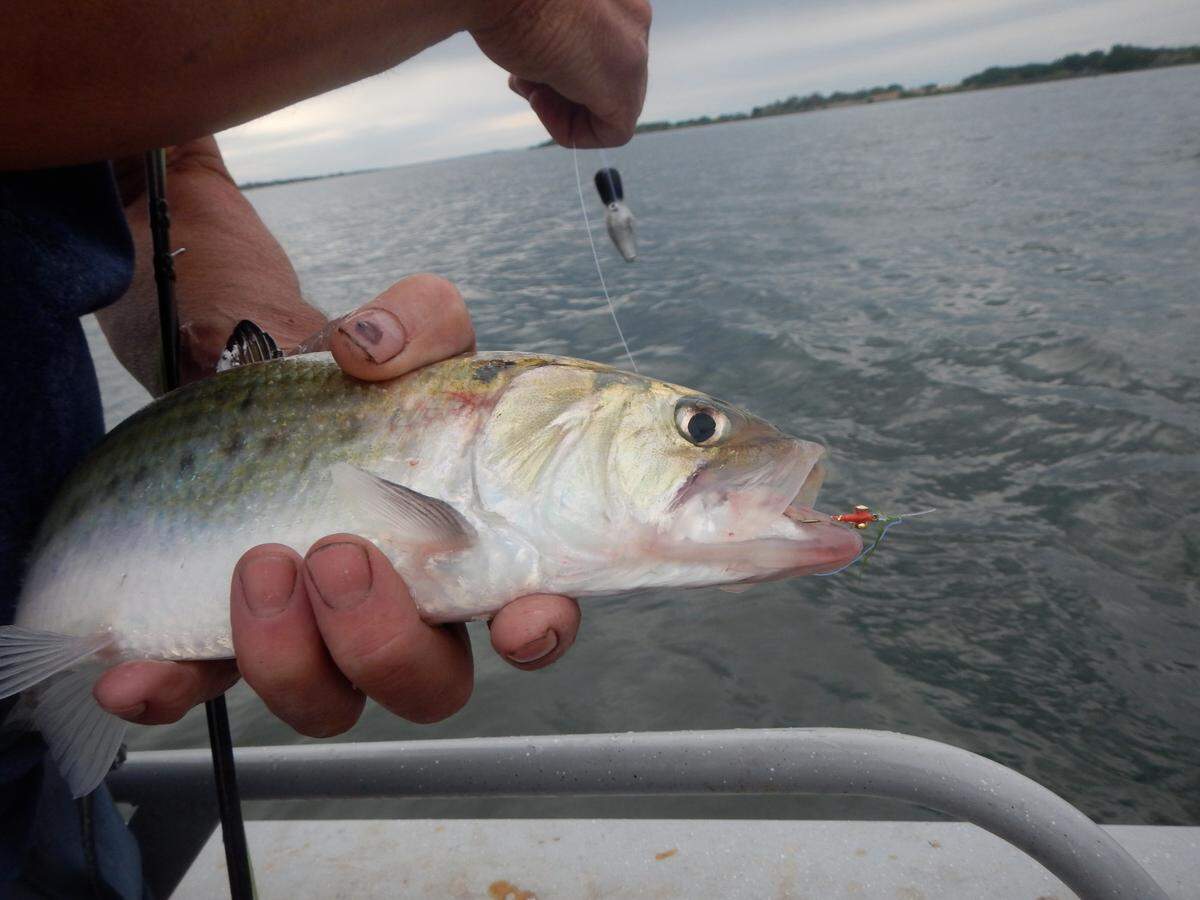
Shad tend to follow defined shoreline contours when they migrate. They are sensitive to light and generally stay within 3 to 4 feet off the bottom during the day.
Once you identify the optimum current and depth where a migrating school of shad is active, anchor up and wait for your rod tip to go down.
If you miss a strike leave your lure in place. Shad are a schooling species. More fish are likely to be in the vicinity.
Kids and shad fishing
For young children whose fishing experience has been limited to reeling in 8-inch hatchery trout, shad fishing is a blast.
Fish range from 1½ to 3 pounds in size, put a good bend in your rod, and often go airborne. While the initial hookset is exciting, it doesn’t stop there. Netting a feisty shad is a challenge for youngsters and entertaining to watch.
For bank anglers it’s a matter of finding access to areas having relatively swift current that encourages shad to migrate close to shore.
Casting from rip-rap downstream of Ice Harbor and McNary Dams is a viable options, as are shoreline points in the Hanford Reach.
Colored beads, red-and-white flies, and crappie jigs worked across a current seam with either a spinning rod or a fly rod with sinking line works. Small spinners and spoons can also lead to a strike.
Shad for dinner
Several culinary options are available if you keep your catch.
First, prepare shad by removing the head and tail and scaling them. You can cut the flesh into 2- to 3-inch cubes and pickle it.
Alternatively, stuff the body with seasoned dressing, wrap tightly in foil, and bake at a 300 degrees F for 4 to 6 hours to soften the many small bones.
Pressure canning is another option. Adventuresome gourmets wrap the gonads (i.e., roe sac and testes) in bacon and fry in olive oil or sauté in cream and serve over grits.
As for me, I set aside a dozen or so medium-sized shad in the freezer for later use as crab and sturgeon bait.
Excuse my poor English, but there ain’t no fishing like shad fishing.
This East Coast transplant provides opportunity for anglers of all ages. If there’s a lesson to be learned, it’s that success furthers support of an all-American outdoor activity at a time when finding something positive to cheer about is important.