
New study shows Blue Mountain forests are changing, intensifying fire dangers
A new study indicates climate changes will intensify wildfires in Oregon’s southern Blue Mountains, making them more frequent, more extensive and more severe.
Brooke Cassell, a forest ecologist who now lives in Everett, led a team of researchers from Portland State University, North Carolina State University, the University of New Mexico and the U.S. Forest Service.
“Rising temperatures, longer fire seasons, increased drought, as well as fire suppression and changes in land use, have led to greater and more severe wildfire activity,” said the report published on Nov. 21. in Ecosphere, the Journal of the Ecological Society of America.
“Over the next century,” Cassell wrote, “the combined effects of climate change and wildfires are likely to shift the composition of mixed-conifer forests toward more climate- and fire-resilient species, such as ponderosa pine.”
“If these forests become increasingly dominated by only a few conifer species, the landscape may become less resilient to disturbances, such as wildfire, insects and diseases, and would provide less variety of habitat for plants and animals,” wrote Cassell, the study’s lead author and a recent Ph.D. graduate from the university’s Earth, Environment and Society program.
The researchers looked at how climate-driven changes in forest dynamics and wildfire activity will affect the landscape through 2100.
The team used a computer model to simulate and predict how the forests and fire potential will change over time in response to current management practices and two projected climate scenarios.
The results show that climate warming in the western United States is causing changes to the wildfire regime in mixed‐conifer forests.
“Even if the climate stopped warming now, high-elevation species such as white bark pine, Engelmann spruce and sub-alpine fir will be largely replaced by more climate- and fire-resilient species like ponderosa pine and Douglas fir by the end of the century,” said the report.
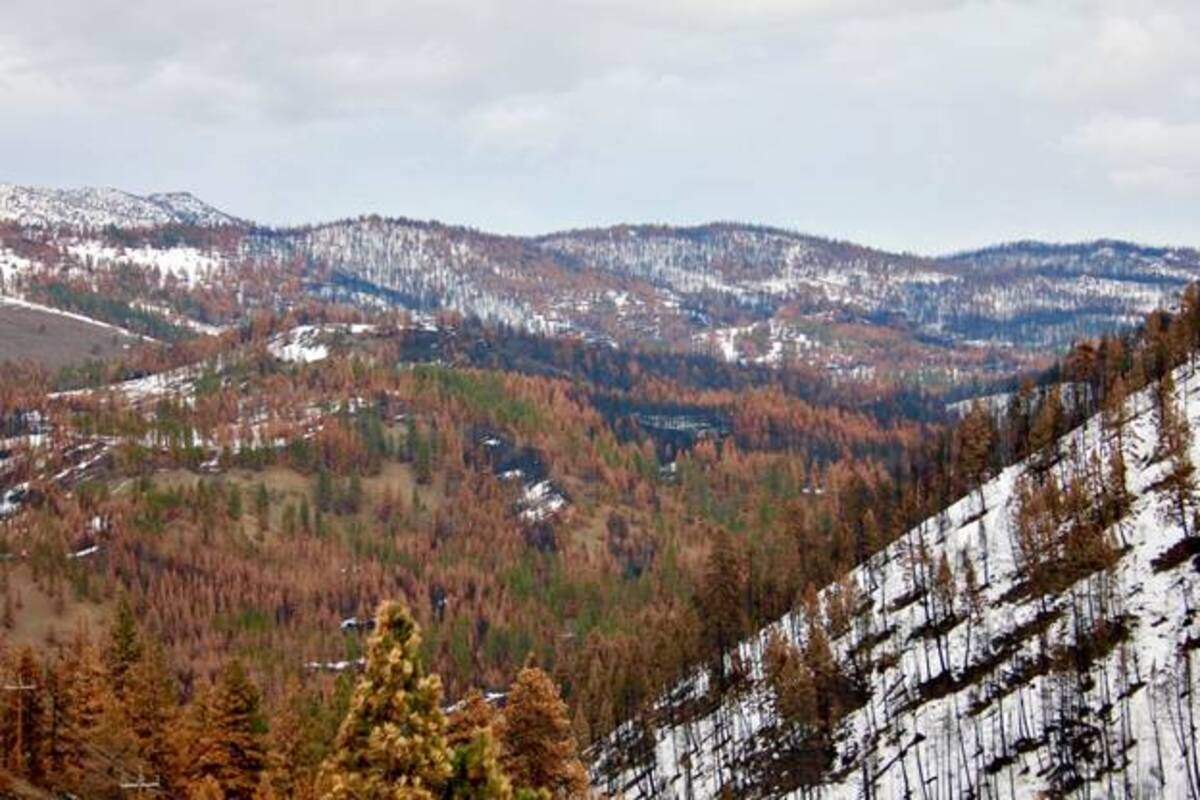
A growth of the shade-loving grand fir that has been expanding in the understory of the forest also is expected to increase, even under hotter and drier future climate conditions, providing more fuels to help spread wildfires and make fires even more severe.
Forest management strategies
Cassell said that the team’s findings suggest that forest managers should consider projected climate changes and increasing wildfire size, frequency and severity on future forest composition when planning long-term forest management strategies.
The team also suggests that in light of the projected expansion of grand firs, managers should increase the thinning and prescribed burning to help reduce the extent and severity of future fires.
The projected climate changes generated a 20 percent increase in the number of extreme fire years.
This modeling study suggests that climate‐driven increases in fire activity and severity will make high‐elevation species vulnerable and will reduce the diversity of the landscape.
“There will be significant shifts in the composition of the trees in the forests,” he wrote.
This story was originally published November 25, 2019 at 5:00 AM.