
Despite fraught WA history, nuclear power may again have its day | Opinion
Nearly three decades have passed since Energy Northwest, operator of Washington’s sole nuclear power reactor near Richland, changed its name to shed its former identity and move beyond its troubled financial past.
No longer would the Washington Public Power Supply System go by the acronym WPPSS, which had morphed into “Whoops” when the municipal corporation defaulted on $2.25 billion in bonds. The system, a consortium of public utilities, was responsible for the largest public default in U.S. history at the time. The fallout was traumatic for the region, and the financial and management failures were mind-boggling. Public distrust took root.
In a 1983 Seattle Times roundup of the year’s biggest stories, the bond default was second only to the death of U.S. Sen. Henry M. “Scoop” Jackson, who had represented the state in Congress for 42 years and ran twice for president.
Washington state voters became so soured on the idea of nuclear power, and how the effort went so far awry, they wanted a say in the financing of big electricity projects. In 1981, 58% percent of voters approved Initiative 394, demanding public leaders ask voters for permission before financing electricity plants of more than 250 megawatts. (The Legislature later changed that to 350 MW).
Though nuclear power accounts for about 19% of all U.S. electricity generation, in Washington it was a nonstarter.
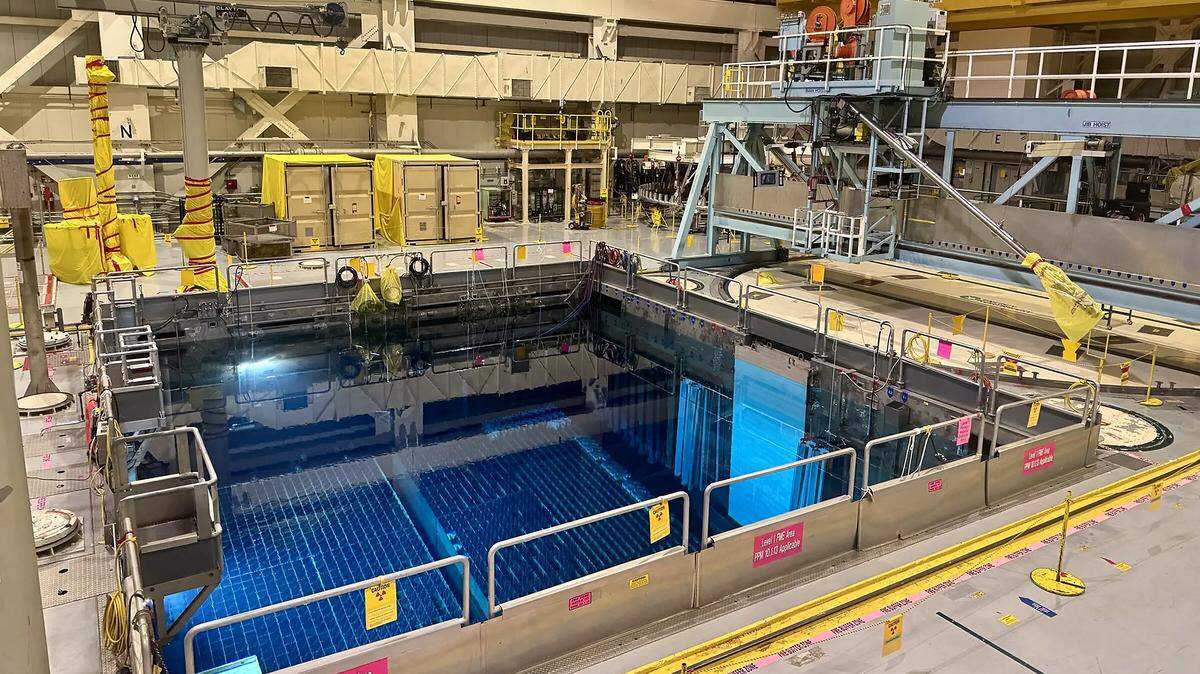
Today, two reactors sit among old-growth sagebrush and Russian thistle on the desertlike Energy Northwest site. The Columbia Generating Station was completed and has been generating electricity for 41 years. The other, known as Plant No. 1, is a large concrete dome that was mothballed at about 65% completion.
During the 2000-01 energy crisis, when Enron was perpetrating a nationwide grift on power customers, good old Columbia Generation Station was delivering electrons that were like gold. Though the plant was due for a maintenance shutdown, that was delayed a few times to help keep the lights on.
I was the Tri-City Herald editorial page editor back then, and I called then-Gov. Gary Locke’s office about the prospects for finishing off Plant No. 1 because it had been fully permitted before it was mothballed. Over the phone, I got a hard “no,” with a scoff and, I sensed, an eyeroll.
Fast forward to now, and you could easily bowl me over with one of the tumbleweeds that are kinetic fixtures of the shrub-steppe region.
Washington’s ambitious climate strategy
With state support, Energy Northwest and Amazon are exploring the prospect of bringing an advanced nuclear technology facility to Washington. The Legislature provided $25 million, fittingly with revenue generated from the Climate Commitment Act’s cap-and-invest program.
I say fittingly, because it helps explain why people are suddenly less likely to look askance at nuclear power and more likely to see it as a climate solution. Nuclear power does not generate carbon emissions, although it does use nuclear materials, which need to be handled carefully after use. The Obama administration abandoned a yearslong effort to establish a long-term repository at Yucca Mountain, Nev. So commercial nuclear waste is stored above ground in secure casks at the reactors.
Additionally, a group of bipartisan state lawmakers just introduced House Bill 2090, which would “integrate advanced nuclear energy into the state energy strategy.”
State Rep. Stephanie Barnard, R-Pasco, is the prime sponsor, and the second is House Democratic Majority Leader Joe Fitzgibbon, who has well-polished environmental credentials, including spearheading the state’s 2021 clean fuel standard.
Providing the impetus for these ambitious actions was the state’s 2019 Clean Energy Transformation Act, which requires Washington to have electricity sources free of greenhouse gas emissions by 2045. Under that law, the last coal plant in the state, TransAlta, was supposed to shut down this year, but the Trump administration last week ordered it to stay open. State leaders say they will fight it.
Simultaneously, the demand for power continues to increase. And electricity development is not keeping up. Nor is construction of electricity transmission lines. Forecasters say rolling brownouts are a possibility.
The confluence of voracious demand for power, the limits of wind and solar power sitings, and the possibility of advanced nuclear reactors has opened the door again to this technology.
Attitudes are changing; climate change is the driver
“When I was a kid, nuclear was the scariest thing out there,” Fitzgibbon said. “Now, climate change is the scariest thing.”
He is sure the state will need more cheap baseload power, though not so sure that nuclear can be done in a cost-efficient way: “But we should not take if off the table.”
Interestingly, Fitzgibbon was only 13 when WPPSS changed its name in 1998. That generational shift might be one reason why public attitudes have been changing.
Marc Daudon, a longtime environmentalist appointed to the Energy Northwest board in 2011, has long been a skeptic of nuclear power and is a cautionary voice on the board. He noted that, in addition to the urgency of abating climate change, generational attitudes are possibly a factor.
More people are thinking that “nuclear energy could be part of the solution, and you see that in polls, you see that across the country,” said Daudon. “Partly that seems to be kind of a generational thing. This younger generation didn’t have all the experiences that maybe you and I had, growing up …”
He referred to the partial reactor meltdown at the Three Mile Island Nuclear Generating Station near Harrisburg, Pa., which had no releases or injuries. There was also the deadly 1986 Chernobyl accident north of Kyiv in Ukraine, and the tsunami-triggered failure of power and cooling at Fukushima Daiichi reactors in 2011.
Those sobering episodes underscore the importance of scrupulous caution, study and accountability as nuclear is considered as a way to reduce carbon emissions.
Daudon added that there is also a new context to consider: “Part of that, I think, is everybody reconciling their thinking to how we need to make this energy transition, and where the relative issues associated with nuclear compare to the climate crisis.”
Still, there will be opposition.
State Rep. Gerry Pollet for years has headed Heart of America Northwest, which has scrutinized the federal nuclear defense cleanup on the Hanford site. He remains concerned about any waste streams from the new plants. Not only are fuel rods stored above ground, but all other low-level radioactive wastes from the new reactors would be added to the commercial radioactive landfill in Central Hanford.
In 2024, the Confederated Tribes and Bands of the Yakama Nation and the Confederated Tribes of the Umatilla Indian Reservation sent letters to the Legislature, registering similar concerns and saying they should be consulted about any decisions.
The Amazon role
Among the growing demands for electricity are technology companies’ data centers, which fuel artificial intelligence, cloud computing, streaming and more.
Enter Amazon. In October, the retailing giant and Energy Northwest announced a funding agreement for a feasibility report to explore the Cascade Advanced Energy Facility. The concept would include advanced nuclear small modular reactors, which don’t require the large footprint of existing reactors or the construction costs. Maryland-based X Energy would build the reactor facility and is already working on deploying its particular technology with Dow Chemical in Texas, as part of the federal Department of Energy’s Advanced Reactor Demonstration Program.
Initially, the project would include four of the small reactors, each producing about 80 MW each for a total of 320 MW. (In contrast, the Columbia plant produces around 1,200 MW.) Amazon will put up $334 million to help finance the project and agrees to buy the power during the startup phases.
Interestingly, it would be sited in the shadow of the mothballed Plant No. 1.
Greg Cullen, Energy Northwest’s vice president of energy services and development, understands questions about why public money and a public agency would be associated with a private company in this way.
Noting the risk associated with the new technology, he said there will be a public benefit.
“Eventually, the utilities will have access to up to 50% of the power,” he said, adding that some are considering buying some of the initial generation.
Cullen said the effort is in early stages. But the full board, which includes representatives from 27 Washington public utilities, including Seattle City Light and Snohomish Public Utility District, has given unanimous conditional approval for the agency to establish the conditions required for final approval.
That approval also would require a majority from each of the governing boards to approve it as well. In City Light’s case, that would be a majority of the Seattle City Council.
So there are many hoops to jump through, technology to test, and safety and financial standards to establish — all with big helpings of robust transparency.
At least one thing is for sure. The Tri-Cities is particularly suited for the job. In addition to the nuclear plant, Hanford’s main mission is the cleanup of decades of defense waste.
And the venerable Pacific Northwest National Laboratory is peopled with scientists, researchers and others pursuing groundbreaking work in engineering, chemistry, bioproducts, and chemistry and materials sciences, among others.
This is a well-educated, sophisticated community willing to advance science.
“People that understand (the Cascade project) the most are not only OK with it, but they want it here,” Cullen said.
Editor’s note: This column was updated to clarify that low-level waste from the new reactors would go to Hanford’s central radioactive landfill.
Kate Riley: is the editorial page editor at The Seattle Times; kriley@seattletimes.com; on X: @k8riley.