
Energy Secretary sees ‘scientific marvel’ of Hanford nuclear site for 1st time
AI-generated summary reviewed by our newsroom.
- Energy Secretary Chris Wright made first visit to Hanford nuclear site in Washington
- He inspected Hanford vitrification plant as crews poured and staged glassified waste
- Two melters are active; DOE plans to operate both concurrently in 2026
Energy Secretary Chris Wright saw the Hanford vitrification plant in action in his first visit to the nuclear cleanup site in Eastern Washington on Friday.
After more than 23 years of on-and-off construction, the huge plant started turning radioactive and hazardous chemical waste into a stable glass form during the government shutdown in October.
When the energy secretary visited, the plant was ramping up its glassification of waste and had filled 22 containers, each 7.5-feet tall and 4-feet wide with waste ready for disposal.
“Secretary Wright witnessed how decades of hard work have resulted in the world’s largest vitrification plant and reaffirmed his commitment to the success of the Hanford mission,” said Rep. Dan Newhouse, R-Wash., said in a statement after the tour.
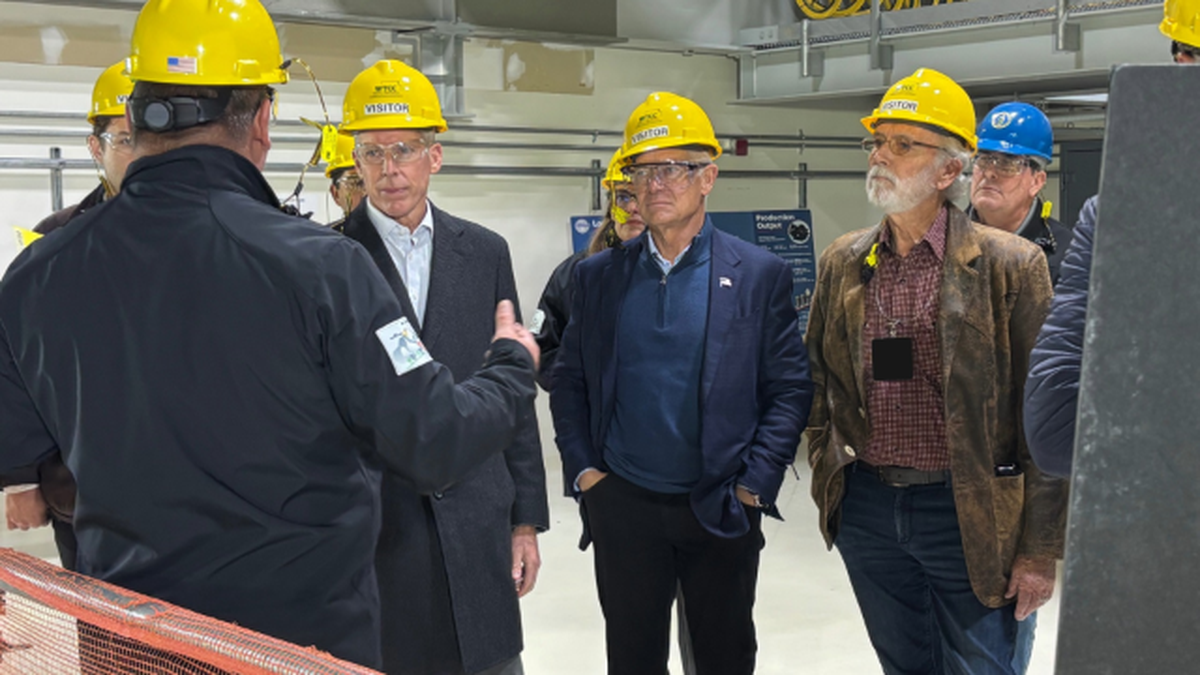
Newhouse; Casey Sixkiller, the director of the Washington state Department of Ecology, a Hanford site regulator; and Tim Walsh, the Department of Energy assistant secretary leading the agency’s Office of Environmental Management, were among those who accompanied Wright on the tour.
Wright was at the plant on a busy day, with three separate activities underway at the vitrification plant.
What energy secretary saw
Three containers of glassified waste were hauled off the vitrification plant’s campus on Friday using a special transporter. Each filled stainless steel container weighs about 7.5 tons.
The containers now are staged at a lined landfill for disposal nearby in central Hanford.
Those that left the vit plant Friday included two containers of waste glassified in the vitrification’s first melter and one from the second melter, which has more recently started treating waste. The vitrification plant is using two melters to treat waste with plans to start operating both at the same time next year.
Friday was also a day that waste that had been pretreated to prepare it for glassification was being transferred to the plant.
Initially, the less radioactive waste is being separated from waste in underground tanks and then transferred for treatment at the vitrification plant’s Low Activity Waste Facility.
By 2033 DOE is required by a federal court consent decree to also start treating high-level radioactive waste at the vitrification plant.
And in a third activity Friday “they were actually pouring glass while we were there,” Sixkiller said.
Those on the tour watched monitors in a plant control room that showed the level of a molten mixture of glass and radioactive waste rising in a stainless steel container.
“You cannot understand Hanford unless you get out on site and see it,” Sixkiller told the Tri-City Herald after the energy secretary’s tour.
“... I thought it was a really good opportunity for the secretary to see for himself this engineering and scientific marvel that is the vitrification plant.”
80-year-old waste being treated
Hanford officials said the vitrification plant was working well, according to those on the tour.
The Hanford nuclear site near Richland in Eastern Washington was used from World War II through the Cold War to produce nearly two thirds of the plutonium for the nation’s nuclear weapons program.
Among the waste left from the work is 56 million gallons of radioactive and chemical waste stored in underground tanks, some for eight decades. Many of the tanks are prone to leaking.
Not only has the vitrification plant begun to glassify waste, a pilot test has also turned about 2,000 gallons of low-activity radioactive waste from Hanford tanks into concrete-like grout and disposed of it in arid areas of Utah and Texas.
DOE plans to grout more tank waste for out-of-state disposal as vitrification continues. To be buried at Hanford waste must be low activity and vitrified.
Sen. Patty Murray, D-Wash., had accused DOE of dragging its feet this year on starting to treat waste at the vitrification plant. Wright told her in a phone conversation that there were safety concerns, Murray said.
Wright said at a Thursday news media briefing a day before seeing the vitrification plant that was false.
WA interest in Hanford future
Sixkiller also used the secretary’s visit Friday to discuss the future of Hanford site land, including for possibly energy projects on the limited amount of Hanford land designated for industrial use.
He said he told DOE officials that the state of Washington wants to be part of that conversation.
“We have a vested interest in not just advancing the cleanup mission at Hanford but advancing the economic opportunity vitality of this part of the state,” Sixkiller said. “We want to find ways to work together.”
Wright spent two days in the Tri-Cities.
Although he held two news media briefings during his Tri-Cities visit, he was not available to comment after seeing the vitrification plant.
On Thursday, he was at Ice Harbor Dam to discuss the Trump administration’s support for retaining the four hydropower dams on the lower Snake River in Eastern Washington.
Also on Thursday, he toured DOE’s Pacific Northwest National Laboratory in Richland and announced the lab’s key role in the Trump administration’s Genesis Mission, an initiative to speed scientific innovation with the use of artificial intelligence.
He commissioned a prototype laboratory that will use AI to autonomously study microbes as Ginkgo Bioworks builds a 32,000-square-foot facility on the PNNL campus under a $47 million contract.
The facility, which should be operating in 2030, will continue work with microbes at the prototype lab to speed research that could develop new medicines, make product material more efficiently and recover valuable metals from waste.
This story was originally published December 8, 2025 at 5:00 AM.