
Gov. Jay Inslee’s progressive legacy often left Eastern WA feeling overlooked | Editorial
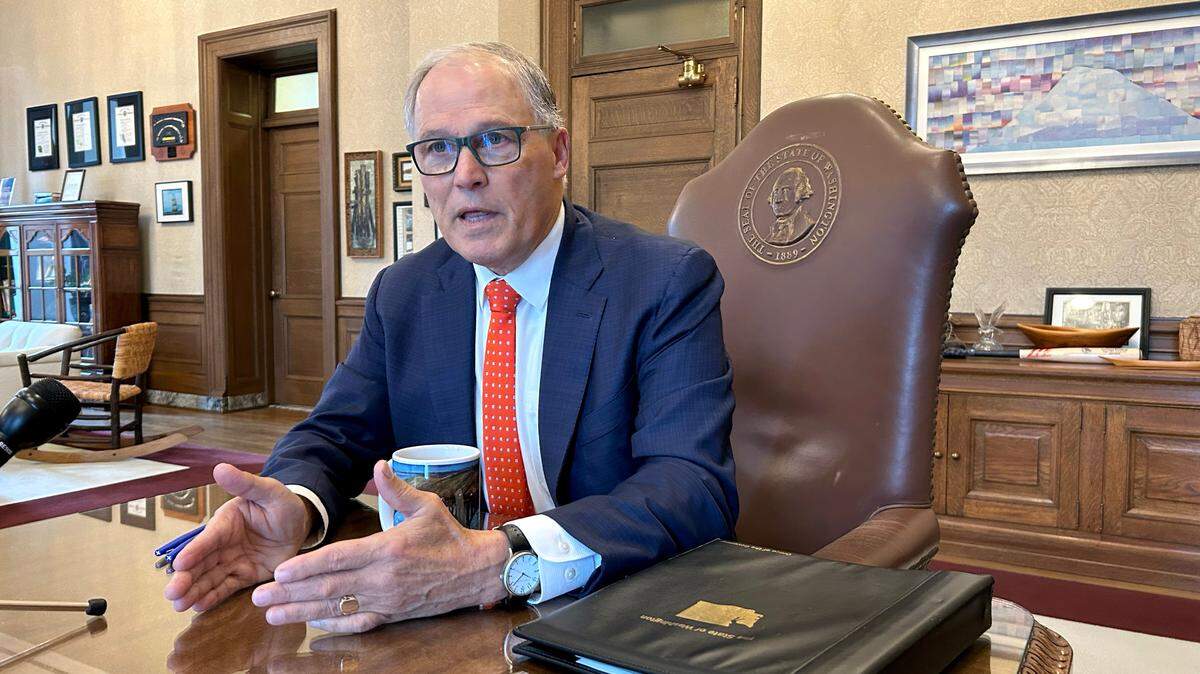
Gov. Jay Inslee will leave office in a few days after leading Washington for a dozen years. He and his Democratic allies in the Legislature have reshaped the state and overcome unexpected crises but have left some significant challenges for the next administration.
Climate change has been Inslee’s passion from the get-go. He even sought the Democratic nomination for president running as the climate candidate. Under Inslee, Washington became a national and global leader on climate policy.
He worked with lawmakers to pass the Clean Energy Transformation Act, which mandates 100% clean electricity by 2045, and the Climate Commitment Act, which created the state’s cap-and-trade program to reduce greenhouse gas emissions. Voters overwhelmingly ratified the latter on November’s ballot.
His climate advocacy was not without controversy, though. Business interests argue that it has led to higher prices for fuel and has been a drag on economic growth. Inslee also has gone overboard at times, as he did last year when he rammed through maximum wind power on the Horse Heaven Hills over the objections of local residents, ecologists and tribal groups.
In a recent interview with the Tri-City Herald Editorial Board, Inslee defended the wind farm decision. When asked why he did not engage with local residents to sell it, he argued that the energy siting process does not allow him to do so.
If that’s true, it’s something the Legislature should change so that the next time a governor wants to force a project on a community, he at least has a chance to engage with locals and try to convince them of its merits.
Inslee also has been squishy on removing Snake River dams and replacing the lost clean hydropower. The Biden administration has moved toward removal. Inslee insists that he has not made up his mind, but he has not pushed as strongly for the federal government to adopt a go-slow approach as he might have.
Energy and climate are inextricably linked to the economy, and on that front it is difficult to see Inslee’s time as anything less than a success. The state experienced a robust economic boom, driven in large part by its thriving tech sector, including new green technology. Innovative industries coming to the Hanford nuclear site and the rest of the Tri-Cities are proof of that.
Yet, prosperity did not reach all Washingtonians. The homelessness crisis today is worse than when Inslee took office despite the state’s spending billions of dollars on aid and affordable housing. Indeed, during his interview with us, Inslee identified this as the issue he most regrets not making more progress on.
Inslee’s leadership was crucial during the COVID-19 pandemic. The first laboratory-confirmed case of COVID in the United States was in Washington.
The governor acted quickly and decisively. Washington had one of the lowest death rates in the nation. If it had matched some of the worst states, thousands more would have died from the disease here.
His policies were not perfect, especially when it came to closing schools and helping students close the education deficit, but few things are in hindsight. He also clung to overly broad executive authority for too long.
Inslee leaves some challenges for his successor, Gov.-elect Bob Ferguson, the homeless and housing crises among them. State spending is forecast to exceed state revenue. Schools still are not as good as they should be even after meeting the McCleary mandate. Transportation infrastructure remains in need of major upgrades.
The wind farm was not Inslee’s only parting slight toward the Tri-Cities. His proposed budget omitted funding for renovations at Washington State University’s Tri-Cities campus while recommending full funding for new buildings and upgrades in Pullman, Spokane, Vancouver and Wenatchee. Ferguson and lawmakers should share the funds more equitably.
The sense that Eastern Washington is being left behind and ignored simmered throughout Inslee’s tenure, despite his having some history here as representative from the 4th Congressional District.
He and his Democratic legislative majority pushed a progressive agenda often with little regard for the needs and wants of Washingtonians who do not live near Puget Sound. That must change.
Inslee has been governor for almost 10% of Washington’s statehood. As Washington looks ahead, the foundation he laid offers challenges and opportunities for further progress.