
Decades-long struggle to build Richland performing arts center now up to voters
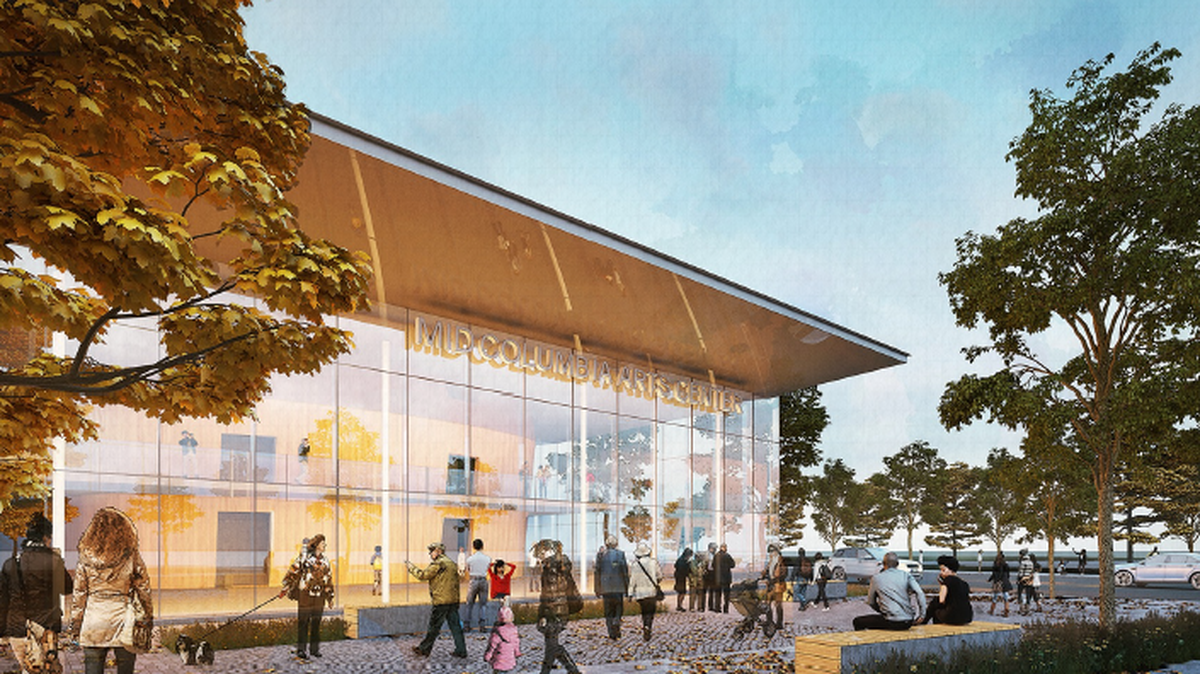
Richland voters will soon decide if sales taxes should help pay for an $81 million performance hall overlooking the Columbia River.
Ballots were mailed Jan. 22 for the Feb. 11 special election. The Richland Public Facilities District is asking voters to approve Prop. 1, which would raise the local sales tax by two-tenths of 1%, or two cents on a $10 purchase.
If approved, the 30-year tax will generate about $4 million a year from the start on taxable retail sales in Richland, where the current rate is 0.087.
Washington state currently collects 0.065 and local government collects 0.022.
The proposed tax would allow the facilities district to finance bonds to cover 80% of the cost to design and construct an 800-seat performing arts center near the Reach Museum near the west end of Columbia Park at the Richland Wye. Contributions and selling naming rights would cover the remaining 20%.
The public facilities district is the taxing entity for the project. The nonprofit Arts Center Task Force is promoting it and plans to operate it if built.
4 items on ballot
The Mid-Columbia Performing Arts Center is one of four tax requests before voters in Benton County on the Feb. 11 ballot. There are no requests in Franklin County. Ballots must be returned or postmarked by election day.
The Kiona-Benton and Finley school districts are seeking voter approval for property tax levies together worth about $10 million for public education.
Kiona-Benton is asking for a two-year operations levy. Finley has two requests on the ballot, a two-year operations levy and a two-year capital levy for safety, security and technology.
Home for the arts
The the theater funding passes with the simple majority needed from voters., it will fulfill a decades-long campaign to provide a permanent home for local arts organizations.
The Mid-Columbia Symphony, Mid-Columbia Mastersingers, Mid-Columbia Ballet and Mid-Columbia Musical Theatre all plan to call it home.
The 800-seat capacity is controversial with opponents saying it is too small to accommodate the larger touring productions Mid-Columbia residents want.
But supporters say 800 is a responsible balance. More seats would cost more money and be harder to fill for typical performances by local organizations.
Richland’s performing arts proposal is well researched, said Carol Moser, a former Richland City Council member who co-wrote the statement in favor of the performing arts tax for the Voters’ Pamphlet.
Moser said she’s been working to support the theater concept for more than 30 years and is confident the supporters are on solid ground when they say it will be self-sufficient within three years of opening.
The Arts Center Task Force assessed costs, bookings and and future profitability in exhaustive detail in a 131-page report released in 2024. (attached below.)
“It is very well researched,” she said
The Arts Center Task Force is promoting the Feb. 11 ballot request through yard signs and informational sessions. It previously paid for studies, designs and other costs associated with creating a build-able project.
According to its most recent IRS filing, the task force has about $1.1 million in assets to support the project. It reported spending about $2,600 on yard signs to support the Feb. 11 ballot in two reports filed with the state’s Public Disclosure Commission.
Its final information session, “Why Voting ‘Yes” matters,” is at 6:30 p.m., Feb. 3, at the Richland Public Library, 955 Northgate Drive.
Profitable in three years
The proposed project includes a main performance hall in the heart of a larger arts complex.
There will be gathering spaces for community events, a gallery and accommodations to support banquets, lectures and smaller recital-type performances.
The performing space would be used at least 150 times per year, according to projections. Another 150 events would be held within the center each year.
By its third year, total revenue will come to about $1.6 million, with $610,000 representing user fees and the balance attributed to contributions, endowments and fund raising.
Operating costs are projected at $1.5 million.
“The center should generate an overall net profit by its third year of operations,” the report anticipates.
Opponents also object to new taxes. One Facebook user vowed to hold a tea party if it passes.
Broadway style shows?
At 800 seats, the proposed theater isn’t large enough to serve the community, argues Melissa Lough, a recent Richland resident and full-time student.
Lough wrote the argument against the measure in the opposition statement in the Voters Pamphlet after noticing that no one was stepping up.
Lough said she supports a larger theater and would join an effort to make it happen if the opportunity arises.
She learned about the tax measure from social media. Lots of people said they were against it, but no one had formed a “con” committee.
“There are a lot of people who are against it and I feel our voices should be heard,” she said.
She also called for a firmer agreement to use the land, which is owned by the U.S. Army Corps, near Reach for a theater. Too, she said the Arts Center Task Force needs to be more forthcoming about private funds it is raising to support the effort.
“I would like it to happen, but it needs to fit the community.”
Vic Epperly, a former Kennewick mayor, has long objected to city-level projects, saying the Tri-Cities needs to unite behind a regional effort. Richland’s 800-seat vision falls short, he told the Tri-City Herald.
“Vote ‘No’ so the Richland PFD sales tax can be combined with the Kennewick PFD sales tax to provide the funding needed for a performing arts center complex that is anchored by a large capacity theater and has features to meet the needs of the local arts community as well,” Epperly wrote in a statement submitted on behalf of the con committee.
Opponents also note that local schools and churches offer a mix of larger, well-equipped auditoriums.
Notably, Richland recently invested more than $7 million to update Richland High School’s 1,500-seat auditorium. Other local high schools can seat up to 1,200 in their various facilities. Faith Tri-Cities in Pasco is popular for its expansive and comfortable theater-style space as well.
But advocates say school functions are a priority. That leaves arts groups in the cold or limited by school schedules and needs. The community needs a permanent performing arts center to serve as a cultural hub for the region.
What is a facilities district?
The Washington Legislator allowed local government to create public facilities districts to build stadiums, theaters and other public amenities.
They may ask local voters for up to two-tenths of a percent sales tax increase to fund them. Richland, Kennewick and Pasco all have such districts. A regional version is dormant.
Richland’s PFD is led by directors appointed by the Richland City Council. It is chiefly concerned with operating the Reach Museum. It has never directly asked voters to support a project.
Its counterparts in Pasco and Kennewick are pursuing their own projects.
Pasco is building a $37.5 million aquatics center in the Broadmoor area. Its voters agreed to a two-tenths sales tax on a 55%-45% margin in 2022.
Kennewick is working to update the Three Rivers Convention Center even though its voters rejected sales tax requests in 2016 and 2017. Instead of using a sales tax increase, it is partnering with the city of Kennewick and A-1 Hospitality, a Tri-City hotel development and management group, to bring much-needed updates to the region’s primary meeting and event facility.
The facilities district and its partners are advancing plans to expand the convention center by 110,000 square feet and to build a Marriott-flagged “AC” hotel on the campus.
Regional theater, a brief history
Formal efforts to establish a regional theater began in the 1980s, but informal ones began decades earlier.
The Arts Center Task Force initially planted to site its theater at the Port of Kennewick’s Vista Field. It backed out of an agreement to buy 10 acres at the former airport in 2020.
It began working with the Richland facilities district and made the Reach site its preferred option.
Public facilities districts receive state money to build arenas, concert halls and similar venues. They can ask voters to raise sales taxes by up to two-tenths of a percent for specific projects.
If Richland voters sign agree to raise the sales tax, the Richland facilities district expects to break ground in 2027 and open the performing arts center a year later.
This story was originally published January 25, 2025 at 5:00 AM.