Vote by mail increased minority participation in Washington and Tri-Cities. Other hurdles remain
People of color vote more often in Washington than they did 15 years ago when most counties switched to vote by mail, according to election and census data reviewed by McClatchy.
Still, hurdles to registration and voting that seldom plague white people remain persistent in some communities of color, according to interviews with leaders and those eligible to vote.
Language barriers, lack of community outreach, distrust of government and a lack of confidence in the voting process all plague communities of color in Washington, McClatchy learned.
But activists and others are striving to increase voter participation in minority populations.
“I am a person that has a right (to be heard) just as much as anybody else,” said Kimsang Lor, a 44-year-old Tacoma Cambodian American voting rights activist.
Most Washington counties adopted universal vote by mail between the 2004 and 2006 federal elections.
“I remember going to the polls, and it was intimidating,” said Veronica Hinojosa, 54, a Gig Harbor social worker. “I did not like going to the polls, because they don’t teach you how to use them.”
Overall, 51% of Washington’s voting-eligible population cast ballots during the four congressional — or “off-year” — elections in 2006 and later, according to data compiled by the U.S. Election Project.
That’s up from an average of 45% during the four elections before 2006.
Washington’s voting-eligible residents of color have also been increasing their participation in elections since vote by mail went into full effect, according to Census Bureau data.
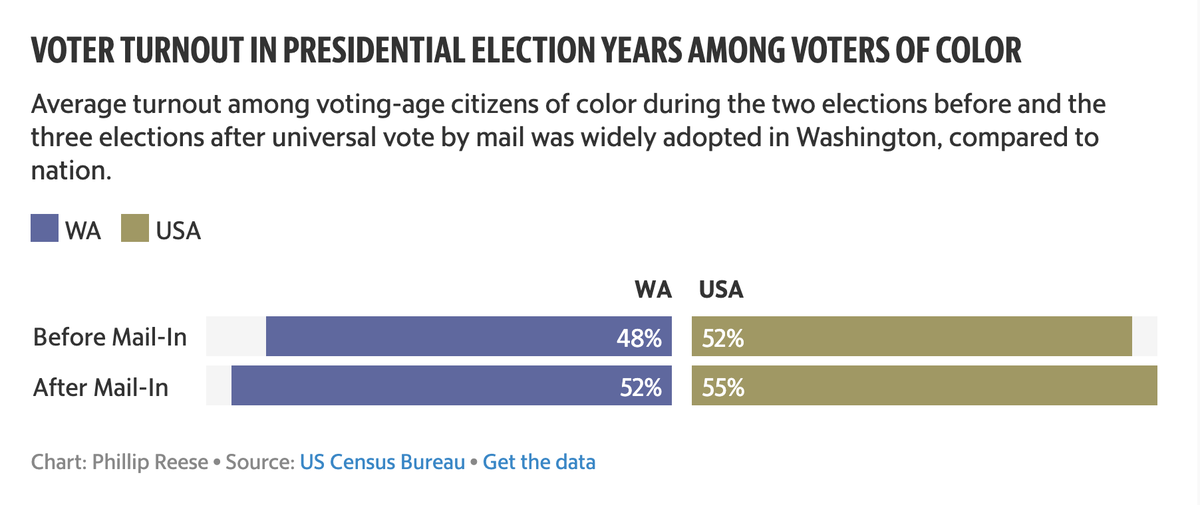
The data is based on comparing census data with precinct-level overall voting participation. Elections officials do not track voter participation based on race.
The figures on voters of color have a substantial margin of error, largely because Washington is not as racially diverse as many other states.
In Benton County
Voter participation increased in Benton County’s most ethnically diverse area — the primarily Latino community near Kennewick High School — after the widespread implementation of universal mail voting.
About 65% of registered voters in the area cast ballots during the 2004 presidential elections, before universal mail balloting was widely adopted statewide. By comparison, an average of 74% of registered voters in those precincts cast ballots in the next three presidential elections.
About 39% of registered voters in the area cast ballots during the 2002 congressional election, before universal mail balloting was widely adopted statewide. By comparison, an average of 49% of registered voters in those precincts cast ballots in the next three congressional elections.
Some of the change in voter participation may be due to factors other than mail-in voting, including changing precinct boundaries and neighborhood demographics.
In Franklin County
Voter participation increased in Franklin County’s most ethnically diverse area — an area that corresponds with Pasco’s eastside — after the widespread implementation of universal mail voting.
About 16% of registered voters in that area cast ballots during the 2004 presidential election, before universal mail balloting was widely adopted statewide. By comparison, an average of 56% of registered voters in those precincts cast ballots in the last two presidential elections.
Some of the change in voter participation may be due to factors other than mail-in voting, including changing precinct boundaries and neighborhood demographics.
The Latino vote
Voter apathy or a lack of understanding might be leading to low voter turnout among Pasco’s minority communities, said Ruben Alvarado, Pasco Councilmember District 2. Complacency could be the cause.
“I think a lot of the city has changed for the better in the past 10 years,” Alvarado said.
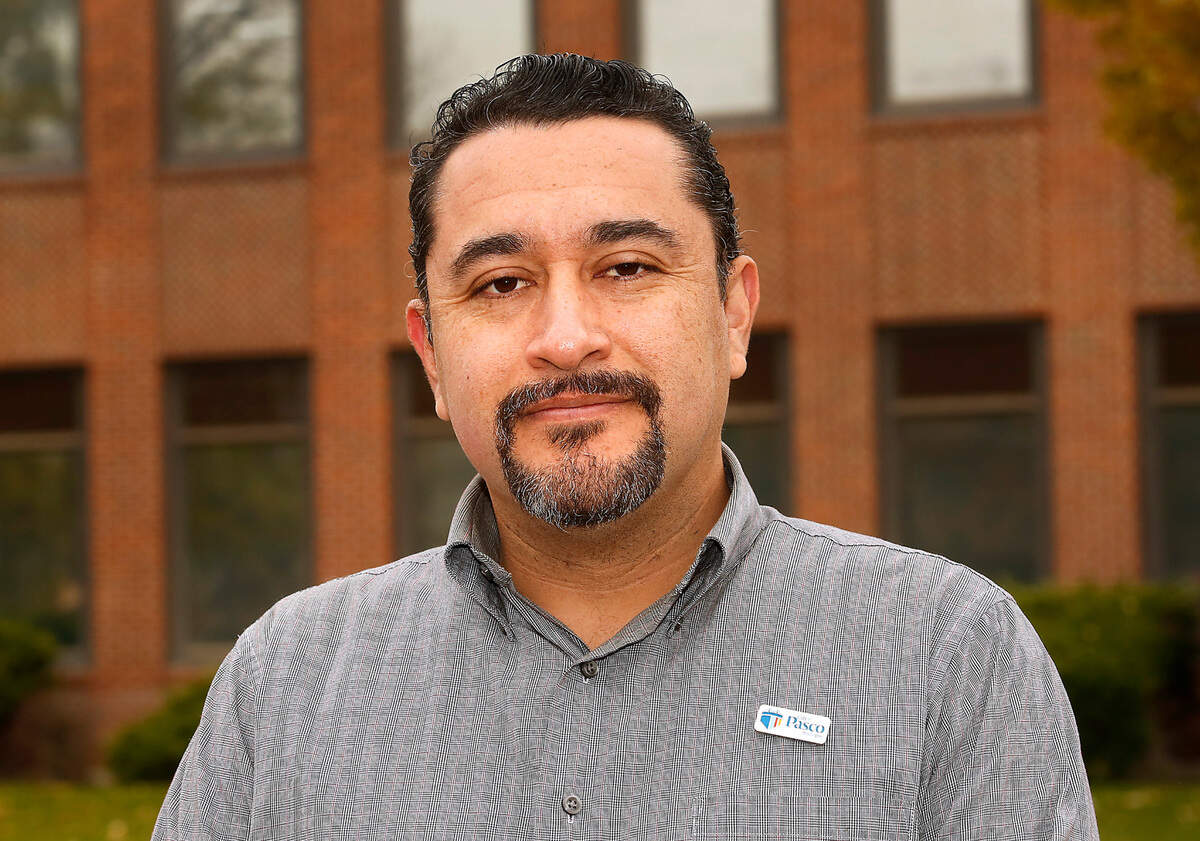
“There might be a sense that because things are better there’s not necessarily too much to raise awareness of,” he said. “But I do sense that when there is controversial issues, folks in my district at least, have been more likely to speak up and come to city council meetings.”
The move to district-based voting coincided with a noticeable increase in Latino participation, Alvarado said. Another barrier to voting may be familial language barriers, he added.
“Perhaps because there is not necessarily a culture of engagement with the parents, then the kids or the second generation may not be as likely to (vote),” Alvarado said. “Whereas, if you are raised in a house where the parents are pretty civically engaged, the kids who grow up are maybe more likely (to vote).”
Saul Martinez, Pasco Mayor, said he sees education as key in getting more minorities to vote. He thinks Latinos will make up a majority of the Pasco voting population in the next 10 to 15 years.
“Here, in the city of Pasco, we’re expecting a paradigm shift because we have a high percentage of young Latino students in our school systems,” Martinez said. “And as they are going through the guided education system, (they are) understanding the importance of being involved in the community and voting.”
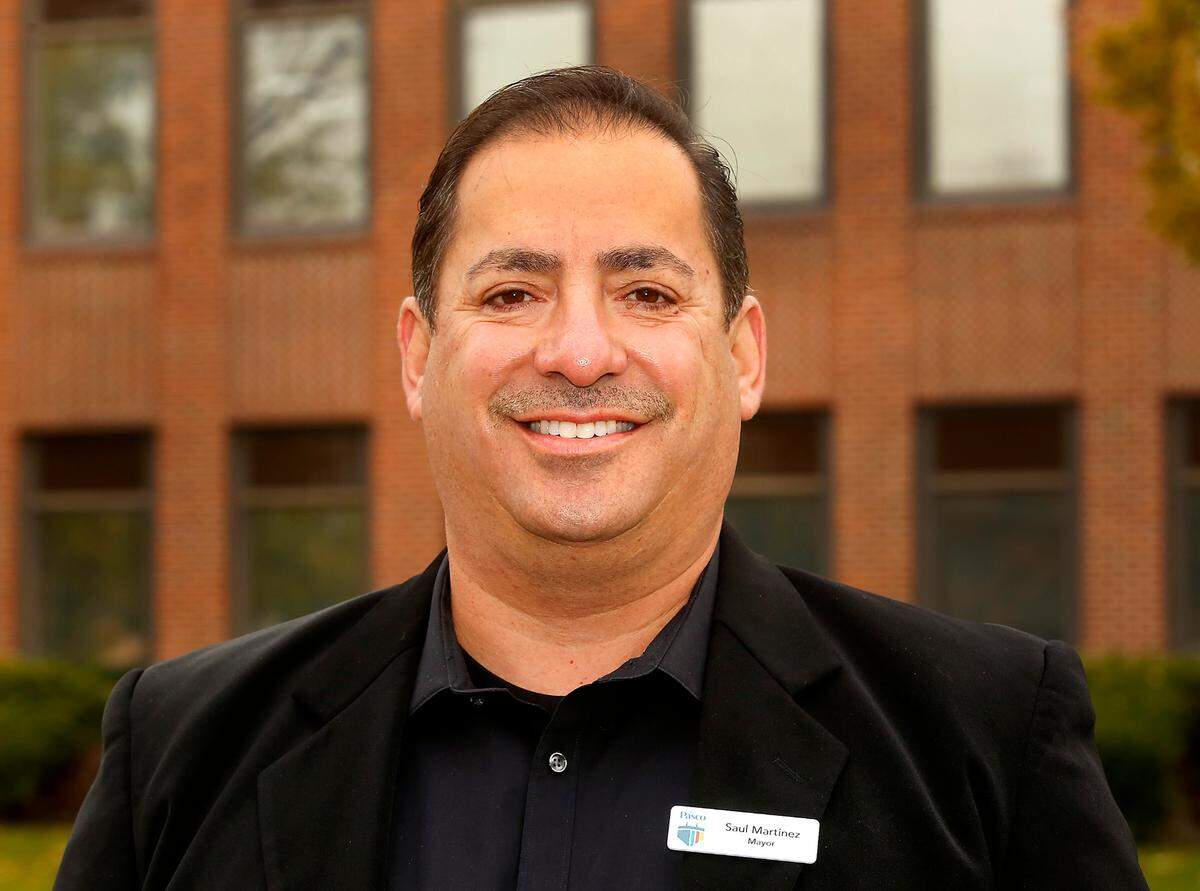
Martinez said low turnout may be due to cultural differences. He said immigrants from places such as Mexico tend to have less confidence in elections because there’s a sense that elections in Mexico are rigged.
“They kind of bring that as part of their culture, their mistrust of government,” Martinez said. “These high populations of folks that come from Mexico don’t and won’t make it a priority to vote because of that stigma that they might have of government.”
Latinos make up the second largest racial population in Washington, behind whites. And they’re growing.
The most recent census data has Latinos as 13% of the state’s population, up from 7.5% in 2000. But the group’s representation in elected government offices has not kept pace with its growth.
“If we don’t have representation, our voices are not going to be heard,” said Sara Irish, an immigrant from Mexico. “We are never going to be able to do anything.”
Irish, who works in community engagement for Molina Healthcare in Pierce County, has volunteered with various Latino and general community get-out-the-vote campaigns.
“I can be influential and help others to register to vote and take advantage of the privilege and the right of voting,” she said.
Irish said first-generation Latinos often have a fear of sharing too much information with the government.
“And for them to get registered or provide information to the government, where they are going to know where they live, that is a little worrisome,” she said.
That fear can permeate naturalized citizens.
“People who become citizens, they’re also afraid, because it’s no guarantee anymore that you are safe,” she said.
Registration in the United States requires more initiative compared with Mexico, she said. There, voter registration is a necessary part of life.
“Even to go to the bank and cash your check, getting a passport or visa or something to travel, you have to bring your voter registration card,” Irish said. “It is the most trusted source of information about each individual.”
Still, elections are often corrupt in Mexico, she said.
“Even though people vote, it is already assigned, who’s going to win,” she said.
That can lead to voter apathy.
“Their voice is not going to be heard,” she said. “Who wants to do something for nothing?”
Irish would like to see more voter education outreach from government officials to Latinos. That includes community meetings in English and Spanish.
She would like to see Spanish language versions of the voter guide.
Irish said it’s a duty of all citizens to vote.
“When they become a citizen, one of the obligations is to serve this country,” she said. “It’s a privilege to be able to vote, because not everybody can do it. Otherwise, if we don’t participate, we cannot complain.”
Irish and her friends are volunteering to pick up ballots and deliver them to drop-off boxes for the Nov. 3 elections.
“And we don’t care what affiliation you have,” she said. “We just want to make sure that your ballot makes it on time to the box.”
Second generation
Hinojosa grew up in Sunnyside, the daughter of immigrants from Mexico. She said her farmworker parents didn’t talk much about voting.
“I don’t remember growing up hearing anyone really talking to me about the importance of getting involved civically, and voting,” Hinojosa said.
Her parents had a third grade education. They became citizens about 2000.
Hinojosa first voted while in college. In those days, it was all at polls.
Voting by mail changed her behavior, she said. She doesn’t have to stand in line or make last-minute decisions.
“When I get my ballot, I have an opportunity to go through and take time to look at what’s in there; to think about what I want to vote for; who I want to vote for,” she said. She’s doesn’t miss polling places.
Hinojosa has a six-person household. They are all registered to vote and have voting parties before elections.
“We’ll get together and we’ll talk about, and we’ll fill out our ballots,” she said. “And we seal them and then we’ll mail them.”
Although registration forms come in Spanish and other languages, ballots do not. That can be a problem.
“It’s all in English,” Hinojosa said. “So, that can be intimidating.”
Then there is general mistrust of the government. Hinojosa said that Latinos might not want to expose their family members to unnecessary scrutiny.
She also said voting by people of color can be indirectly suppressed because they are convicted of crimes at higher rates, compared to whites.
Hinojosa thinks reaching out to ethnic groups by people from within those communities can increase voter participation.
“Many groups don’t trust people from the government, but they trust people within their community,” she said.
Living under a dictator
Liesl Santkuyl once spent her days registering people to vote at farmers markets, Tacoma Housing Authority’s Salishan community and at other locations.
“We always had registration papers with us,” she said. “I still carry all of the paperwork in my car.”
Born in Venezuela, Santkuyl grew up in the United States. Today, she’s a manager at the College Success Foundation, a nonprofit organization that assists low-income, first-generation students of color to pursue college educations.
Just registering to vote is a hurdle in the Latino community, Santkuyl said.
“It’s not common knowledge that you register to vote,” she said.
Although she left Venezuela as a baby, she returned to live for a few years in her late teens and early 20s. Compared with Venezuela, voting seems to be more optional in the U.S., she said.
But presidential politics can ignite passions, she said, and this year it’s causing an uptick in registrations in the Latino community.
Latin America is vast, comprising Mexico, Central America, South America and Caribbean islands. It’s not all homogeneous.
Central and South American immigrants often have a different take on government and voting compared with their Mexican neighbors, Santkuyl said.
Dictators and Latin America were intertwined in the 20th century. Haiti’s Francois Duvalier, Chile’s Augusto Pinochet, Panama’s Manuel Noriega, Peru’s Alberto Fujimori, Cuba’s Fidel Castro are just some who shaped their countries’ histories.
But, where 20th Century dictators seized power and often used brutal tactics to keep it, 21st century Latin American dictators use sham democracies to stay in power, says Jose Mauricio Ganoa, a Harvard Law School researcher and author.
Some immigrants see echoes of those regimes in current American politics, Santkuyl said.
“I think even Latin American people right now are like, this feels like Latin America,” she said.
The cynicism that Central and South Americans felt in their home countries can stay with them, Santkuyl said.
“I think that that carries over into the United States,” she said. “There’s not an optimism that your vote makes a difference. It feels much more like this is the machinery of politics.”
In her 20s, Santkuyl spent three years in Guatemala with the Peace Corps during the country’s long running civil war. It’s estimated that up to 200,000 Guatemalans died in the conflict. Entire Mayan villages were wiped out.
Fluent in Spanish, she would engage locals in villages and bus trips along the Pan American Highway.
“I would have lots of whispered conversations,” she said. She would ask Guatemalans why they didn’t rise up against the repressive regime in power.
“People would say, you don’t know what it’s like to have a family member disappear,” she recalled. “Or somebody shut up by armed people showing up in the middle of the night.”
That kind of fear persists and bleeds down to future generations.
“I think it makes it even harder to get people to trust in the process of government here when you come to the United States,” she said. “The government is not to be trusted in some ways. Or, there’s a lot of cynicism. Does your vote really count?”
How we did this story/caveats
McClatchy used data from the U.S. Elections Project, the U.S. Census Bureau and several county elections offices in Washington to determine voter participation rates for this story.
Voter participation rates for the entire state came from the U.S. Elections Project. The rates look at the percentage of the “voting-eligible” population that cast ballots. The voting-eligible population is the adult population minus non-citizens, the incarcerated and felons.
Voters do not list their race when registering to vote or voting. The U.S. Census Bureau conducts a survey after every even-year election that includes questions about voter participation, along with questions about race, ethnicity and age. McClatchy used the results of this survey to determine turnout rates by race, ethnicity and age.
Since the survey is based on a sample of the population, it has a margin of error. For some ethnic groups, the margin of error is large. To mitigate this, McClatchy averaged turnout rates across several elections when possible.
At the neighborhood level, there is no specific data available on the ethnic makeup of voters. As a proxy, McClatchy identified the census tract in several Washington counties with the highest proportion of residents of color. It then identified the voting precincts that corresponded most closely with those tracts and looked at voter participation trends in those precincts. Boundaries for census tracts and voting precincts usually don’t match perfectly. In addition, the boundaries for voting precincts change over time The demographic makeup of neighborhoods also changes over time. These boundary and demographic changes may affect voting participation rates for these areas over time.
— These three stories were produced with the help of a grant from the Solutions Journalism Network.
— Reporter Martín Bilbao contributed to this report.
This story was originally published October 21, 2020 at 6:00 AM.