Black, Asian voters in Washington make gains but share hurdles to voting
Washington’s Black and Asian voters have increased participation in elections since vote by mail was widely adopted. While issues facing both populations are unique, activists say they could all benefit from targeted outreach from government officials and politicians.
Black voters
Blacks don’t have the immigration complications and language barriers Latinos and Asians sometimes face. But some in the African American community doubt their vote makes a difference in a system they feel is rigged against them.
Washington’s Black population is 4.4%, according to Census Bureau data. But that number doesn’t take into account the 4.9% of people who identify as two or more races. Nationally, roughly a quarter of all people in that category list Black as one of those races.
The youth vote
“We are looking at getting as many people as possible out (to vote),” said Malando Redeemer, the Tacoma NAACP’s youth council director.
Registration and voting is the youth council’s primary focus ahead of the Nov. 3 election, Redeemer said. His volunteer registration crew ranges in age between 13 and 22.
Redeemer, 24, has only known vote by mail. But, he’s also worked for a civic and voter engagement program in Oakland, Calif., where poll voting is still in effect. He said vote by mail has made a difference in Washington.
“I think that voting by mail is one of those huge opportunities for people to vote because your ballot comes right to you,” he said.
Redeemer acknowledged that a stable mailing address is less likely with younger voters. But, if they’re civically engaged, they’ll find a way to get their ballot.
Young Blacks often feel their vote won’t make a difference, Redeemer said.
“They feel as if their voice doesn’t matter,” he said. “And time and time again, when working in that arena, that was something that I heard a lot. Why should we vote?”
The solution, he thinks, is engaging the population with voting education in between elections, rather than just in the last few months before an election. He also wants civic engagement to be taught in schools.
“You’ll have a generation where voting is not a foreign thing to them, but it’s just a natural thing that they do,” he said.
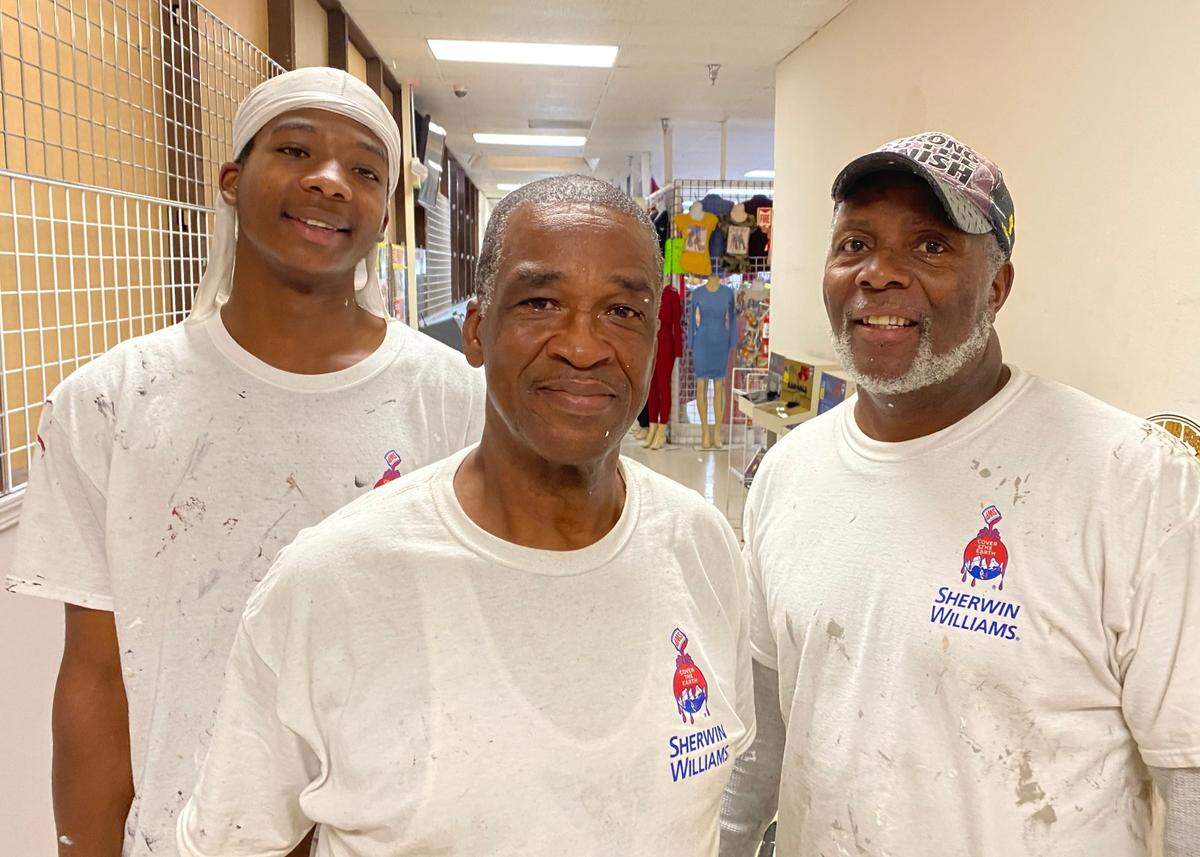
Painters with opinions
At a table inside the B&I Shopping Center on South Tacoma Way in Lakewood one recent September afternoon, three African American painters were on a lunch break. All had varying takes on voting.
Stimulus checks and eradicating the coronavirus were high on Charles Crittendon’s list of issues pushing him to vote. He wants a change in leadership.
Crittendon, 68, is politically active. He’s been making his own Joe Biden/Kamala Harris T-shirts at home.
He said he votes in every election.
“We got to get everybody to vote,” Crittendon said. “A lot of people just refuse to get involved. And then when things don’t go right, then they get bumping their gums.”
His co-worker, Kurt Carter, had a different take. He’s not voting in the election even though he’s registered.
“I don’t see any candidate qualified to make America great again,” Carter, 61, said. “I don’t think America has really ever been great. It’s too diverse, too segregated, too racist and too capitalist.”
Carter said America needs to turn to religion for answers.
Both men brought up social justice issues, particularly police brutality.
“It’s always been going on,” Carter said of killings of African Americans by people in authority. “They’ve been lynching Black people since slavery. And (Black) people are in prison for nothing.”
Taking in the conversation was Jasiha Christian, 17, the men’s paint-splattered protege. Too young to vote now, he has no plans to register when he turns 18. He thinks his vote will be ineffectual.
“The stuff that the O.G.s are talking about and the stuff that I hear about — presidents and campaigns and stuff — already I don’t really want to vote because it’s not gonna go nowhere and it’s not gonna do nothing different,” Christian said.
From in person to vote by mail
Tacoma Deputy Mayor Keith Blocker, 39, grew up in Philadelphia, where he voted in person.
When he came to the Pacific Northwest in 2006, he immediately became a convert to vote by mail — by necessity. It suited him, he said, because he’s a last-minute voter. Even when he’s on the ballot.
“I’ve got to vote for myself,” he said with a laugh. “I might need that one vote.”
But getting information by mail, even if it’s a ballot, seems outdated, Blocker said — especially for younger people.
“Getting mail means you’re responsible for something,” he said. “It’s not something younger people are used to.”
Increasing voter participation among Blacks starts with the recognition that the community is relational. It thrives on person-to-person contacts, Blocker said.
All too often, the Black vote is taken for granted, he said.
Politicians and others pushing civic engagement could be better served by reaching out to African Americans, Blocker said.
“I think that’s a missed opportunity, in terms of investing and engaging the Black community,” he said. “There’s usually no tailored messaging.”
It doesn’t have to be just in presidential election years. It could be for something as simple as a school bond vote.
“If you want more Black people to vote, go talk to Black people,” Blocker said.
It’s not about telling people how to vote, he said, but instead listening to and understanding the issues and needs of the Black community.
The Asian vote
Vote by mail has been a big hit in the Asian Pacific community, said Lua Pritchard, the executive director of the Asia Pacific Cultural Center.
“They like mail voting,” she said. “It beats having to stand in line.”
Some people discuss ballots with family members or at voting parties.
“Typically, mom and dad or grandma, grandpa, they kind of follow along with their children,” she said. “They educate them on different candidates.”
Making his voice heard
Kimsang Lor says he doesn’t like politics despite a years-long effort to get his Cambodian American community in Tacoma to participate in elections.
“I have come to the realization that it affects me even if I don’t like politics,” the voting activist said. “My only voice that can be heard is really my vote.”
Lor, 44, came to the U.S. when he was eight years old, a refugee fleeing his war-torn homeland.
Today, he works at the Asia Pacific Cultural Center, belongs to the Tacoma Refugee Choir and teaches Khmer language and culture to young people.
Vote by mail has become so woven into Washington’s electoral fabric that it never comes up in conversation, Lor said. Young people don’t know any other method and most older Cambodian Americans first registered after vote by mail went into effect.
Still, vote by mail is part of the registration pitch he gives, whether it’s to a relative or community member.
“Even with registration I just say it’s so easy,” he said. “Just go online.”
Immigration and politics
Like many Latinos, Asian immigrants can have a suspicion of government when it comes knocking on the door.
“There actually are folks that I know of, households that are terrified of the census,” Lor said. “They want to stay under the radar. They don’t want to get noticed.”
That fear includes registering to vote.
The desire for anonymity is often immigration related, Lor said. A family might have undocumented members.
Some might have a distant criminal past that includes only a single felony. But, it could be enough to get them deported. If that person is the family’s breadwinner, it can spread fear throughout the household.
“They don’t want to draw ICE,” Lor said. “They rely on these guys to bring in income.”
But immigration issues have also led some to become more civically active, Lor said. And it has spurred them to become citizens.
“They started applying more vigorously, regularly for citizenship when they qualified,” Lor said.
Today, the main part of Lor’s registration pitch is that individual votes can add up to make change.
“Do you want to make a difference for your community, even, for us immigrants?” Lor said. “Then vote, vote, vote, vote.”
Lor’s 88-year-old mother just registered in September, he said. The Cambodian Civil War refugee has been a U.S. citizen for 10 years.
In Cambodia, she lived under the repressive, totalitarian Khmer Rouge regime. Recent political winds in the U.S. have alarmed her, Lor said.
“My mom still has trauma from that era,” Lor said. “She sees what’s going on, she sees the news.”
Despite success with his mother, Lor hasn’t been able to persuade his 18-year-old nephew to register.
“I could tell he wasn’t interested, or he didn’t want to have the conversation,” Lor said.
Lor doesn’t pitch one candidate, party or direction to vote to the young people he teaches. Some of them are turned off by politics because they are too young to vote.
He tells them they can still have their voice heard.
“Those adults that live in your house rely on you for information,” he tells them. “They may not understand everything that’s going on, because of a language barrier. That’s on you to educate them. And through them, you will have your voice.”
Language and trust
Voting by mail doesn’t help if you can’t read the ballot.
That’s one issue that faces the Asian Pacific community when it comes to voting, Pritchard said.
Even registration materials cover only a handful of the dozens of languages represented at the center.
“There’s so many languages involved in our group,” she said. “We can’t be crying out for that all the time. We understand.”
Still, family members can help non-English speaking elders with their ballots — something that’s easier to do with vote by mail, Pritchard said.
Even with registration forms in different languages, some immigrants are illiterate in their own spoken language.
In Cambodia, the Khmer Rouge regime murdered intellectuals, teachers and professionals.
“The folks that immigrated over either feigned ignorance or they didn’t know (how to read and write),“ Lor said. “They were farmers.”
The horrific crimes committed by governments upon their own people can have lifetime consequences. Some countries coerce votes or enact revenge on those that vote against them.
“They still have that trauma, about the government possibly coming (for) revenge,” Lor said of elders.
“This is the reality of my Cambodian community.”
— These three stories were produced with the help of a grant from the Solutions Journalism Network.
This story was originally published October 21, 2020 at 6:00 AM with the headline "Black, Asian voters in Washington make gains but share hurdles to voting."