
Lone Democrat for Benton commission has outraised 3 Republican candidates
The lone Democrat in two Benton County Commission races next week has raised more than the three Republican candidates combined.
Just days from the 2020 General Election, Justin Raffa has reported $69,400 in contributions to his campaign since registering in mid-May with the Washington Public Disclosure Commission, or PDC.
By comparison, incumbents Jerome Delvin and Jim Beaver, along with newcomer Will McKay, have raised a total $57,000, their PDC filings show.
In all, over $75,000 could be spent in the campaign for the two seats on the commission.
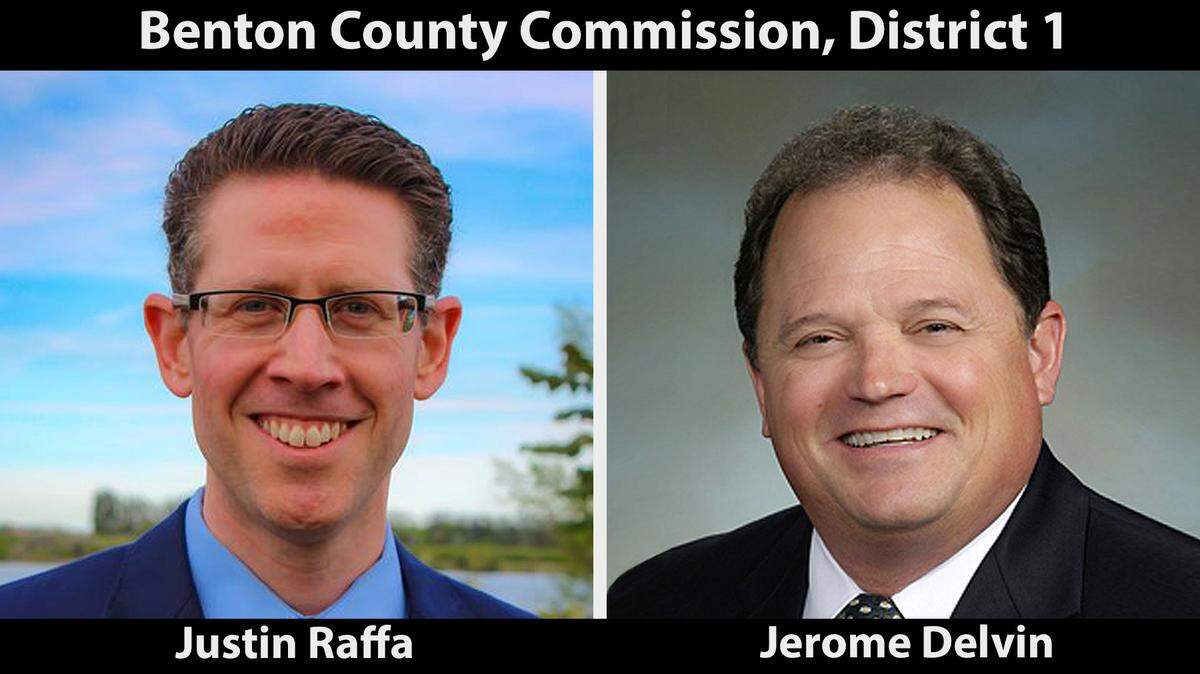
Raffa is trying to unseat Delvin in District 1, which covers Richland and West Richland.
Delvin has been a commissioner since January 2013 and is seeking his third term. He has raised $30,000 as of Friday, according to his PDC filings.
Delvin is an ex-Richland police officer and a former state representative and senator who served in the Legislature for more than 18 years.
Raffa finished about 1,600 votes over Delvin in the August primary, or about 7,900 to Delvin’s 6,300. But there were three other Republican challengers who drew about 9,700 votes away from the top two. Neither Delvin nor Beaver were endorsed by the Benton County Republican Party.
Raffa is a professional musician is the the artistic director of the Mid-Columbia Mastersingers and chorusmaster of the Yakima Symphony Orchestra.
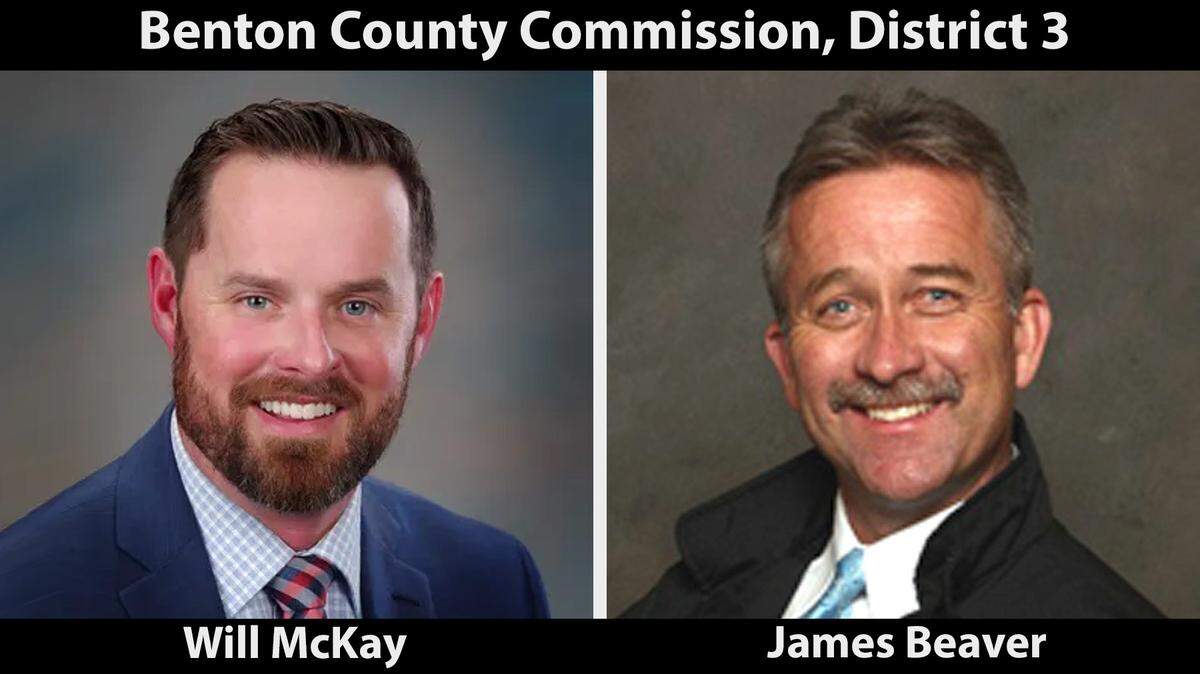
In the race for District 3, which includes Kennewick, Beaver is facing challenger Will McKay.
Beaver, the current board chairman, is going for a fourth term and has raised just $1,700. McKay’s campaign has brought in $25,200, the PDC shows.
Their race was so close in the primary that it triggered an automatic recount.
Beaver eked out a win to advance to November with 5,089 votes, 260 behind McKay’s 5,349. A third Republican candidate came in a close third with 5,042 votes.
Beaver has been on the board since January 2009, after serving on the Kennewick City Council for 18 years, including 12 years as mayor. He also was the longtime owner of Beaver’s Furniture.
McKay is a contractor with his own company, W. McKay Construction, and is co-owner of the indoor trampoline park, Max Air Tri-Cities.
Commissioners serve four years and make $112,000.
COVID-19 response
The coronavirus pandemic and the economic fallout from the lengthy emergency shutdown dominated campaign talking points for the top four candidates.
Delvin said he has been leading Benton County’s efforts to mask up and move forward with help from local health officials and the governor’s office.
It was only after the mayors and other city officials were deluged with constituent emails that they got onboard and “gave more voice from the Tri-Cities” to re-open.
“I didn’t sit around and wait, but I was actively using my contacts in Olympia to get us where we are at,” Delvin told the Herald’s editorial board.
Raffa admits being very critical of the county’s pandemic response, saying he did not see any action for nearly four months.
That was “too little, too late,” he said.
If he had been commissioner at the time, Raffa said he would have been more proactive and worked to get out in front of the issue. He’s confident that would have helped Benton County get to Phase 2 of the governor’s reopening plan much sooner.
McKay said he didn’t want to see the Tri-Cities defy Gov. Jay Inslee’s order, but wishes local leaders had made it clearer to the state that they know what’s best for this area.
He said really the choice should be up to the business owners and customers, and for those who don’t feel safe to just stay home.
“Let us control our counties the way we see fit. Shame on us if our hospitals get overran, which I believe they never did get overran,” McKay told the Herald’s editorial board.
He compared the different phases of the pandemic to the 9/11 attacks in New York City and the planes that hit the World Trade Center towers.
“Our first tower fell down when COVID hit us, and we lost all of our constitutional rights,” said McKay. “And now we’re at the second tower of possibly losing a lot of other things if we don’t come out and vote — for our president, for our governor, for all our local leaders.”
He later clarified that he feels it is unconstitutional to wear a mask, and said people have lost the basic part of their freedoms with the closures and restrictions.
Beaver said with his small-business background, he understands what it means not to have revenue coming in and the paychecks are due for employees.
He said Benton County kept pressure on the governor and the state Department of Health, but in the end they just had to follow the steps to advance through the phases.
“I didn’t have any real influence, if you will. ... I could have stood up and beat on a drum but that’s not going to solve anything,” said Beaver. “That actually makes the governor back up and say, ‘I’m not excited about Benton County, and I want to go a different path there.’”
Governance and relationships
McKay says he never considered being a public servant like his Kennewick councilman father, and admits giving Bill McKay a hard time for going to meetings at night and standing up for his constituents.
But when the younger McKay heard Benton County commissioners were not taking active steps to subvert or end the state’s stay-at-home order, unlike their peers in Franklin County, he decided it was time to step in.
Will McKay wants to see a better relationship between leaders of the two counties and four cities.
Beaver said the commissioners always try to work with their peers across the river, but in the end their first priority is to Benton County.
He added that he tries to do the best job he can and will continue to serve as long as he gets the support of the citizens.
Delvin said he is running for his “third and final term,” and wants to continue to see the county rise up from the current COVID state and resulting economic struggles.
He said he would not have run again if his heart was no longer in it.
Delvin said he’s been a full-time commissioner who answers the phone calls and emails, and “shows up all the time and gets engaged in discussions.”
But Raffa questioned if his opponent has “grown hardened to his position” over the last few years and has developed a personal disdain for working with Franklin County.
He said would bring “new eyes and new empathy to the role.” He described himself as a “collaborationist by nature” as both an artistic director and a choir director, and said a good relationship between two separate jurisdictions starts with the elected officials.
Sever bicounty court
Raffa accused Delvin of quietly working to influence the Legislature to dismantle Benton-Franklin Superior Court.
He said it would lead to a cost increase, questioned why it’s necessary when the current system has worked for at least 70 years, and suggested Delvin is supportive of the idea because of his “inability to work with other elected officials.”
Delvin noted that most taxpayers would never even know if the two counties split their Superior Court operations.
That’s because aside from a shared court administrator, each county has its own clerks, prosecutors and defense attorneys. The judges, bailiffs and court reporters are assigned to proceedings by administrators, and their costs are the same no matter which county they’re in, said Delvin.
“Just because it’s been that way for 50, 60, 70 years doesn’t mean the model still works,” he said. “I think both counties can stand on their own now.”
But Delvin added that he has got “bigger fights” right now and is not focused on revisiting the issue of dissolving the judicial district.
Beaver, who also was in on the conversation nearly five years ago, says he does not feel pressured to break up the court. He thinks the current bicounty system works well.
However, he does question the decades-old formula that has Benton County footing 70 percent of the Superior Court funding, while Franklin County covers 30 percent of the bill.
The formula originally was based on population, and now is calculated from caseloads, he said.
“If you’re going to be a partner in something, I think it should be 50-50,” said Beaver. “(Franklin County) has 50 percent of the vote, but only pays 30 percent of the cost. To me that’s not a partner.”
McKay does not agree with the idea of a split because he believes it will lead to increased costs.
He said if Beaver does not like the uneven percentages assigned to each county, he should have fixed that issue by now after so many years on the city council and then the county commission.