
8 WA bills could close ‘dangerous gaps’ for opening new sex offender homes
AI-generated summary reviewed by our newsroom.
- Tri-Cities legislators introduce 8 bills to tighten placement rules for sex offenders.
- WA bills would extend buffers, add notification steps and increase local input.
- Bills must leave committee by Feb. 4 or sponsors must refile measures.
Tri-City legislators introduced eight bills that add new rules to the placement of transitional homes for sexually violent predators.
But it remains unclear if any of the legislation will reach a hearing before the Wednesday, Feb. 4, deadline to have the bills out of their committees.
But Reps. Stephanie Barnard, R-Pasco, and April Connors, R-Kennewick, are calling on people to reach out to the state’s Community Safety Committee.
On the senate side, Sens. Matt Boehnke, R-Kennewick, and Nikki Torres, R-Pasco, have introduced proposals that mirror Barnard’s and Connors’s measures.
The wave of outrage and continued protests over a proposed Tri-Cities home for offenders to be released from the McNeil Island special commitment center prompted the action.
The Eighth Avenue home in Kennewick could house up to five men after they’ve served prison time for sex crimes and then were held at McNeil Island for mental health issues. They are transitioned to privately contracted housing in some communities after a panel decides and a judge rules that they are ready for release.
This would be the first in the Tri-Cities and only the fourth in Eastern Washington. There are many more in Pierce and King counties in Western Washington.
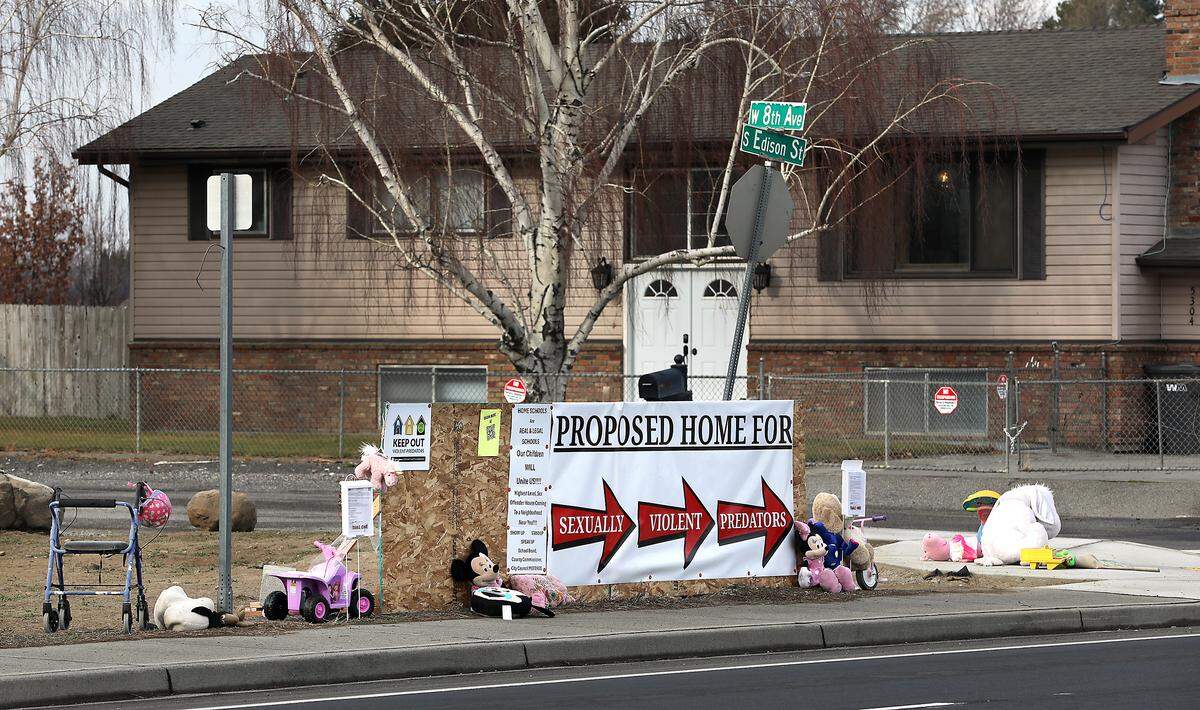
Connors and Barnard argue the current laws “do not sufficiently account for neighborhood density, proximity to vulnerable populations or meaningful local law enforcement input.”
“Their goal is to close what they describe as dangerous gaps in existing statutes that enable administrative convenience over the safety of Washington families,” the release continued.
The legislation covers a variety of concerns including keeping the homes out of areas with children, increasing the distance from schools and increasing the number of people who must be notified of that program being place in their neighborhood.
Connors said the bills could have an immediate impact on the Kennewick home because if this passed this session the changes could take effect before an offender is placed there this summer.
“People are angry because they feel blind sided and forced to accept a proposed placement decision by the state without their consent,” Connors said in the statement. “Neighborhoods with children should not be treated as dumping grounds for dangerous individuals who have committed some of the most heinous crimes imaginable.”

Barnard called the current process “opaque and dismissive of the very real concerns of our families.”
“These bills are designed to create hard, non-negotiable boundaries that DSHS cannot ignore to satisfy a contract,” she said in the release. “We are fighting to restore authority to our local communities and ensure the placement of sexually violent predators is subject to the highest level of scrutiny, respecting the sanctity of our homes and the safety of our most vulnerable citizens.”
Torres and Boehnke echoed those concerns.
“These individuals were civilly committed because courts determined they pose a serious danger,” Torres said in a release. “Releasing them into communities near schools, playgrounds and places where kids gather, without firm limits and strong oversight, puts public safety at risk.”
Barnard and Connors are calling on Democratic leadership to schedule hearings immediately. If the bills don’t leave committee before the Feb. 4 deadline, they would need to be introduced again next year.
The Senate bills are in a similar position. They are being referred to the Human Services Committee, but have not been scheduled for a hearing.
Connors told the Tri-City Herald the chair of the committee, Rep. Roger Goodman, D-Kirkland, was not interested in adding hearings on the bills.
The legislators are calling on concerned community members to contact the House Community Safety and Senate Human Services committees.

What is being proposed?
The bills appear to address some of the key concerns around the plans proposed home in Kennewick.
The home is about a half-mile away from Edison Elementary School, and concerned parents and grandparents say there are hundreds of children in the neighborhood.
Presently, the homes can’t be placed within 500 feet of schools and registered daycares.
Four of the bills would increase restrictions on the location of the homes:
• House Bill 2654 or Senate Bill 6340 increases the distance between the transitional homes and schools, child care facilities and recreational facilities from 500 feet to a half mile.
• House Bill 2687 and Senate Bill 6334 stops placement of the transitional homes next to homes with children.
• House Bill 2693 and Senate Bill 6336 stops the placement of the homes in neighborhoods with a high percentage of children living within 500 feet.
• House Bill 2694 and Senate Bill 6337 prevents the homes from being placed within direct line of sight of schools, child care facilities or recreational facilities.
Two more bills would make other changes:
• House Bill 2665 and Senate Bill 6317 requires the people buying property for a transitional home to provide written notification to the county sheriff, local legislators and county officials before the sale closes.
• House Bill 2698 of Senate Bill 6338 allows the county prosecutor to make recommendations about whether a home’s location is appropriate before any placement occurs.
The final two bills would add other restrictions:
• House Bill 2635 and Senate Bill 6301 requires the offender’s community corrections officer to be located within 50 miles of the offender home is located.
• House Bill 2696 or Senate Bill 6339 says the home needs to be owned by the same people running the program. For example, the home on Eighth Avenue is not owned by Joe Field who is expected to run the program. It is common for businesses to buy properties under an LLC to be used for the program because of legal liability issues.
Legislators have previously pushed to increase notification requirements in 2023 after a similar home was proposed for Tenino. The proposal created controversy and was eventually canceled. The measures never made it to a committee hearing.
This story was originally published January 29, 2026 at 3:42 PM.