Are Pasco’s new council districts fair to Latino voters? 1 group says no way
The city of Pasco’s recently-passed plan to redraw city council districts could be headed for a legal challenge.
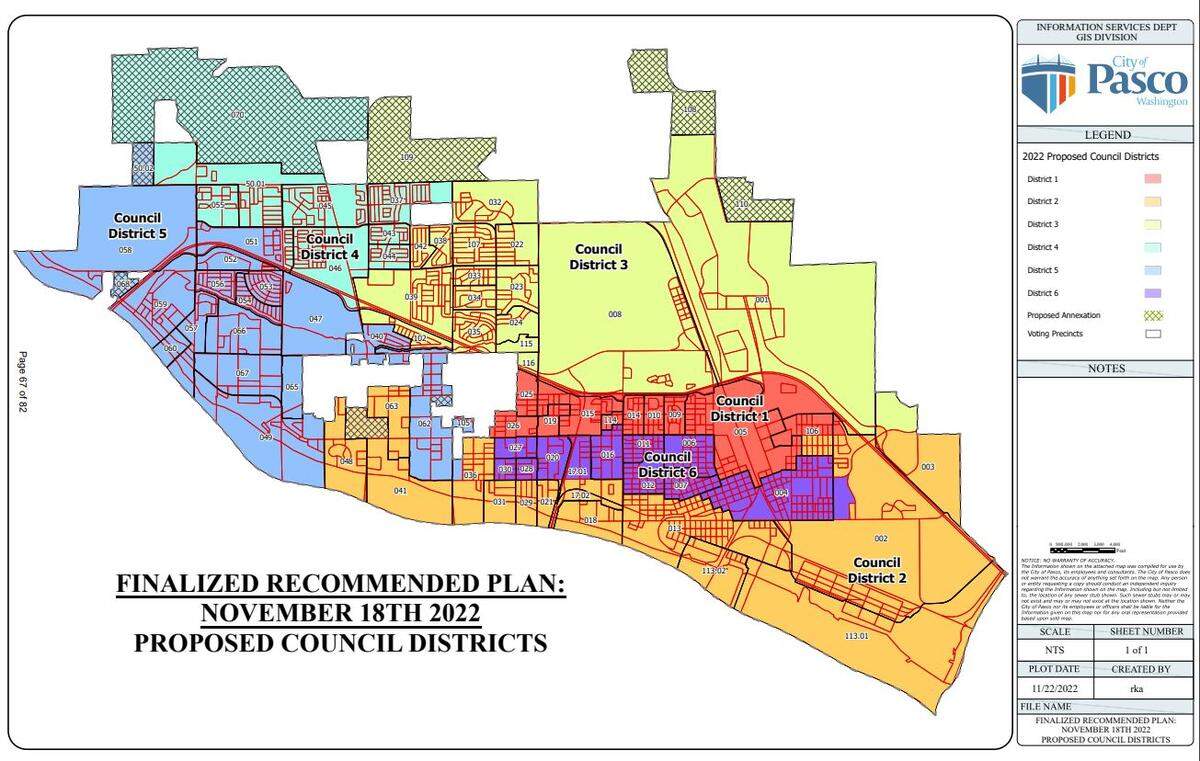
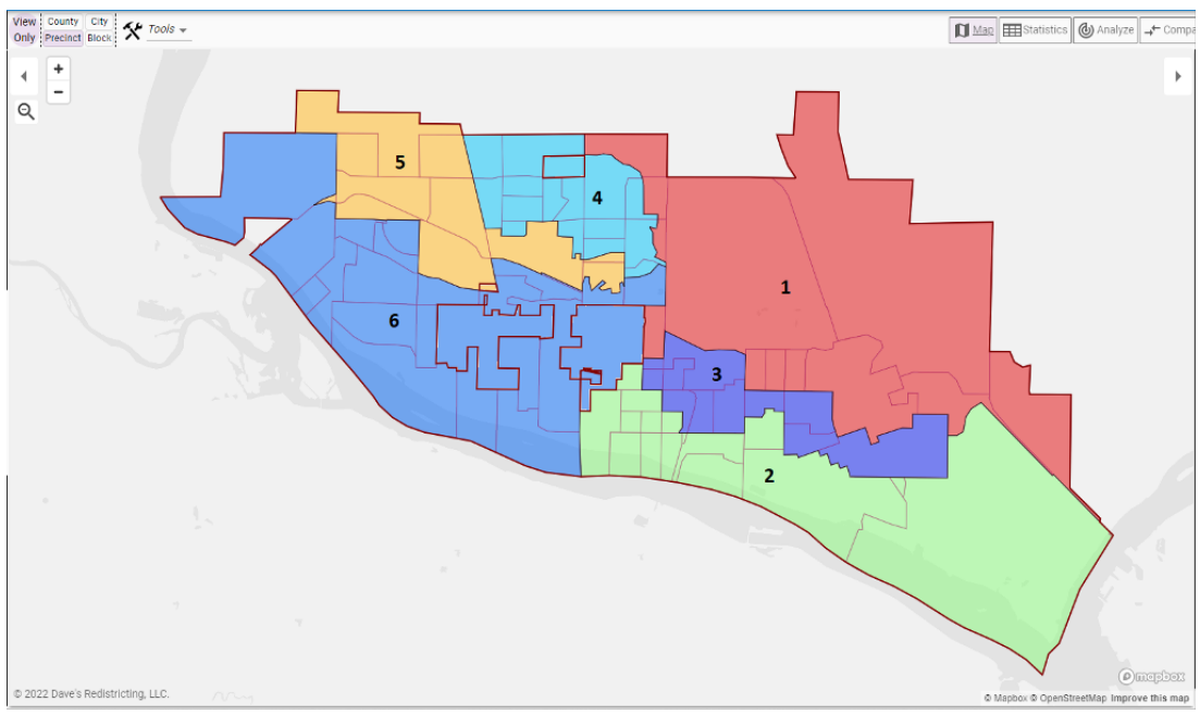
The Tri-Cities League of United Latin American Citizens (LULAC) says the map drafted by the city demographer and approved last week by the city council “dilutes” the strength of Hispanic voters and might not align with the Washington state Voting Rights Act.
That’s according to a letter sent by the Latino organization to the city on Dec. 5 — a day before the council voted adopted the map. The group also submitted its own map for consideration.
The Herald obtained the letter and map this week through a state Public Records Act request.
“If you go back to this map — where you’re really interrupting or diluting the Latino voting power, so we would (not) be able to elect someone who reflects who we are — then we would be in a position that we would have no other course of action but to file a lawsuit against the city,” Gabriel Portugal, president of Tri-Cities LULAC, recently told the city council.
The main issue at hand is District 2, which encompasses southeastern parts of the city.
Portugal and the league claim Pasco is diluting Hispanic votes by extending the district into whiter west Pasco neighborhoods. District 2 — one of three Hispanic majority voting districts — is the “most changed” under the new map, he claims.
“District 2 was the one that suffered the most as far as changes, and looking at District 2 — how it extends all the way from east to west, as well as brings down some precincts — it would dilute the vote. And that was very worrisome for us,” Portugal told the Tri-City Herald.
Under the city’s approved plan, about 51.6% of District 2’s voting-age population would be Hispanic, making it an “opportunity district.”
But under the league’s plan, 55% of the district’s voting-age population would be Hispanic.
Local governments are required every 10 years, at the conclusion of the U.S. Census Bureau’s decennial count, to redraw election maps in order to balance out population changes.
Between 2010 and 2020, Pasco’s population grew by about 29%.
The changes made to Pasco’s map will go into effect starting next year for Pasco City Council candidates running in August 2023.
Several of the current council members said they felt the redistricting process was not transparent and was rushed. The council didn’t see a proposal from city staff until late October.
Mayor Pro-Tem Craig Maloney said at the Dec. 5 meeting that the process was a “bloody nose for the city.”
“Ultimately, I don’t think this is the map I would have drawn if I were to be handed the demographic information and some crayons, but through some very rigorous questioning that I’ve performed and research that I’ve done, I am convinced at this point that the map meets the requirements of the law, and that is the key of the decision that we are to make today,” he said at the time.
The city council ultimately approved the map 5-0 at that meeting, with Councilman Pete Serrano abstaining from discussion and decision making.
Peter Morrison, the city’s contracted demographer, has written in reports that his map does not dilute Hispanic votes, is in line with federal and state voting rights acts, and strengthens Hispanics’ share of eligible voters in District 2. He also was involved in the city’s previous redistricting effort.
‘Rushed, inaccessible and hidden’
“The redistricting process that the city undertook this year has been rushed, inaccessible and hidden from the public until recently,” Portugal claimed in the letter to the city.
“The city has had almost two years to publicly workshop a redistricting plan, hold hearings and gather community input, but refused to do so. Instead, the city only notified residents of its intent to redistrict a few weeks ago, in late October 2022, just days before the redistricting deadline,” said the letter.
Portugal also argued that the city should have sought Voting Rights Act analysis from the American Civil Liberties Union of Washington state. City officials have previously noted that they’re not required by law to seek an external opinion, though.
“We’re saying that, in the spirit of working together, they should have reached out to the ACLU. We understand they’re not required. But in the spirit of working together, they should have reached out,” Portugal told the Herald.
Past voting rights violation
Pasco’s redistricting process comes with some special circumstances and plenty of baggage.
Its most recent map was approved by a federal court in 2017. Before that, the city had a different voting system that affected which candidates a voter could choose.
The city council was made up of seven elected officials selected by voters at-large — meaning across the entire city — in the general election. Five of the seven seats were chosen exclusively by council districts in the primary election.
Beginning in 2014, the city began a process to advocate changes in Washington state law that would allow “code” cities, like Pasco, the ability to shift to a district-based voting system that would allow only voters within their respective districts to select their council member.
The goal was to create a system that didn’t “limit the impact” of a growing base of Latino and Hispanic voters. About 56% of Pasco residents are Hispanic or Latino, according to 2020 U.S. Census data, and the Washington Votings Rights Act would later ensure that minority groups have “equal opportunity to elect candidates of their choice.”
The ACLU of Washington got involved in 2016, warning the city that its elections system was likely violating the federal Voting Rights Act.
The two entities proposed a “partial consent decree” to negotiate a solution to bring the city into compliance with the federal law.
In early 2017, federal Judge Lonny Suko supported a Pasco plan that led to the election system the city currently has today. The plan resulted in five new city council candidates elected to office that year.
Earlier this year, Pasco began work on redrawing its council districts in accordance with the 2020 U.S. Census data after there was a delay in releasing the numbers because of the COVID pandemic.
This story was originally published December 13, 2022 at 7:05 PM.