Some Hispanic leaders worry Pasco plan will undermine Latino voters. Deadline is looming
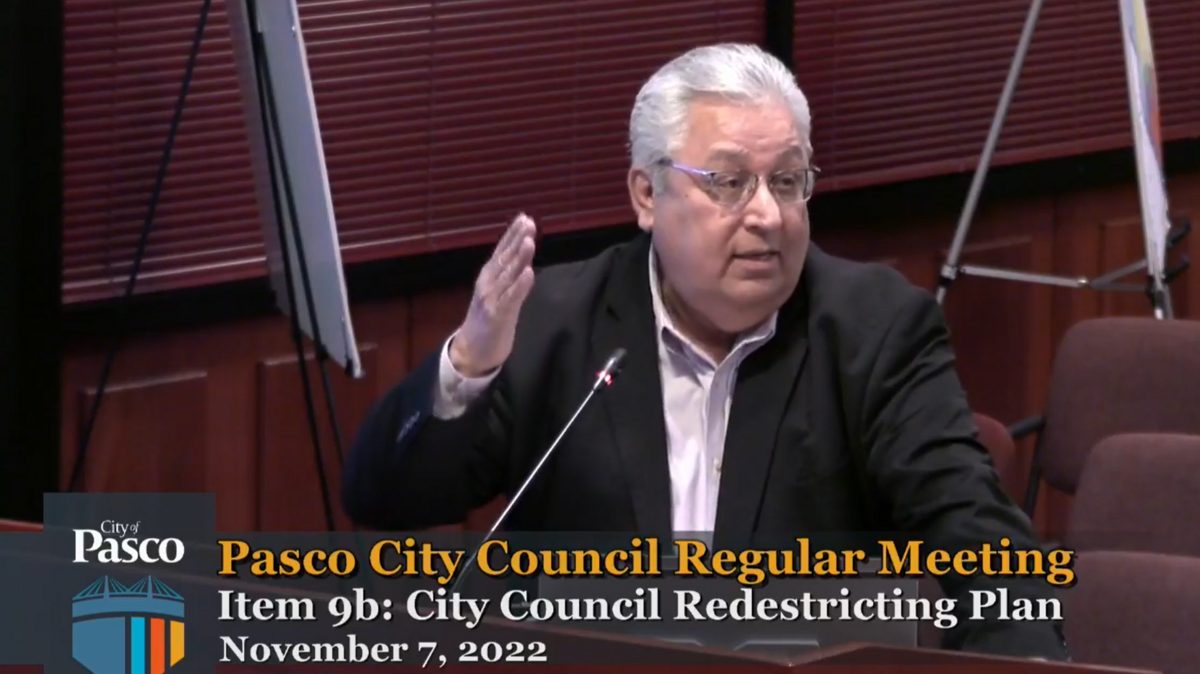
Some Pasco community leaders are criticizing the city’s new redistricting plan, raising concerns whether the new map dilutes Hispanic voting populations and if splitting up voter precincts is the right approach.
The Pasco City Council this week held its second and final public hearing on the redistricting plan. It expects to adopt the map on Monday, Nov. 14, before a mandated deadline.
Several people — including council members — have raised concerns over the city’s crunched timeline for accepting the map and opaque answers as to how certain boundaries were determined.
It’s possible a new version of the map could be released before the end of the week.
David Cortinas, president of the Tri-Cities Latin Business Association, questioned the legality of the map.
And he claimed that Mayor Blanche Barajas and the city council “gave away” one of the Hispanic community’s council districts when they appointed Irving Brown Sr., the council’s lone Black member, to a vacant seat.
“We had three (districts) that were in favor for Latinos to win and we won... And then, when it was time to reappoint one of the seats that was won by a Latino, it was given away to an African American,” said Cortinas, the publisher of the Hispanic newspaper, La Voz, who added that “some of my best friends are African Americans.”
Brown Sr. was appointed earlier this year to replace Nikki Torres in District 3, which encompasses northeastern parts of the city. Torres, a Latina, decided to run for an open state Senate seat in the Washington Legislature and left the seat 6 months into her first term.
There are currently two Latinos serving on the council: Barajas and Joseph Campos.
“Despite how many African American friends you have, this council appointed Councilmember Brown to that position based on the merits of his experience and his service to this community, and his district, and the fact that he ran,” Councilwoman Zahra Roach rebutted.
“And, beyond that, there was a Latina that was in that position who decided to step down that many of us supported for that position, so that’s unfortunate she made that choice to do so. That bears no burden on this council,” she continued.
Barajas said the current council “is representative of our city.”
City attorney Eric Ferguson re-emphasized that the focus of both the state and federal voting rights acts are to give racial or language minority groups an equal opportunity to elect candidates of their choice, not to ensure a person of a specific race or ethnicity gets into office.
About 56% of Pasco residents are Hispanic or Latino, according to 2020 U.S. Census data.
City, district, county and state governments are required to adjust voting boundaries every 10 years based on the most recent U.S. census.
The U.S. Census Bureau conducted their latest count in 2020, although the COVID pandemic complicated the federal agency’s timeline for releasing that data.
Precinct splitting, voter dilution
Some Hispanic leaders say there hasn’t been “ample enough time” to allow the public to review the new boundaries and give their opinion on the changes.
The city unveiled the new plan and map two weeks ago. Some council members said perhaps the city gave “too much oxygen” to recent debates on lifting its ban on retail cannabis rather than focusing more on the redistricting issue.
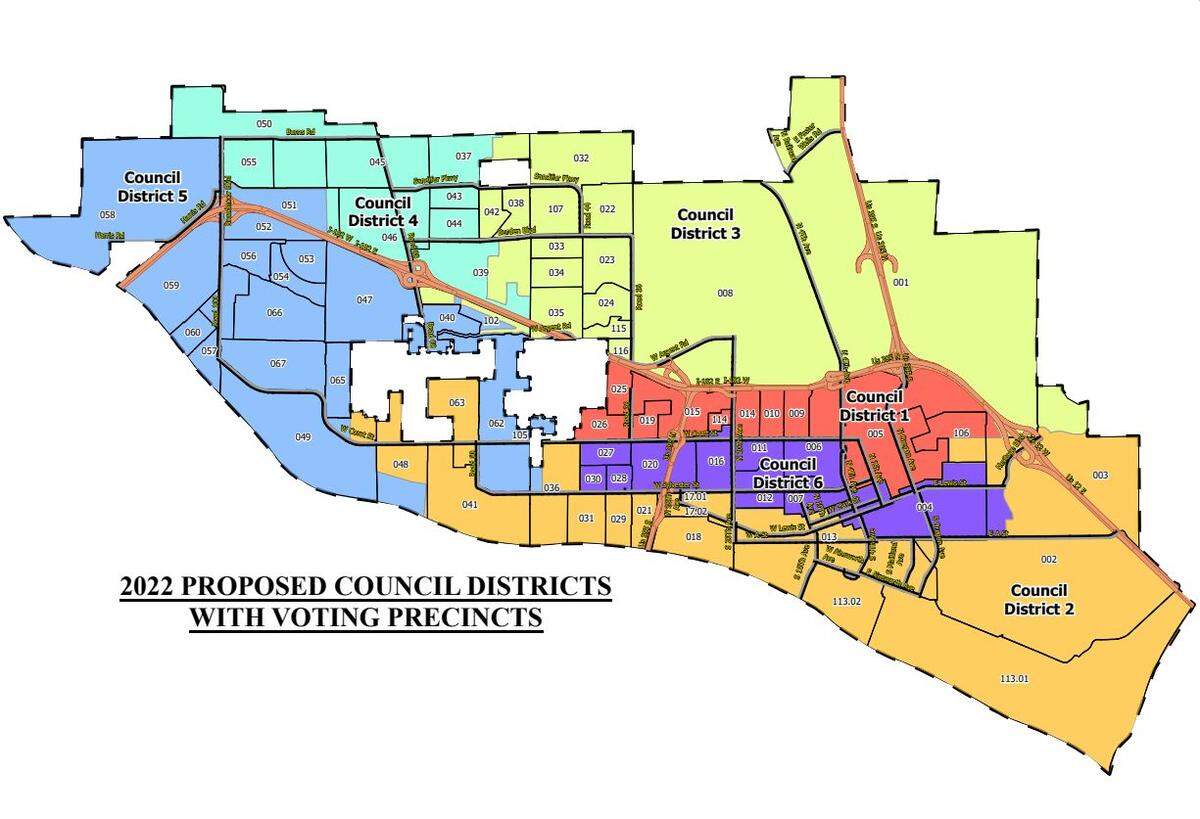
Gabriel Portugal, representing the local council of League of United Latin American Citizens, told the council that the new map appears to “dilute the Latino vote” in District 2 by extending it to include “high-density, white precincts” in west Pasco.
But not everyone agreed.
“There is no credible delusion of Hispanic voting strength in the draft redistricting plan that puts it at risk of noncompliance with the state and federal voting rights act,” said another community advocate Felix Vargas. He called the map “better” than the one that was drawn from a federal consent decree in 2017.
Hispanic voters make up the majority of voters in three of Pasco’s six council districts. The seventh seat on the council is an at-large position chosen by all voters in the city.
The plan as it’s drafted keeps together three districts where a majority of the voting population is Hispanic. Those are District 1 (58.6% are Hispanic and of voting age), District 2 (51.6%) and District 6 (58.6%).
Conversely, Non-Hispanic voters make up a three-quarter majority in District 3, District 4 and District 5.
The creation of these districts in 2017 resulted in a new and diverse city council being elected.
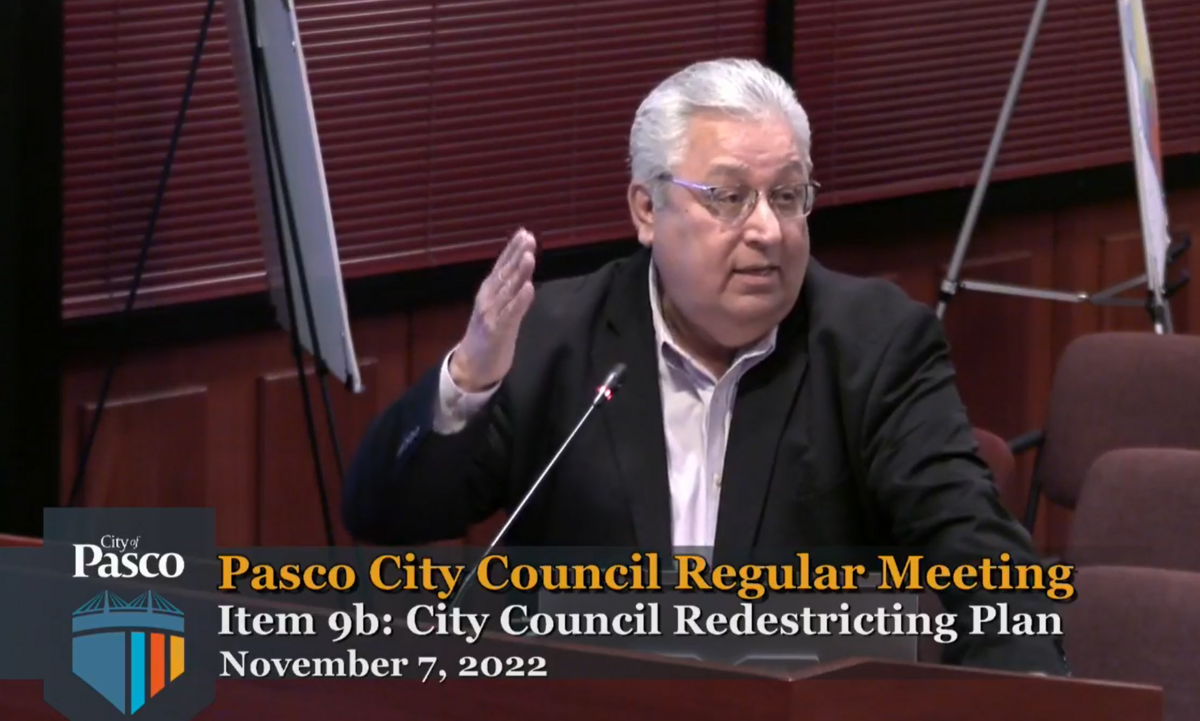
Cortinas said there were about a dozen areas on the new map where the new council districts divided or carved up existing voter precincts. That’s concerning, he said, because different precincts would vote for different candidates. He questioned the legality of changing splitting the precincts.
“I’ve never seen that before,” he said. “I’m not so sure if the ACLU would agree with a map where precincts are being divided.”
During Franklin County’s recent redistricting efforts, maps were drawn in a way that avoided dividing precincts.
“Typically, we prefer the districts do their best to use whole precincts, but we will administer our districts elections as they’re sent to us, provided they’re within the laws,” Matt Beaton, Franklin County auditor and chief elections official, told the Tri-City Herald.
But demographer Peter Morrison, who worked with Franklin County and the Pasco School District on recent redistricting and elections system overhauls, said voter precincts are largely regarded as “administrative boundaries,” and aren’t sacred and can be redrawn.
He only split precincts, he said, when it made sense to preserve Hispanic voting strength.
Pasco’s 2017 plan included split precinct boundaries, too, but the Franklin County Auditor’s Office asked the city to make minor adjustments to avoid splitting precincts in order to simplify the voting system.
Voting rights violations
Pasco’s most recent map was approved by a federal court in 2017. Before that, the city had a different voting system that affected which candidates a voter could choose.
The Pasco City Council included seven elected officials selected by voters at-large — meaning across the entire city — in the general election. Five of the seven seats were chosen exclusively by council districts in the primary election.
Beginning in 2014, the city began a process to advocate changes in Washington state law that would allow cities, like Pasco the ability to shift to a district-based voting system that would allow only voters within their respective district to select their council member.
The goal was to create a system that didn’t “limit the impact” of a growing base of Latino and Hispanic voters. About 56% of Pasco residents are Hispanic or Latino, according to 2020 U.S. Census data.
The ACLU of Washington got involved in 2016, warning the city that its elections system was likely violating the federal Voting Rights Act.
The two entities proposed a “partial consent decree” to negotiate a solution to bring the city into compliance with the federal law.
In early 2017, federal Judge Lonny Suko supported a Pasco plan that led to the election system the city currently has today. The plan resulted in five new city council candidates elected to office that year.
Earlier this year, the city of Pasco began work to redraw its council districts in accordance with the 2020 U.S. Census data.
Between 2010 and 2020, Pasco’s population grew by about 29%.
This story was originally published November 9, 2022 at 10:12 AM.
CORRECTION: This story has been updated to correct the percentages of Hispanic voter-age constituents in three proposed Pasco City Council districts. The correct percentages are 58.6% in District 1 and District 6, and 51.6% in District 2.