Pasco says goodbye to its city manager. He ‘opened doors’ to rapid growth and diversity
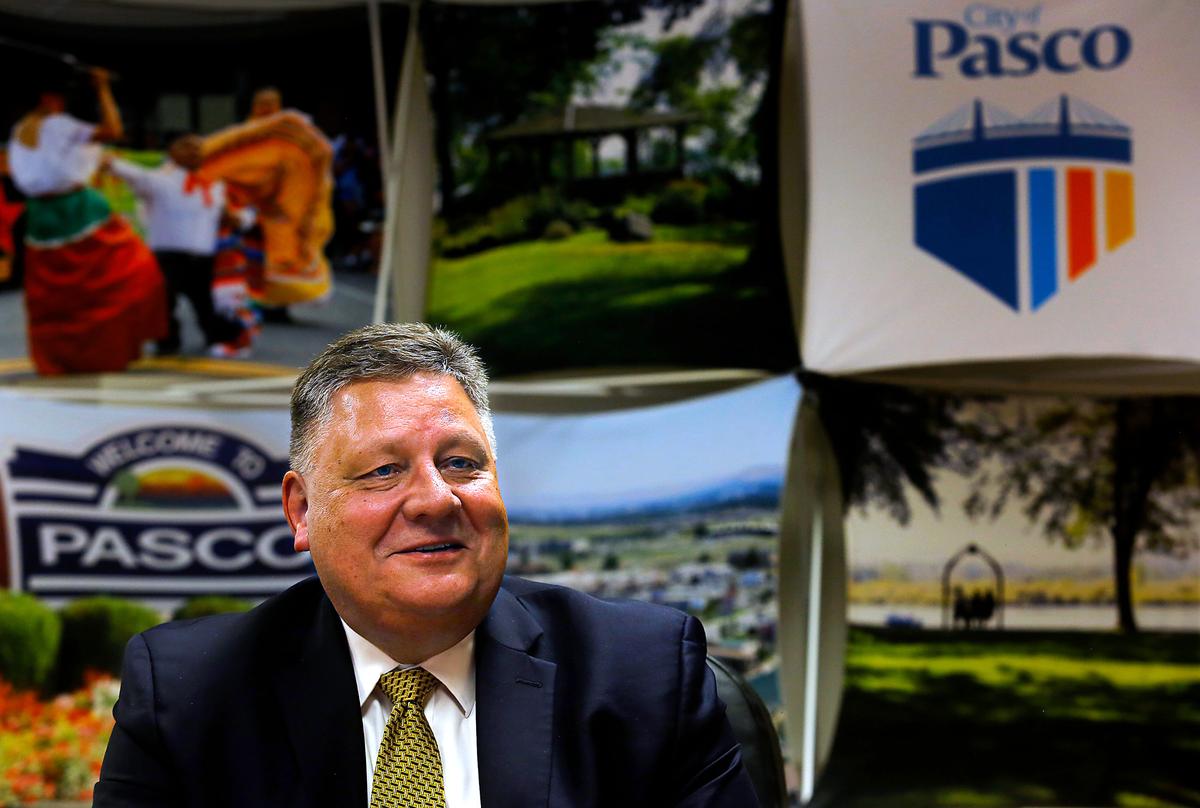
In a career that’s spanned more than four decades of city leadership, Dave Zabell likes to think he gave his eight best years to Pasco.
As Zabell prepares to retire on Monday, he took some time to reflect on his career, both the highlights and the moments that tested him as a leader.
Zabell came to the city of Pasco in 2014 as city manager, replacing Gary Crutchfield who had held the position for 30 years.
When he accepted the job, Zabell said he knew from the onset that one of his priorities needed to be bringing the city’s underserved Latino community to the table. Despite Pasco being majority Hispanic, the community had only one representative on the city council at that time.
Felix Vargas, chairman of community group of Consejo Latino, recalled meeting the candidates for the position and being impressed by the way Zabell had taken the time to bicycle around downtown to introduce himself to community members.
“We were invited to meet the candidates for city manager, and we looked at all of them,” Vargas said. “We walked away, saying if anyone is going to do what we think needs to be done, it’s that guy Zabell.”
Community and policing
Zabell was only in the position a few months when the city was rocked by the shooting death of Antonio Zambrano-Montes at the hands of three Pasco police officers.
Ultimately the officers were cleared of wrongdoing, but Zambrano’s death led to some of the largest protests the city has ever seen, and dialogue that resulted in significant changes to the city’s policing. The family also settled a civil lawsuit against the city.
Vargas said that the shooting led to community members coming forward with their own stories, and concerns about the way the community was being policed.
“We had a systemic problem in our view,” he said. “We protested, we did all the things that we could in a peaceful way to express our misgivings about this.”
Vargas said that throughout the process, Zabell let the police chief lead, but was there ensuring community members were being heard.
Vargas said that ultimately, that effort “moved the needle forward to affect positive change in the way the police department conducted itself.”
Speaking about the aftermath of the shooting, Zabell recalled that amid national protests over policing and the treatment of people of color, Pasco was able to have a real dialogue and work on changes at a time when other communities saw clashes because protesters felt they weren’t being listened to.
What struck him most was that, despite the pain the community was experiencing, they were able to work together. Zabell is quick to give others the credit, and praise the way people worked together. He’s just proud to have been able to help steward the process.
Vargas said it was a process that couldn’t have achieved the results it did without him.
“The changes that came from the dialogue that the community and the people had with the police department and Department of Justice ... resulted in a new police department in my view,” Vargas said. “They had new policies, new operational guidelines, when not to use lethal force and it brought about a new focus on procuring people who were bilingual. It effectively started a program of community engagement. All those had an involvement by Mr. Zabell.”
Vargas said their relationship was marked by early morning coffee meetings, and Zabell’s willingness to leave the door open for anyone who wanted to bend his ear.
“Eight years later, I can say that our confidence was well placed, we’re very pleased,” Vargas said. “He’s opened doors to the Latino community, and to my knowledge, never said no to anyone who wanted to speak to him.”
He hopes those conversations with Zabell over coffee will continue, just at a little more reasonable time in the morning.
Representation
Vargas also credited Zabell with helping the city navigate its voting rights lawsuit, which led to changes in the way the Hispanic community and Latinos are represented, and avoided a costly and drawn out lawsuit.
Before the lawsuit, members of the community felt they were being left out of the process by “At Large” general elections, that led to all white or nearly all white city councils. Now the council is made up of six seats voted on by their district in both the primary and general elections, and a single at-large seat.
“What that did, in effect, was change the dynamics in the city council,” Vargas said. We went from having a very old guard city council that was out of touch with the entire community to a council that truly reflected the population and the sentiment.”
“Again, had it not been for Mr. Zabell’s involvement in guiding the city to remain open to this option, to avoid the divisive and expensive route this wouldn’t have happened.”
Teamwork
In speaking with both Vargas and Zabell, both men brought these issues up as defining moments in Zabell’s leadership of the city, but Zabell was always quick to defer the praise to others.
That team that Zabell so readily praised is the reason he’s going to miss coming to City Hall every day.
“What I’m most proud of, one of the things I’m going to miss going into retirement … is watching people develop in an organization,” Zabell said. “Not being able to see that on a regular basis, not being able to watch people grow in their professional life.”
“You kind of get that bug for public service. It’s one thing to have a job, but once you figure out why you’re here and how you fit into the grand scheme of things, people are working with purpose at that point. I missed that most during COVID.”
When speaking of his team, and the community he has poured nearly a decade into, Zabell gets choked up thinking of not seeing them every day. He said that during the earliest days of the pandemic, that was the hardest thing to navigate.
“I’m proud to be a part of a team, starting with the council right down to our newest employee, that’s been able to deal with what’s come our way,” he said.
For him, running a city means being part of it. Having to tell people not to come to the table in person was incredibly difficult for Zabell, he said, because he knew that despite online options becoming more prevalent, there were people whose voices weren’t being heard.
“It was really depressing, not being open to the public was probably the most difficult thing,” Zabell said. “Not being able to offer that interaction in a meaningful way to the public was very difficult for me.”
Development
When Zabell first moved into his office in City Hall, the demolition work around the future Lewis Street overpass was beginning. Crews had just done demolition work in the blocks around where the bridge is now beginning to tower over the BNSF railroad line, at the east entrance to downtown Pasco.
A lot has changed in that time. Pasco has changed. It has grown, and its economy and development are thriving.
Key to that growth has been a focus on infrastructure. Zabell said that if Pasco is going to continue on its trajectory they have to be proactive.
Zabell said that in his 42-year career, he can’t remember another instance of a city and community being so closely aligned in their vision for growth and willing to take the steps they need to get there.
“When I first got here a big challenge was helping the council and public understand that a lot of our infrastructure was worn out, at the end of useful life,” he said.
“I think the city did an admirable job keeping up with all the growth in the ‘90s and early 2000s, but one thing with government is when we build a bridge or a road, we check that box and ‘Boom!’ we’re done, we never need to do it again. Sometimes we forget it wears out,” he said.
From roadways to water infrastructure, Pasco has not only worked diligently to update old infrastructure, but build out for the future. Right now all over the city there are areas of work being done to allow for continued growth, from the newly annexed area of northwest Pasco to industrial expansion.
Looking forward
Zabell doesn’t like taking the credit for all of that though.
What has meant the most to him is being recognized by the community for the work they’ve done together, including a lifetime achievement award from the Tri-Cities Hispanic Chamber of Commerce this past month.
“Those are pretty special to me. Coming here I remember that part of the job announcement was trying to unify the community,” Zabell said. “Trying to make sure that investment is equitable across the community and gearing our community to English and Spanish has been important to me.”
“Obviously there’s still tons of work to do, that we can all do, but I feel really good about that recognition for trying to unify our community and bring it together. I felt like this is the place where I can put all that experience and knowledge together, they got my best eight years.”
Now he’s looking forward to spending more time with his family, and being able to make it to his grandchildren’s games. He said it’s been hard to catch basketball games when he’s having to drive to Sunnyside after work.
He’s also hoping to spend more time in the mountains and backpacking.
“A little bit of traveling, but people ask if I’m going to Italy or Europe or Asia, but I kind of want to see the United States before I go traipsing around the globe,” he said.
About Zabell
Before coming to Pasco, Zabell was previously city manager in Fife, and deputy city manager in Yakima before that. He’d also worked as an administrator in Bothell and Marysville.
Zabell was in the Navy from 1976-79, serving aboard the USS Enterprise aircraft carrier before getting his public administration degree from Upper Iowa University and then a master’s from the University of Washington, according to Herald archives.