
Forest creature — sporting ‘goggles’ — flies across the Andes. See the new species

When a bird quickly flies across your view, it can be nearly impossible to look at its more subtle features.
People spend decades perfecting the ability to identify a bird by just a glimpse of their colors or even a call from a distance.
But what if two birds were so similar, they were thought to be the same species for at least a century — until now.
When a group of ornithologists, or bird researchers, from Brazil, Argentina and Houston were visiting various natural history museums in the Americas and Europe, they opened a drawer containing specimens of Trichothraupis melanops, a black-goggled tanager, according to a study published June 13 in the journal Zootaxa.
They chose that drawer “by chance” back in 2012, they said, and then immediately noticed that not all of the specimens looked the same.
Some of the birds appeared gray, compared with the “olive” color more commonly seen for the species, according to the study.
Then, when researchers compared the plumage, or feathers, around the eyes, they noticed that the specimens categorized from the Andes Mountains had a bit more “goggle” than the others.
The birds are native to the forests of South America, researchers said, predominantly in what is known as the Atlantic Forest in eastern Brazil and across the Andes Mountains.
Black-goggled tanagers live in a few isolated populations, as far as 5,500 feet above sea level, according to the study.
When populations are left isolated over long periods of time, mutations can cause the species to deviate from its known relatives, eventually leading to a new species altogether.
Here, evidence of this deviation was laid out for the researchers to see. These were two different species.
“After decades of stasis, we have witnessed a steady increase in the number of bird species recognized in the Neotropical region over the last few years,” researchers said. The increase is in part because of “museum discoveries.”
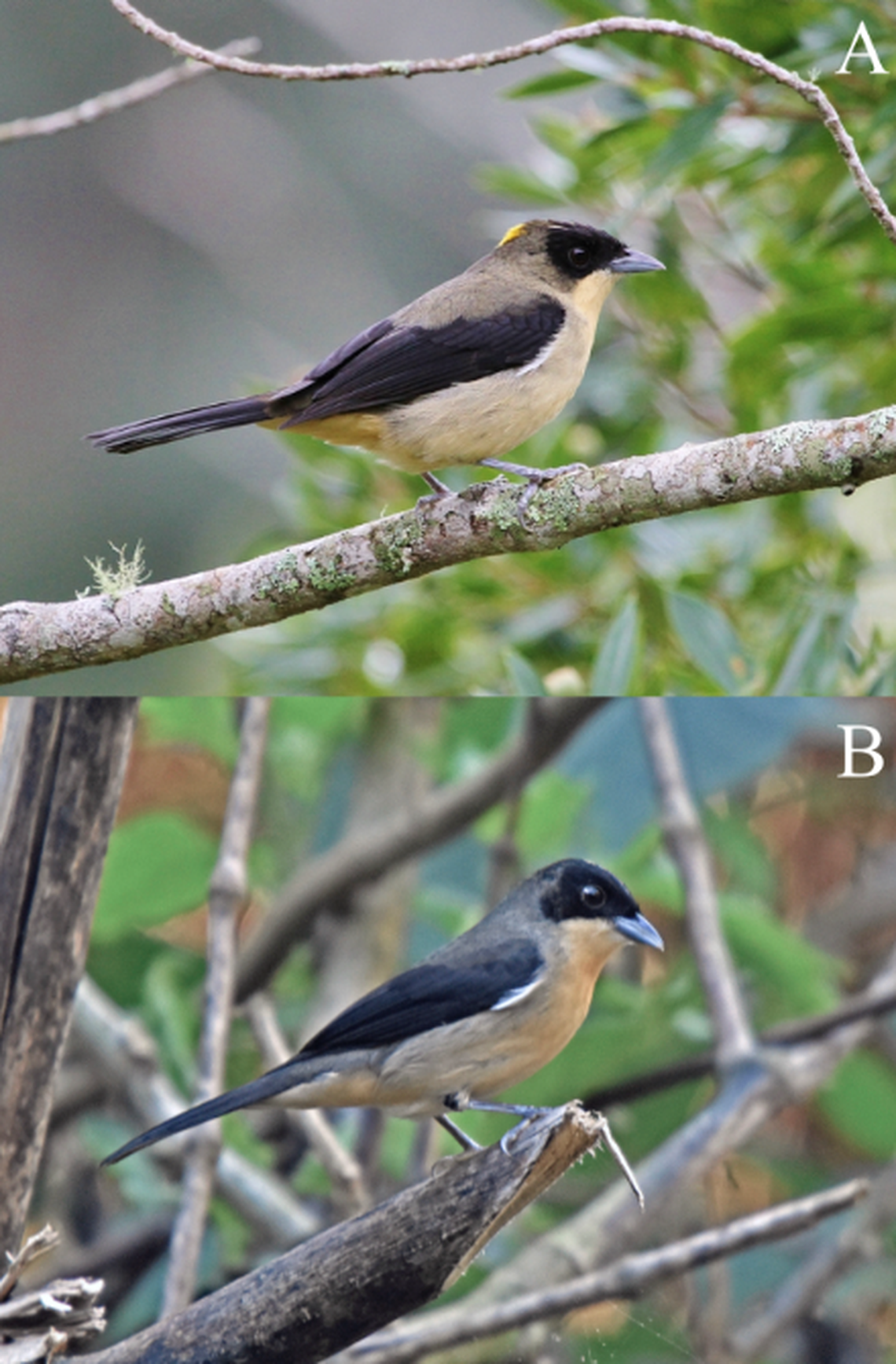
The new species, named Trichothraupis griseonota, is now known as the Andean black-goggled tanager, referencing their unique mountain population.
“The first and most noteworthy (trait) is the black facial mask,” according to the study. “In the new species, it includes the auricular (ear) region, whereas in T. melanops this mask is only a narrow line behind the eye, not reaching the auriculars.”
The under tail of the new Andean species is also a “cream color to buff-yellow,” much lighter than the “cinnamon” color seen on its Atlantic cousins, researchers said.
The color of the back feathers, “greenish-olive” in the Atlantic and gray in the Andean, were also noted by the researchers.
Another way to tell species of birds apart is their song.
There are not many sound recordings of the Andean species, according to the study, but researchers believe the species itself is not as vocal as those living in the Atlantic Forest.
Differences between the few recordings that were available again suggest two separate species.
The Andean black-goggled tanager is a “forest-dwelling” bird that lives on the eastern slope of the Andes in Peru, Bolivia and northwestern Argentina.
“The fact that these distinct lineages had not been recognized before is somewhat intriguing, given that Trichothraupis is a common species, abundantly represented in collections, which has been known to ornithological science since at least the early 19th century,” researchers said. “What is even more remarkable is that our initial 10-year-old insight that there might be two species came not from an encounter with an unfamiliar bird during fieldwork … but instead from the oldest, most traditional form of practicing avian taxonomy: the examination of (animals) in natural history museum collections.”
This story was originally published June 14, 2024 at 2:32 PM with the headline "Forest creature — sporting ‘goggles’ — flies across the Andes. See the new species."
