Deep-sea creature — holding ‘giant eggs’ — may be new species off Mexico. See it swim
As technology advances, fewer corners of the planet remain untouched.
But in the depths of the ocean, there is an entire world yet to be explored.
That’s why we have robots.
Researchers from the Monterey Bay Aquarium Research Institute, GEOMAR’s Helmholtz Center for Ocean Research Kiel and the University of South Florida joined forces on an expedition in the Gulf of California off Mexico’s west coast to search out the undiscovered deep, according to a June 11 news release.
Using a remotely operated vehicle, or ROV, the team could stay at the surface while the machine, armed with a camera, went to a depth of more than 8,000 feet, researchers said in a study published May 26 in the journal Ecology.
Looking around, something big and orangish-red came into the camera frame, followed by a wave of tentacles.
It was a massive squid, but something about it was different.
As the animal turned, researchers saw that she was holding a brood of “giant eggs” in her tentacles, according to the release.
A video of the encounter, recorded in 2015, was posted June 11 on YouTube.
“Squid play an important role in the ocean — they’re fierce predators and a vital food source for lots of animals, even humans — but we have a lot to learn about the squid that live in the deep sea,” Henk-Jan Hoving, a postdoctoral fellow at the Monterey Bay Aquarium Research Institute, said in the release.
The squid was carrying between 30 and 40 eggs, according to the study, which measured about half an inch across.
“The giant size of the eggs that were held for brooding by the gonatid female in the Gulf of California is unprecedented for squids,” researchers said. “Eggs previously documented for other gonatid squids typically do not exceed (one-fifth of an inch).”
The size of the eggs, and comparing the female squid to other known species, researchers believe this is a previously undescribed species belonging to the squid family Gonatidae.
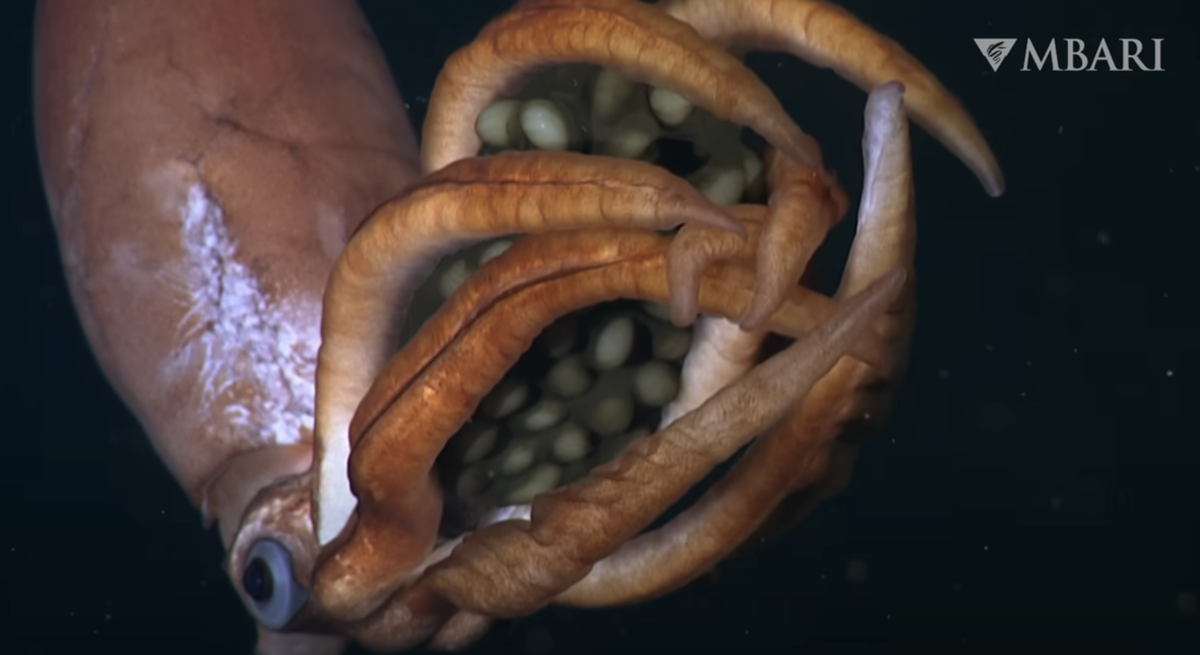
“Brooding takes a lot out of a mother squid. She won’t eat while carrying her eggs and ultimately dies after her eggs hatch,” Hoving said. “But her sacrifice improves the chances that her offspring will survive. It’s just one of the many remarkable adaptations that may help cephalopods to survive in the deep sea.”
Squids commonly leave clumps of their eggs on the seafloor, allowing their natural buoyancy to carry thousands of eggs into the water column, researchers said.
Because brooding eggs leaves a mother vulnerable, researchers believe there must not be a strong predator in the area that could attack, according to the study.
The Gulf of California is west of mainland Mexico and east of the Baja California Peninsula.
This story was originally published June 14, 2024 at 10:07 AM with the headline "Deep-sea creature — holding ‘giant eggs’ — may be new species off Mexico. See it swim."