
Officials dig in on $75M national clean energy research lab in Tri-Cities
Construction is beginning in Richland, Wash., on a new national center to speed the transition to clean energy and modernize the power grid.
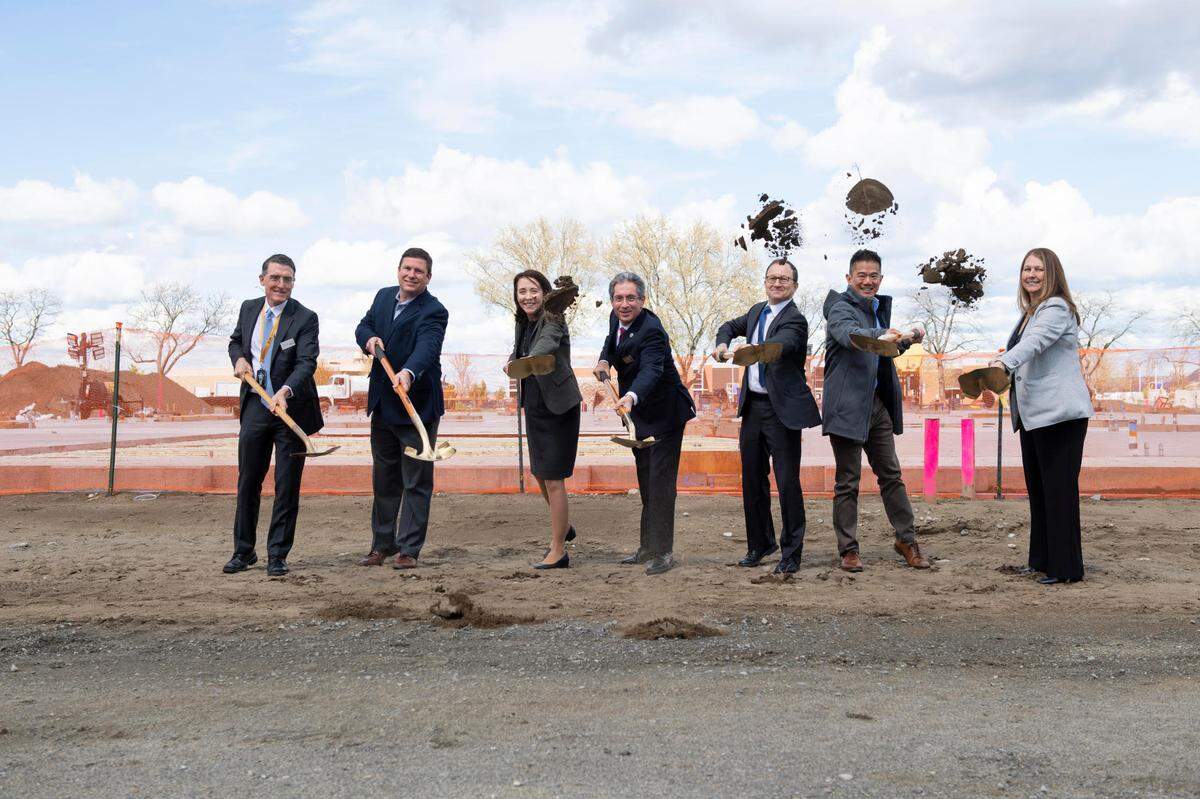
U.S. Sen. Maria Cantwell, D-Wash., was among those who used a golden shovel Thursday to symbolically break ground on the $75 million Grid Storage Launchpad on the Department of Energy’s Pacific Northwest National Laboratory campus.
The goal is to become the world’s premier energy storage research center, drawing in collaborators and building on PNNL’s expertise in grid energy storage, power grid modernization and improving battery performance, reliability and safety.
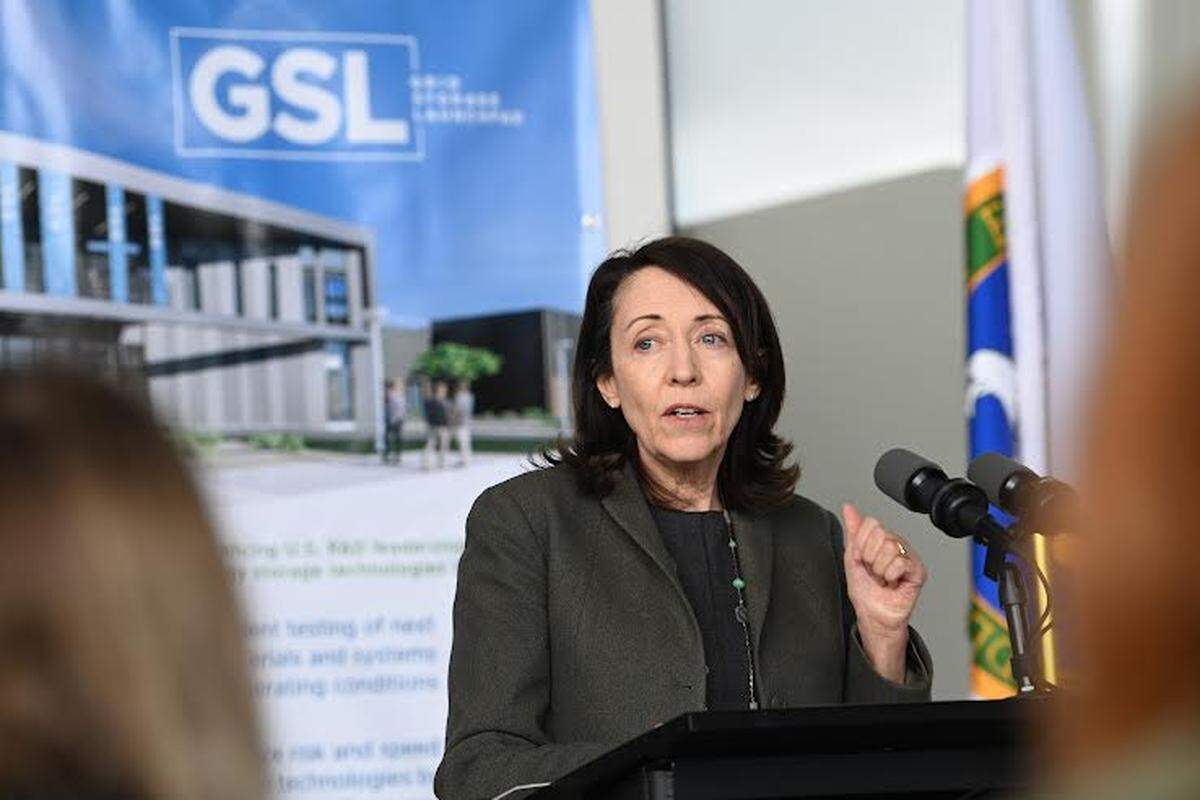
“More and more people now recognize that long duration, low cost grid storage is one of the milestones we need to meet in our nation if we are going to reduce our dependence on fossil fuel and we are going to have our grid of the future,” Cantwell said.
President Biden has set a goal to move the nation to 100% clean power by 2035.
But the nation needs ways to store solar power when the sun isn’t shining and wind power when the wind isn’t blowing for not just hours, but for days or weeks, at low cost.
It must be integrated onto the nation’s electric grid when it is needed to help make the grid more resilient, secure, reliable and flexible.
The new Grid Storage Launchpad sets the nation up for “so many wins,” said Energy Secretary Jennifer Granholm in videotaped remarks.
The faster the PNNL facility can help develop and put into use long-lasting and effective grid storage, the faster working families will have lower cost power, the faster good paying jobs can be created and the faster the planet can be saved, she said.
The launchpad is intended to increase the adoption of clean energy, including wind and solar, by improving battery storage technology that will work with a national power grid that is more resilient, secure and flexible.
“This national research center is designed for collaboration,” said PNNL Director Steven Ashby. “PNNL scientists will partner with top researchers from industry, academia and the national labs to tackle challenges associated with reliability, performance, cost and safety of storage technology.”
Researchers will work on accelerating the development of battery storage systems for the grid from basic materials to system components to validating complete grid-scale storage systems under realistic operating conditions.
The Grid Storage Launchpad will independently test new commercial-scale systems to give developers confidence they will perform as expected.
Researchers at the launchpad will develop rigorous performance specifications to guide technology development, helping reduce the risk for battery developers to speed development.
PNNL launchpad capabilities
Tri-Cities economic development officials are hoping that work done at the launchpad will spin off into local manufacturing of new grid materials and systems developed there.
PNNL was picked as the site for the national project by an independent review team in 2019.
A partnership of Harvey | Harvey-Cleary and Kirksey Architecture, both of Houston, Texas, is designing and building the launchpad, which is expected to open as soon as next year.
%20Renderings.jpg "Grid Storage Launchpad (GSL) Renderings.jpg")
The 86,000-square-foot facility will have 35 research laboratories and offices for about 105 staff.
It will have testing chambers to assess prototypes and new grid energy storage technologies up to 100 kilowatts under realistic operating conditions.
A laboratory dedicated to understanding fundamental material properties of storage technologies also will be included.
A visualization laboratory with audio-visual displays will be used to analyze the role of energy storage in future grid scenarios and develop design criteria for technologies.
Cantwell, Sen. Patty Murray, D-Wash., and Rep. Dan Newhouse, R-Wash., worked to get the $75 million needed for the project.
Washington state contributed $8.3 million from the Clean Energy Fund for scientific instruments that can provide insights into the behavior of battery materials in real time.
PNNL used the money to buy two state-of-the-art electron microscopes and a spectrometer that will allow researchers to view changes to battery materials as they charge and discharge.
This story was originally published April 22, 2022 at 5:00 AM.