
Bid proposal issued for new Hanford lab contract worth hundreds of millions
AI-generated summary reviewed by our newsroom.
- DOE released a draft request for bids for a Hanford nuclear site contractor.
- The contract for operating the 222-S Laboratory will expire.
- DOE is proposing awarding the new contract to a small business.
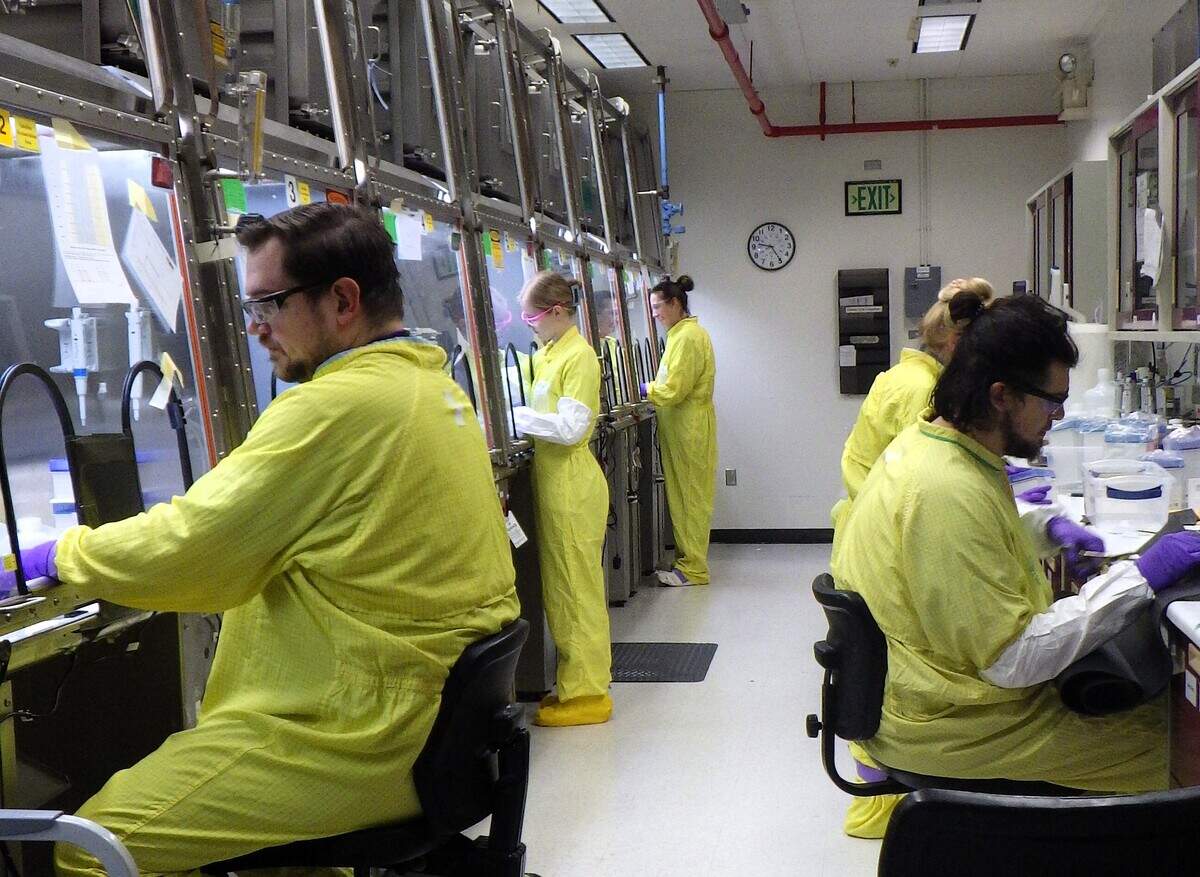
The Department of Energy has issued a draft bid request for operation of the Hanford nuclear site’s 222-S Laboratory, which has the facilities, equipment and staff to analyze high-level radioactive waste.
The current contract, which was valued at $389 million when it was awarded in 2020, is held by a team of two small businesses, Navarro Research and Engineering and Advanced Technologies and Laboratories International.
Navarro-ATL was awarded a five-year contract with two possible one-year extensions and has just one possible extension left before its contract expires.
DOE plans to again only consider small businesses for the new contract. The size limit is businesses with 1,000 or fewer employees.
By releasing a draft bid request — or draft request for proposals, as DOE calls it — industry and other interested parties can ask questions and comment to provide feedback to DOE before it issues the final bid request.
DOE is proposing another five-year base period for the new contract with two one-year option periods.
The contractor chosen would have its costs reimbursed and then receive additional incentive pay to provide the contractor a profit. However, the transition period to the new contract is proposed to be paid at a fixed price.
DOE is particularly interested in hearing comments by a July 31 deadline on particular topics, including these:
▪ Conflict of interest restrictions.
The proposed request for bids would prohibit the new contractor from also having a financial interest in the Hanford support services contracts back to 2009 through parent companies, affiliates or subcontractors. The Hanford support services contractor is currently Hanford Mission Integration Solutions, a joint venture of Leidos, Centerra and Parsons with OSC Technical Solutions as a primary subcontractor.
▪ Whether more than the transition period for the new contract could be paid with a fixed price rather than reimbursed costs plus incentives to provide profit.
▪ A look at the relative importance of evaluation factors.
The draft requests for proposals say key personnel will be the most important factor considered in picking a contractor, followed by the technical and management approach, and then past performance.
The current 222-S Laboratory contractor received good marks in its last evaluation, which was for fiscal 2025.
It received $5 million, or 95% of incentive pay available, and a DOE rating of “very good.”
Most work at the site is done by contractors and subcontractors hired by DOE. About 13,000 work for the site, as measured by active security badges.
ATL-Navarro has a workforce of about 400 employees.
As contracts expire and new contracts are awarded, most staff typically are retained under the new contract, although leadership often changes.
The Hanford nuclear site in Eastern Washington was used from World War II through the Cold War to produce nearly two-thirds of the plutonium for the nation’s nuclear weapons program.
Now the nation is spending more than $3 billion annually on environmental cleanup of radioactive and chemical waste and contamination left by past work.
The 222-S Lab is focused mostly on analyzing radioactive and hazardous chemical waste stored in underground tanks until it can be incorporated in a solid glass or grout form for disposal, including analysis of the waste to prepare it for treatment and then disposal.