
Work to finally start under disputed $45B contract for radioactive waste cleanup in WA
The Department of Energy is going forward with a contract award valued at up to $45 billion to a BWXT-led company to manage the Hanford nuclear site tank farms that store radioactive waste and the initial treatment of the waste at the site’s vitrification plant.
A 120-day contract transition starts Monday, Oct. 21, to Hanford Tank Waste Operations & Closure, or H2C, Hanford workers were told in DOE and contractor messages Tuesday.
The H2C contract is for 10 years, with some work ordered by DOE during that time likely continuing longer.
H2C is a newly formed limited liability company made up of BWXT Technical Service Group, Amentum Environment & Energy and Fluor Federal Services.
The contract of Washington River Protection Solutions, owned by Amentum and Atkins, is expiring after more than 16 years, including numerous contract extensions as DOE contract awards were challenged and as DOE changed course on its plan for a new contract.
The current tank farm contractor employs 2,800, including 340 under subcontractors.
Most of those employees are expected to transition to H2C, which will have the option of bringing in its own leadership, possibly including Carol Johnson, a former Hanford contractor leader.
Work under the new contract at the tank farms includes emptying waste from 149 leak-prone single shell tanks into 27 newer double-shell tanks for storage until it can be treated for disposal and eventually permanently closing the tanks.
Work also includes separating out the least radioactive waste from the mixture in the underground tanks to allow it to be treated for disposal.
H2C will employ additional workers to operate the Hanford Waste Treatment Plant, or vitrification plant, after commissioning of part of the plant is completed as soon as August 2025.
Bechtel National designed, built and is commissioning the portion of the massive plant that will begin treating waste for disposal.
Deadlines require the plant to start turning the least radioactive of 56 million gallons of waste now stored in underground tanks into a stable glass form next year. Treatment of high level radioactive waste is not required to start until 2033.
H2C community requirements
The new contract promotes “robust” community commitment and engagement, including support to site reindustrialization by the local community, DOE said on its first attempt to award the contract to H2C. Parts of the site are in Benton, Franklin and Grant counties.
H2C will be required to submit a community commitment plan to DOE, it said then.
The activities could include educational outreach programs, regional purchasing programs and other community support, DOE said.
H2C is expected to be required to subcontract 18% of work under its contract to small businesses, but those do not have to be Eastern Washington businesses, according to the original bid solicitation.
DOE has described the benefits that workers would receive under the new contract as competitive and comparable to current benefits.
H2C owners’ contracting history
Amentum already has a strong presence at Hanford as the owner of the current tank farm contractor with Atkins, leading the Central Plateau Cleanup Co. team and as the primary subcontractor at the vitrification plant construction and commissioning project.
BWXT was awarded the environmental management contract for DOE’s Savannah River, S.C., site in 2021.
Fluor is best known at Hanford for being the site’s main cleanup contractor from 1996 to 2008. It also is a partner with Amentum on the Central Plateau Cleanup Co. contract, which is responsible for most environmental cleanup at Hanford other than tank waste.
This is the third time DOE has tried to replace the expiring tank farm contract.
The tank waste is left from the production of nearly two-thirds of the nation’s plutonium from World War II through the Cold War at the Hanford nuclear reservation site adjacent to Richland in Eastern Washington.
Now about $3 billion a year is spent on environmental cleanup of radioactive and hazardous chemical waste and contamination at the 580-square-mile site.
Contract delays a concern
DOE awarded the tank farm and vit plant operations contract — the Hanford Integrated Tank Disposition Contract — to H2C in April 2023.
But the award has twice been challenged by the only other bidder on the project, Hanford Tank Disposition Alliance, or HTDA, which was formed by Atkins Nuclear Secured, Jacobs Technology and Westinghouse Government Services.
U.S. Judge Marian Blank Horn ruled against HTDA in both challenges. Her most recent ruling in September was followed by a motion by HTDA to reconsider her decision.
Horn held a hearing in the case Thursday in Washington, D.C., which was not officially recorded. But it appeared to give DOE confidence to move forward with the H2C contract.
In newly released documents explaining the judge’s September ruling against HTDA’s second challenge, she said “... it is in the public’s interest to have the agency (DOE) avoid the delays associated with another competition towards a new award decision.”
Delays could put legal deadlines for environmental cleanup at risk and slow progress to treat radioactive waste, some in leak prone tanks, for disposal, she found.
Among HTDA’s arguments against the H2C award was that DOE’s evaluation and analysis of which bid provided the best value for the taxpayer was arbitrary or capricious.
Horn pointed out that an analysis done to select the new contractor found that H2C offered “a clearly superior proposal.”
H2C’s price was as much as 12% higher than HTDA’s but H2C still offered the best value to the government, according to the analysis.
H2C offered the better leaders for the project and a slightly better management approach, which together would “likely exceed performance expectations significantly,” the analysis said.
The leaders for the H2C proposal have not been announced, but HTDA said in an earlier court document that it believed that H2C’s proposed program manager was Johnson.
Although her name was redacted in the court document, HTDA described Johnson’s work history as the project manager for the former Hanford river corridor cleanup contractor who retired from Hanford in 2013 and then was named president of Savannah River Nuclear Solutions in South Carolina. She retired from that job in 2016, it said.
3rd attempt to award contract
HTDA had argued in its first appeal of the contract award to H2C had let its required registration in the U.S. System of Award Management lapse for five months, including when it submitted its final bid for the contract.
Horn agreed and ruled in June 2023 that H2C was ineligible for the award and ordered it set aside.
DOE responded by asking for revised proposals and also changing federal acquisition regulations to say that a bidder must be registered when submitting an offer and deleting the requirement that registration be continuous through the time of the award.
At the end of February DOE again awarded the contract to H2C.
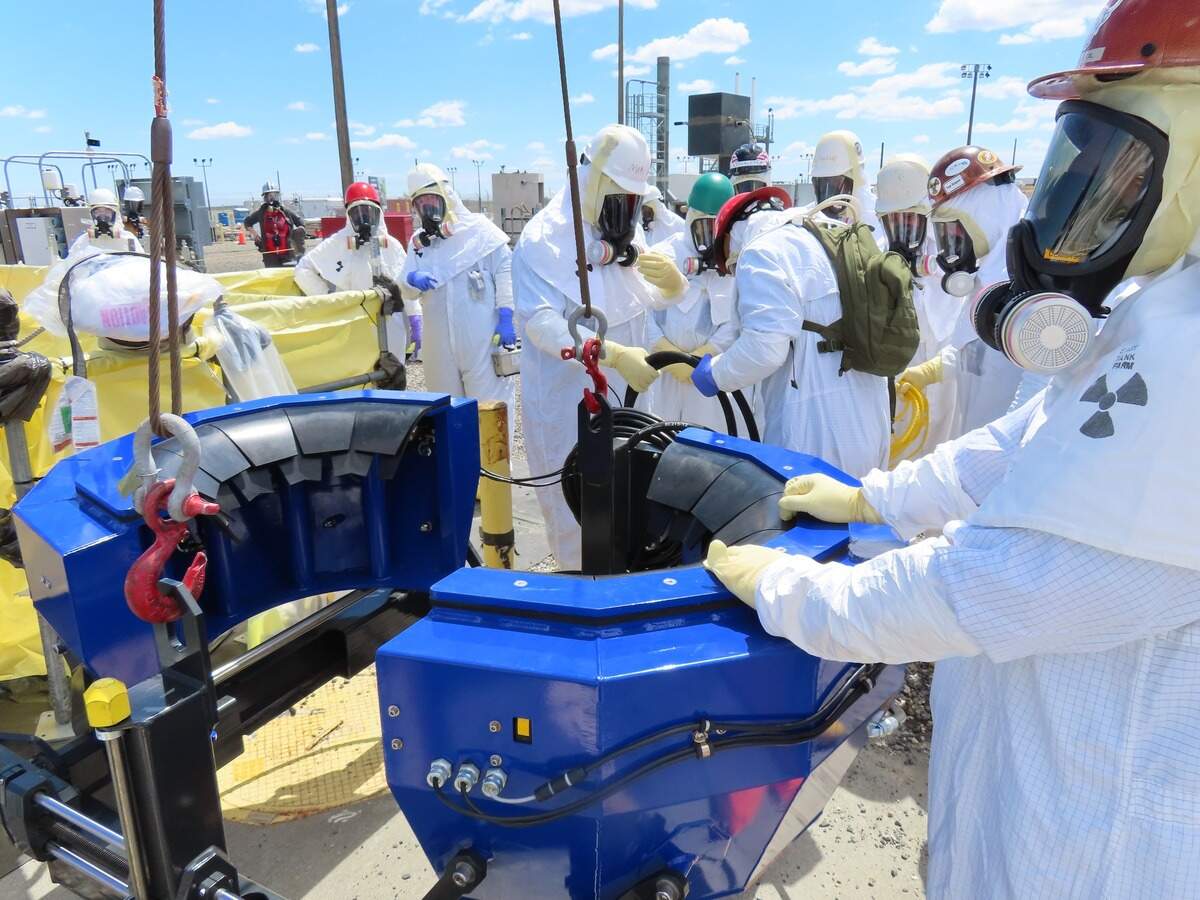
.jpg "7-7-22 3rd Sluicer install in AX-101 (1).jpg")
HTDA appealed again, saying that DOE unfairly changed the rules of the solicitation to award the contract to H2C for a second time, even though it believed that H2C and HTDA had similarly evaluated proposals.
This was the third time DOE has tried to replace the expiring tank farm contract.
In May 2020, DOE awarded a 10-year, $13 billion contract to manage Hanford tank waste to a team headed by BWXT and Fluor with primary subcontractors Intera and DBD. It did not include the vitrification plant work.
The GAO dismissed the appeals, but DOE voluntarily decided to address an issue raised in the appeal and canceled the contract award.
In February 2021, DOE announced that it would instead seek a contractor for both the initial vitrification plant operation and also the management of the tank farms.
This story was originally published October 15, 2024 at 4:50 PM.