
Tri-Cities to name street after Hanford cleanup advocate, community philanthropist
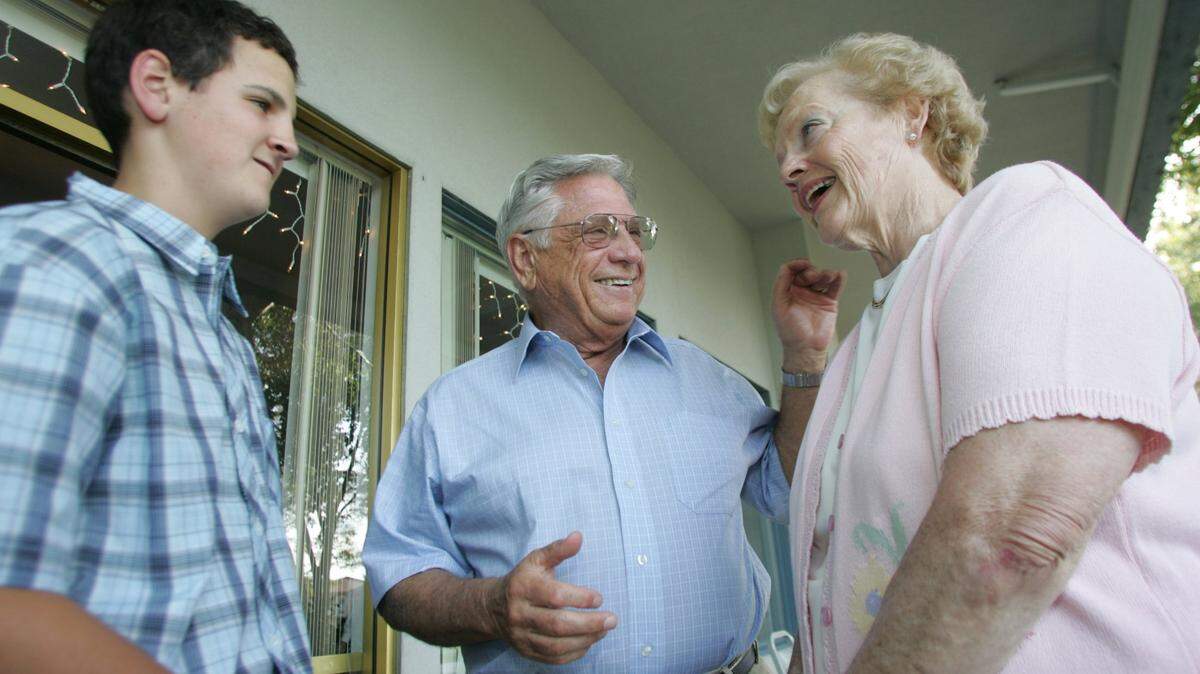
The Tri-Cities will remember one of its strongest champions of economic development and most generous donors to community causes, Bob Ferguson, on Thursday, July 6.
The Port of Benton will rename 11th Street east of George Washington Way in north Richland in his honor. The port owns the block-long street.
It will place a plaque in front of the new Hanford History Project building at 3251 Port of Benton Blvd., Richland, in a tribute at 2 p.m. July 6 at 3251 Port of Benton Blvd.
The public also is invited to a Celebration of Life Mass at Christ the King, 1111 Stevens Drive, Richland at 11 a.m. July 6.
Ferguson died Aug. 12 at the age of 89 in the Chicago area where he had been living near one of his daughters after suffering a serious stroke a year earlier.
Ferguson was the first chairman of the Tri-City Development Council, then called “the Tri-Cities Nuclear Industrial Council,” and was a champion for nuclear power, Hanford nuclear reservation site cleanup and economic development in the Tri-Cities.
A year before his death he donated $500,000 to Washington State University Tri-Cities to endow a faculty position in energy and environment as the first step toward launching WSU Tri-Cities Institute for Northwest Energy Futures.
It is envisioned by Washington Gov. Jay Inslee to become a center recognized globally for its innovation in developing clean energy sources and technology.
Ferguson said when he made the donation that he’d like to see a graduate degree offered for students studying the complex economic, political, technical and social issues of global climate change.
Previously the Ferguson family donated $100,000 to start the William R. Wiley Scholarship for WSU Tri-Cities students. The scholarship honored Ferguson’s friend Wiley, a former Pacific Northwest National Laboratory director, and is helping minority students studying science, technology, engineering, math or nursing in the Tri-Cities.
Ferguson also was a major donor for the Ferguson Education Center, a Montessori school, that opened in 2020 at Christ the King Catholic School in Richland. It was named for his wife, Catherine “Katie” Ferguson.
Ferguson started his career as one of the youngest reactor operators at the Hanford site’s now-historic B Reactor.
During President Carter’s administration he was the Department of Energy deputy assistant secretary, before returning to the Tri-Cities to manage construction of the Fast Flux Test Facility, a 400-megawatt research reactor at Hanford, according to a biography of Ferguson written by C. Mark Smith.
Next Ferguson was persuaded to assume the management of the troubled Washington Public Power Supply System working to build five nuclear reactors, but arrived too late to keep WPPSS from ultimate collapse, Smith wrote.
Ferguson would then become a Tri-Cities entrepreneur, serving as president of R.L. Ferguson & Associates and founding Nuvotec.
Ferguson and two other Tri-Cities business leaders, Bill Lampson and Gary Petersen, successfully sued the federal government in 2010, forcing it to resume the licensing review of Yucca Mountain, Nev., for disposal of the nation’s high level radioactive weapons waste and used commercial nuclear fuel.
In 2020 the three co-founded Clean Up Hanford Now, a Tri-Cities nonprofit advocating for accelerating cleanup at the Hanford site in Eastern Washington.
“He firmly believed Hanford needs to be cleaned up so it can get on with an energy mission,” Petersen said after Ferguson’s death.
Ferguson was interested not only in nuclear energy, but carbon sequestration, large-scale energy storage and hydrogen technology, Petersen said.
In Ferguson’s retirement, he wrote books, including on the nation’s nuclear waste issues.
This story was originally published June 21, 2023 at 9:22 AM.