
This could stop deadly Hanford crashes with wandering deer and elk
Hanford is trying a new way to help thousands of drivers avoid potentially deadly collisions with deer and elk.
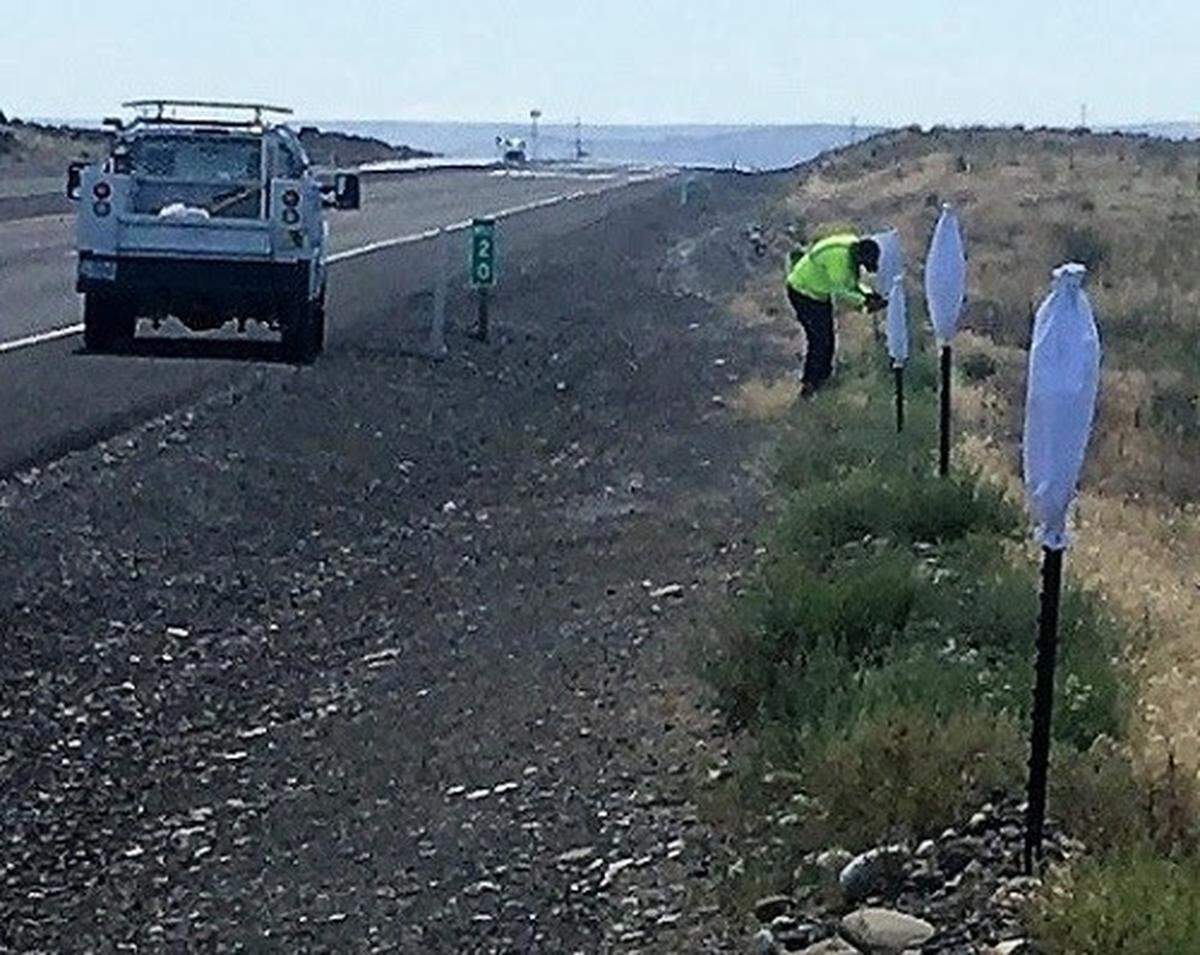
Drivers heading north from Richland on Route 4 South past the Hanford 300 Area will see roadside posts wrapped with white canvas bags every 50 feet.
The ghostly white sacks are a low cost addition that has shown success in other Western states for keeping deer and elk from being hit by cars and motorcycles.
“We’re optimistic that what has helped reduce deer and elk strikes in Utah and Wyoming will work here at Hanford,” said Jeff Frey, the Hanford Department of Energy assistant manager for mission support.
When lights shine on the white bags, making the bags look to other wildlife like a fleeing white-tailed deer, a sign of danger, according to Hanford officials.
A study done for the Wyoming Department of Transportation showed that posts draped with white bags reduced the number of car and deer crashes by 65 percent.
Animals generally waited until the bags were not illuminated by a passing car to cross the road, the study said.
The finding was an accident.
The study had initially covered some posts with reflectors to neutralize the reflectors as a control measure. But they proved more effective than leaving the reflectors uncovered.
The Wyoming study found it to be a cost-effective deterrent, with the bags costing about $1.50 each, which did not include the costs of labor and maintenance.
Deer, elk crashes at Hanford
Hanford contractor Mission Support Alliance started a pilot program with the white bags at nuclear reservation stie this month, installing them on stretches of roadway with a history of vehicles hitting deer and elk.
It will use cameras to track how well the method works over one year.
Collisions with wild animals are particularly a problem during the fall mating season, with about half of all crashes involving deer and elk on Hanford happening in October and November, according to Mission Support Alliance.
In November 2018 a Mission Support Alliance employee, Mikhaill “Mike” Stewart was heading north on Route 4 South toward the Wye Barricade when his motorcycle hit a deer near where the public road passes the Energy Northwest nuclear power plant.
He was critically injured and died.
Deer and elk were hit in at least five more crashes at Hanford that month, including three deer struck in the same stretch of Route 4 South as Stewart’s collision.
Drivers in rural areas of the Mid-Columbia, including on Highway 240 as it crosses Hanford, should be alert for more deer and elk starting in September.
During the fall the number of elk at Hanford can range from 375 to 700, according to the Department of Energy. And they can weigh 500 to 700 pounds.
Avoiding wildlife crashes
Mission Support Alliance and law enforcement agencies offered these tips for drivers in the fall when the risk of hitting deer and elk increases in Eastern Washington:
▪ Be alert for deer and elk at dawn and dusk.
▪ Scan the shoulders of the road and slow down if you see animals. Assume others are nearby.
▪ Increase the distance between you and the car in front of you to leave extra space for stopping.
▪ Be aware of other drivers braking, because it may mean there are animals near the road ahead.
▪ Honk your horn if you see a deer or elk on the road.
▪ Use a car’s bright lights when possible. Dim the brights if you spot a deer or elk to avoid blinding the animal and causing it to freeze.
▪ Don’t approach an animal that has been hit, even if it appears to be dead.
▪ The law requires any collision with a deer or elk off site be reported to local or state police.