Student attendance rebounding in Tri-Cities. But 1-in-4 still missing school
AI-generated summary reviewed by our newsroom.
- Student absenteeism dropped by 1,300 across Tri-Cities in the 2023-24 school year.
- Park Middle raised regular attendance from 58% to 63% through targeted outreach.
- United Way placing mentors in schools to address family barriers and absentee causes.
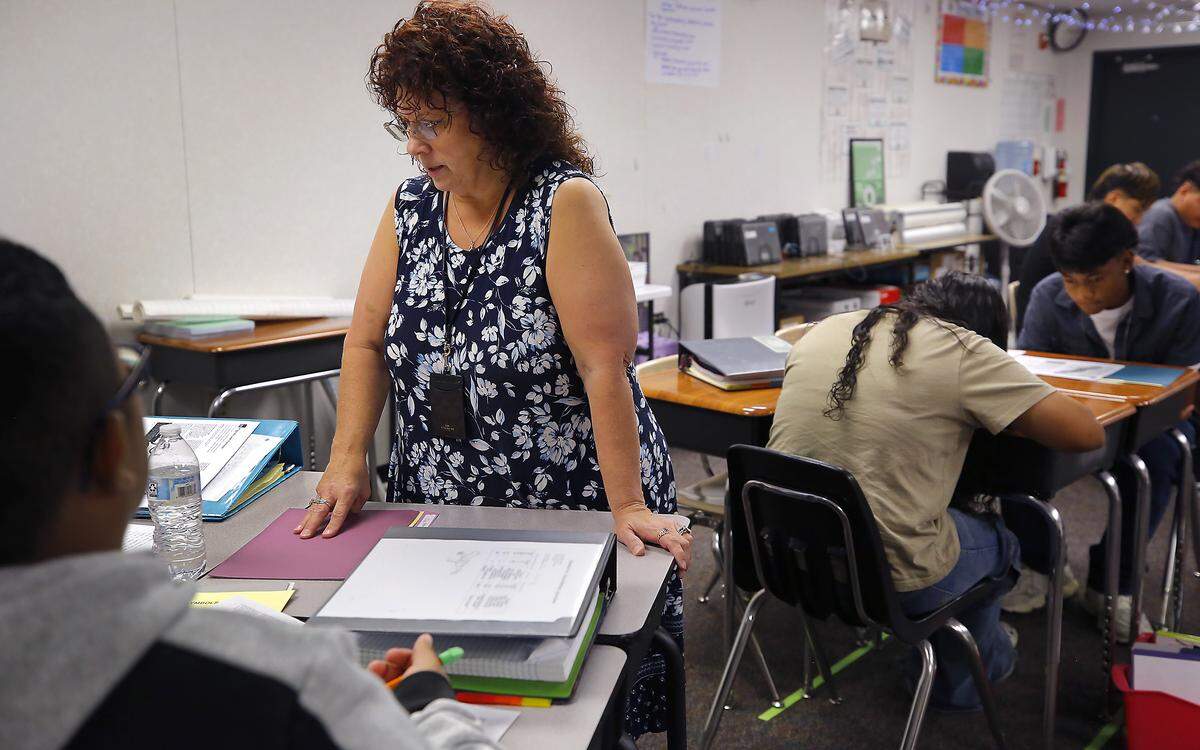
Park Middle School teacher Francine Hicks wastes no time getting her 8th grade students to work on a recent Monday morning.
But before students begin tackling work sheets and group projects, one thing needs to happen: She needs to tally her nest of students.
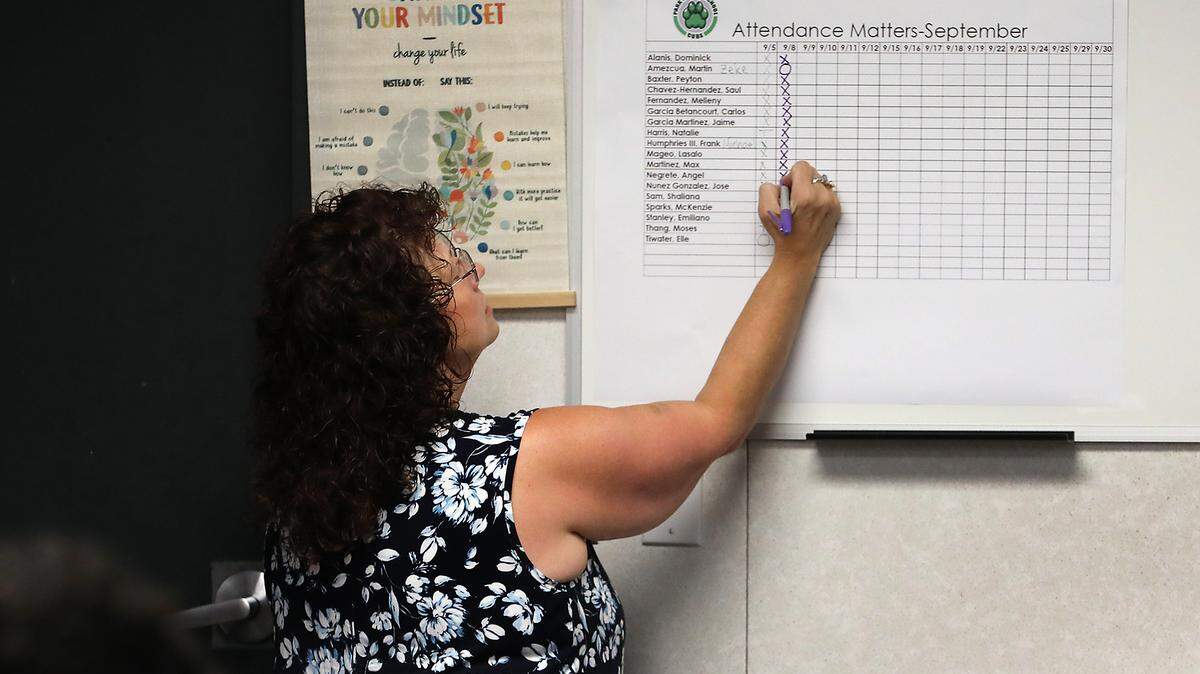
“Let’s see who’s here,” says the Kennewick English and history teacher while walking over to a paper chart with student names listed next to dates.
One-by-one, as she calls out names, she greets them with a “good morning,” a “thank you for being on time this morning,” and a “thank you for getting Chromebooks.” The column for 9/08 quicky fills up, mostly with “X”s for students who are here and a few “O”s for absent students.
One last student scurries into the classroom just as Hicks finishes calling out names. She puts a “T” inside the “O” she’s assigned to that student’s name, bids them a “good morning” and gives them a quick rundown in front of the class on what they’re working on.
“I like that it’s a visual representation for kids, that they can come in and see, ‘Oh, I’ve been tardy so many days this week — I really need to get to class sooner.’ Once they come back, if they’ve been gone for a while, it’s a good way for them to say, ‘I need work for this day, this day and this day.’ So it holds them accountable for work,” says the 22-year veteran teacher.
“And just the acknowledgement of, ‘Hey, I’ve made it all week,’ or, ‘Hey, I’ve made it all month.’ I really love it, actually,” Hicks added.
The poster is just one tool in a Swiss Army Knife that educators are deploying in recognition of Attendance Awareness Month.
And after multiple years of rising rates of chronic absenteeism, and countless efforts to lure students back to class consistently following a historic pandemic slump, Tri-City schools are finally starting to see results.
Year-over-year, about 1,300 fewer Tri-City students are considered “chronically absent.” Washington students are deemed so when they miss 10% — about 18 days — or more of the traditional 180-day school year.
In the latest 2023-24 data from OSPI, about 14,800 students — or more than 1-in-4 pupils from Kennewick, Pasco and Richland — were chronically absent.
Compare that to the more than 16,100 who missed school in the 22-23 school year, which was about 1-in-3 students. Those rates were 2.5-times higher than those seen in 2018-19, the last full school year with reliable data prior to the pandemic.
Schools like Park Middle are going the extra mile when it comes to addressing attendance gaps.
Because of that the school’s regular attendance rate has improved, from 58% to 63%. It’s progress, says Principal Shaun Espe-Amaya, but “still not great.”
“I feel like the efforts we’re making are showing improvements, but we’ll continue to do things and adjust to hit harder the importance of coming to schools and following up with kids faster when they’re not in school,” she said.
Teachers and staff here have tied regular attendance to relationship building.
There’s an emphasis on teachers building connections with students so they know they are missed when not in school, and they’ve also helped students with missed instruction and schoolwork so they don’t become stressed or overwhelmed.
“If you have those big gaps, it’s hard to get caught up,” she said. “There’s this anxiety that builds.”
They’re also making calls to home “in real time” when students are tallied absent.
Another tried-and-true initiative the school is using is the United Way of Benton and Franklin Counties’ “Attendance Matters” posters that Hicks demonstrated. Similar posters were used before the COVID pandemic hit.
Espe-Amaya says they plan to post these in each classroom at Park Middle after attendance roles are in a stable place.
United Way has placed mentors in six local schools — including Park Middle — to work directly with students who struggle to get to class. These workers will collaborate with families, schools and students to tackle root causes of absenteeism.
Communities in Schools Benton-Franklin also does similar outreach work in 33 schools around the Mid-Columbia.
Espe-Amaya says it’s all about finding out the story behind why a student is absent. Their mentor will be calling families, checking attendance posters and finding those creative solutions to get students in chairs.
One student in the past, for example, was furnished with a portable alarm clock after teachers found out they didn’t have a phone or smart device to wake themselves up in the morning.
Regular attendance crucial for learning
Attendance is a make-or-break variable when it comes to student achievement. Simply showing up is a game changer that can put your child on track for success.
The National Center for Education Statistics shows students who attend regularly have been shown to achieve at higher levels than students who do not.
For high schoolers, attendance is a key indicator of how likely they are to graduate. For kindergarten students, class time is crucial for building a knowledge base of skills they’ll use for years to come.
Espe-Amaya says regular attendance also builds good habits and life skills that transfer to the workforce.
Here’s how many students in each school district weren’t in regular attendance for the 2023-24 school year:
- Pasco School District: 31%, or more than 6,000 students.
- Kennewick School District: 26%, or more than 5,100 students.
- Richland School District: 25%, or more than 3,600 students.
While Pasco and Kennewick have cut their shares of chronically absent students by 5 and 4 percentage points, respectively, year over year, Richland remains at around the same level.
Across Washington, more than a quarter-million students did not regularly attend class during the 23-24 school year. That’s 27% of all students, and places it within the top 10 U.S. states ranked by chronic absenteeism.
But the state’s method by which it measures regular attendance does not take into account excused or unexcused absences. Truancy is a narrower definition of absenteeism that specifically measures days when students missed school and recorded an unexcused absence.
OSPI’s data also only includes students enrolled for at least 90 days throughout the school year.
There’s no one overarching reason why Tri-City students missed so much school during the pandemic.
Short- and long-term illnesses, rising mental health challenges, shifting expectations with remote learning, housing instability and transportation challenges remain often-cited variables.
Nationwide, chronic absenteeism was already on the rise before COVID hit, according to Education Week. In the Tri-Cities, it was on the decline.
While both local and national numbers are trending downward, they still remain elevated above pre-pandemic levels.
Several reports cited by Education Week suggest fewer than a quarter of the nation’s K-12 students were chronically absent from school in 2024-25.
Surveys also show students don’t think absenteeism is that big of an issue. And while parents often acknowledge absenteeism as something to be cautious of, they often undercount the days missed by their own student.
Espe-Amaya — who’s been at Park Middle since 1999 and its principal the last 10 years — says their student attendance was strong until COVID threw a wrench into things.
They’ve spent a lot of time in recent years talking with parents about the importance of not missing out on too many school days. Most were unaware of the impacts.
But students can also sometimes be apprehensive about returning to school, especially if its been a long absence and they come back to be greeted to foreign concepts.
In those instances, teachers check in with students multiple times a day in order to get them caught up. Sometimes, that also includes the implementation of an attendance plan and additional resources for the student or family.
Attendance Awareness Month
United Way of Benton and Franklin Counties suggests parents and guardians do the following in order to improve their child’s attendance and their potential for academic success:
- Establish strong morning routines
- Schedule appointments outside of school hours when possible
- Reach out to schools for help when challenges arise
- Talk to their children about why attendance matters