Richland ‘pausing’ paraeducator layoffs announced this week. Here’s the new plan
The Richland School Board says the district will hit pause on plans it had made this week to eliminate basic education paraeducator hours, which would have impacted 34 positions.
In a Wednesday evening letter to staff, the board wrote that it and Superintendent Shelley Redinger were “developing a plan to align expenses with our available resources.” This comes after administrators delayed phone calls it planned to make Tuesday to affected employees.
The plan would have had a direct impact on education since paraeducators — among the lowest-paid, highest-impact district employees — work one-on-one with students and teachers to support instruction and learning. Many have characterized these workers as the “backbone” of the classroom.
“We understand the impacts staffing reductions have on a community like ours, so we are pausing the current request to reduce paraeducators while we formalize a comprehensive plan,” the board wrote. “The district will continue to evaluate in greater detail where these changes can be made, with the least impact on student learning.”
Richland School District has found itself in a fiscal quagmire this school year as its schools reel from rising student needs, insufficient state funding and climbing costs to deliver students an education.
It’s concerns surfaced in early October, when principals were told to implement an indefinite spending freeze in their buildings. Redinger later wrote in a letter that the district planned to operate the 2024-25 school year on a general fund balance of 0.5%, when it normally tries to operate on a 4% balance.
Over the summer, the school board approved a budget that included $233 million in expenditures and $235 million in revenues. An overwhelming majority of that goes directly to student instruction, and in turn 86% of it exclusively to staff salaries. The district had mitigated substantial cuts during the spring budget season by reassigning some teachers and trimming some programs.
Though sudden and jarring, Richland’s financial predicament is not unique.
School districts across the region and country have made steep cuts in recent years with rising costs to materials and operations, higher insurance costs, lower enrollment, and a “spending cliff” caused by one-time federal dollars dolled out during the COVID pandemic.
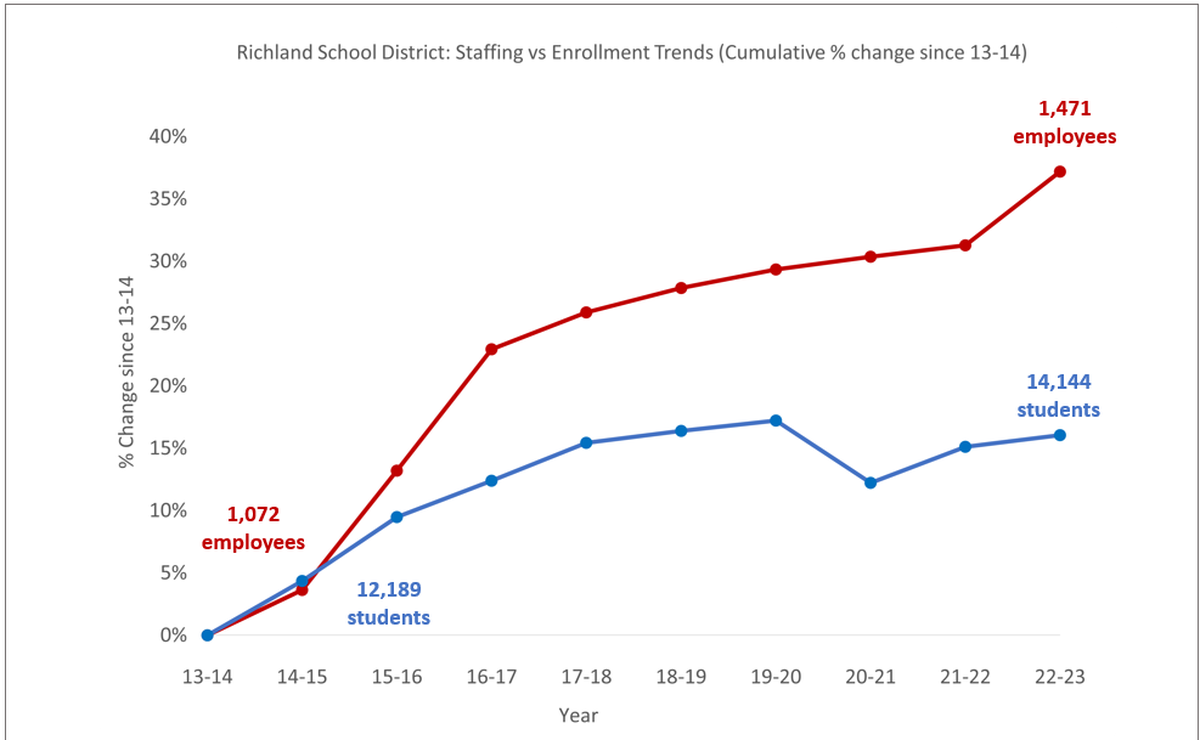
Some districts, Richland included, even continued to hire more staff as enrollment fell or plateaued during the pandemic years. Enrollment FTE is tied directly to funding school districts receive from the state.
But some say only the Washington Legislature can fix this spending discrepancy to ensure the state’s quality of education doesn’t slip.
Compared to 2018, the Legislature is sending out $1,000 less per student today, when adjusted for inflation, said Katy Payne, spokesperson for the Washington Office of Superintendent of Public Instruction.
“OSPI is aware that Richland School District is among the school districts currently dealing with financial instability,” Payne said.
“RSD is not alone in this incredibly tough situation, and the school board will unfortunately have to make difficult decisions in order to keep the district’s budget in balance. Making these hard decisions are how the district is able to keep their budget in balance, though there is no question that it has an impact on the school community,” she continued.
Payne said districts that submit a negative fund balance are required by law to request “binding conditions” from OSPI. Those are essentially a list of criteria the district needs to meet with increased scrutiny and oversight from the state education department.
It’s a process rarely used, Payne said, though there are currently six districts on binding conditions. Payne said that speaks to the critical needs of K-12 funding as schools battle rising inflation and state funding that has not kept up.
Richland School District is not currently under binding conditions and is actively working to address its spending to avoid this worst-case scenario.
The school board said this week the district had reached a point where it was “no longer possible” to continue spending as much as it does in a sustainable manner.
“Our superintendent, working alongside the school board and district staff, has been diligently trying to right-size our budget, without impacting students by making cuts to services or staff,” it continued.
The board says its plan to curb spending will be guided by three priorities: Reviewing business contracts and non-staff expenses, evaluating district staffing and utilizing attrition.
It plans to identify efficiencies, eliminate unnecessary contracts and discuss the renegotiation of current contracts that are essential. Those cuts could be implemented almost immediately.
Officials will also “assess all district positions” to determine their necessity and impact on student learning and safety.
Attrition, or the act of cutting vacant positions, will also continue to be used as staff retire and leave. The district says it plans to fill positions with remaining staff as needed.
This story was originally published October 31, 2024 at 12:42 PM.