Kennewick schools vote on restricting flags in classrooms. Will this start a Tri-City trend?
The Kennewick School Board will place restrictions on how flags other than the U.S. flag are displayed in schools, and another Tri-City school district could adopt a similar proposal soon.
The issue of banning flags, or at least restricting the ones some school boards feel are controversial or divisive, has been catching on nationwide.
It’s a trend that could test the limits of free speech in public school classrooms.
While Pasco school officials have yet to raise the topic publicly, the Richland School Board might be inching toward a ban or placing restrictions.
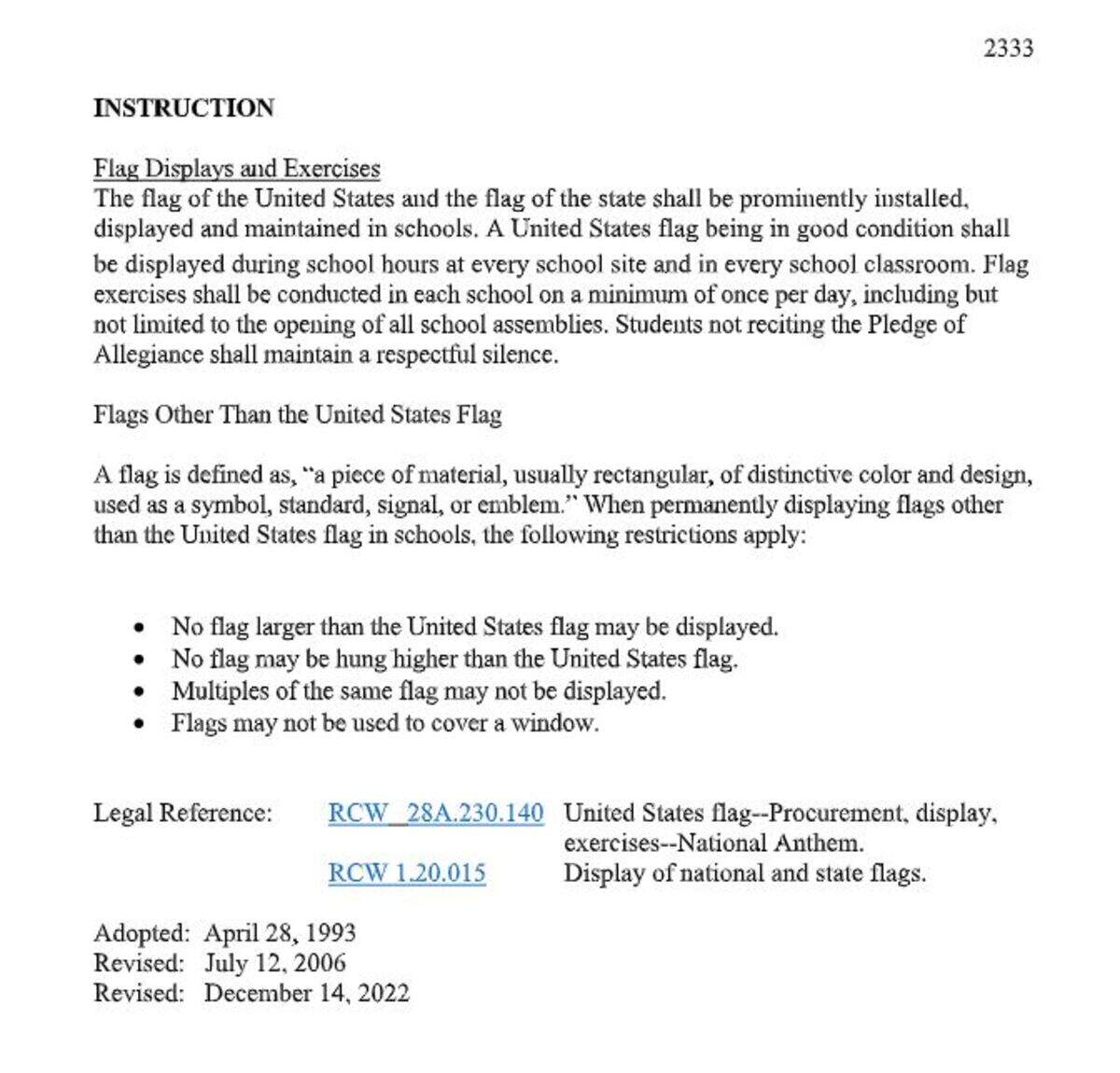
Under an amendment to a Kennewick school policy, flags that are “permanently displaying” in the classroom cannot be:
- Displayed larger than the U.S. flag.
- Hung higher than the U.S. flag.
- Have more than one of the same flag.
- Covering windows.
It also makes changes to how the American flag is displayed in Kennewick schools.
They will now be “prominently installed, displayed and maintained in schools. A United States flag being in good condition shall be displayed during schools hours at every school site and in every classroom.”
The revision passed 4-1, with board member Diane Sundvik opposing.
Before the changes come back to the Kennewick School Board for a second and final reading on Jan. 25, the school board is asking students through a survey on their thoughts on how gay pride or political flags are displayed in classrooms.
“This is not going to be a perfect policy for everybody. Everybody’s not going to say, ‘Yes, this is an A+ policy,’” said board member Micah Valentine, one of the main supporters of this revision. “It’s called a compromise, where everybody is sort of giving a little bit but everyone can live with it ... There’s groups that do not want the pride flag in the schools, and there’s certain groups that really, really say it’s important.”
The subject of revising Kennewick’s flag policies first came up after the school board passed a policy on race in the curriculum earlier this summer.
Valentine said it would be a good way to show conservative voters that they were listening to their concerns.
He told the Tri-City Herald in October that they were looking at removing flags that reflect “controversial issues” or that evoke “strong emotion” after students and parents began voicing complaints over distracting gay pride flags being displayed in the classroom.
Instead of a ban that would have prohibited those specific symbols, though, the board is moving forward by limiting the size, number and placement of all non-U.S. flags.
Dozens of community members, students and parents in recent weeks shared their thoughts to the school board on the issue, with varying perspectives and suggestions — from allowing only the U.S. flag in classrooms, to not banning any flags at all.
“The pride flag hangs in my classroom as a symbol for the acceptance that the students will find there,” Joe Ansingh, an English teacher at Southridge High School, told Kennewick School Board members at a recent meeting.
“Parents send their children to our school, to my classroom, and those kids encounter hatred, prejudice, bullying and are made to feel like they don’t belong. ... The pride flag, in itself, is a simple thing but the weight it carries as a symbol to our LGBT students is paramount,” he continued.
State law currently exists for how schools should display the U.S. and state flag in classrooms, but there are no laws regarding other flags.
Diverse perspectives
“Community members have shared their perspectives on this topic and the perspectives that are shared are really as diverse as the community that we serve,” Superintendent Traci Pierce said at the meeting. “When there’s a diversity of opinion and perspective within the community, it does make it challenging for the board to make a decision that the entire community will agree with.”
The policy that was ultimately adopted does not ban any specific social, political or quasi-political flags or iconography. Banning certain types of iconography used as a type of speech could be legally risky.
Board members took more than an hour to refine the policy before approving it, as questions remained about the subjective nature of a few sentences.
A sentence that got the early chopping block was this one: “The flag of the U.S. stands as the universal and most singularly important emblem of America.”
Board President Michael Connors said that was too subjective a statement.
“I think we should stick to what we’re trying to accomplish, not making a statement. Believe me, I love the flag — I have one at my house. But I don’t need to define or give someone a lesson on the flag in this policy,” said board member Ron Mabry.
Mabry added that he thought the draft policy was “too restrictive” and that he didn’t want to “put handcuffs on the teachers.”
The board also discussed how second language classes, such as French and Spanish, usually have multiple flags from other countries displayed on the walls.
“I just don’t want to take away the teacher’s ability to set up their classroom, to emphasize what they need to emphasize for that year,” he said.
The board will likely clarify what “permanent displays” mean and refine the wording on allowing multiple flags during the January meeting.
Kennewick’s previous flag policy, last revised in 2006, mostly just dealt with how students should recite the Pledge of Allegiance.
Richland school survey
“I think that time is not of the essence in this,” Sundvik told her fellow board members. “Giving time and thoughtfully and legally going through this with community input — I’m going to say that over and over again — is the most important thing, and doing it legally.”
And that also includes student perspectives, she said.
Kennewick plans to follow in the footsteps of Richland to survey students about their thoughts on political flags and iconography that supports LGBTQIA+ students.
Richland School Board student reps Karrin Wierzchoski and Leif Carman at a recent meeting presented their findings from a Nov. 15 survey.
They surveyed about 1,411 students from Richland High School, Hanford High School, HomeLink Academy, Rivers Edge High School and Pacific Crest Online School.
They asked:
- “Do flags depicting political signs make you uncomfortable?” 82% said “no” and 18% “yes.”
- “Do you feel safe or unsafe in a classroom displaying flags?” 59% said “safe,” 6% said “unsafe” and 36% said they were “impartial.”
- “Have you ever felt unwelcome or intimidated because of a certain flag in a classroom?” 18% said “yes” and 82% said no.
- What flags were those? Mostly either gay pride flags or Trump flags.
Most students said they didn’t see flags being an issue in school at all, and felt policies that restrict flags hindered more than helped student mental health, Wierzchoski said.
Flags also served as a “conversation starter” for students to broaden their understanding of different areas of politics.
Only a small portion of students answered that they felt they couldn’t share their political views when presented with a certain flag in classes.
This story was originally published December 21, 2022 at 12:52 PM.