
3 Tri-City school district levies failing, including one of the largest
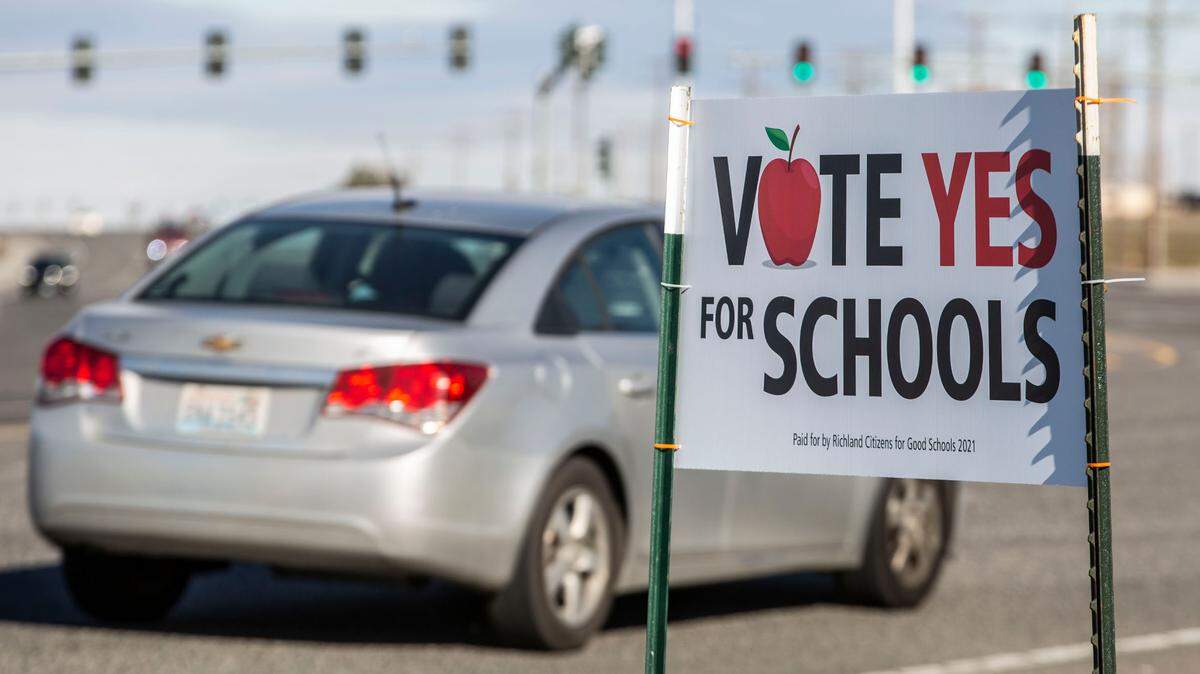
Voters were rejecting three Tri-City school district levies Tuesday night.
Kennewick, Finley and Prosser school districts were falling below the 50% needed to replace their expiring operations levies next year following the first round of votes counted Tuesday.
Benton County reported 27,529 votes were counted with a projected 10,000 votes remaining to count across several school districts.
Richland’s and Pasco’s school district levies were passing.
Kennewick, Richland and Pasco went to voters with four-year replacement levies that bridge the gap between what the state pays for and what parents expect from their schools.
Athletics, music, more security measures and school nurses are all largely or completely funded by money from the property tax levies.
They are replacing ones passed in 2018, and are the first since Washington state increased the maximum levy rate to $2.50 per $1,000 of assessed property value.
The only school district to ask for the full rate was Richland, which had been near or at the limit since the cap was raised in 2019. Unlike Pasco and Kennewick, however, Richland receives less “equalization” money from the state to make up for fewer lower-income families.
Levy opposition
While school districts normally see smooth sailing when they ask for renewals of their operating levies, controversy over COVID regulations spurred levy opposition in Richland and Kennewick.
In Richland, a group of parents opposed the levy measure in voter pamphlet. They raised concerns about what they see as poor test scores and that the “school is not back to a normal learning environment.”
While no official opposition committee formed in Kennewick, some critics were outspoken online about taking a stand against the levy as a way of protesting students having to wear masks in class.
If the levy fails, the district can pay to put the issue back on the ballot later this year.
Kennewick school officials said Tuesday night they will continue to watch the results.
What’s next
The next time districts could put the measure on the ballot would be April 26, but they would need to pass a resolution before Feb. 26.
While Kennewick usually doesn’t have problems passing levies, a little further to the west in Benton City, the Kiona-Benton City district struggled for over a year in 2020 to pass its operations levy.
After two unsuccessful attempts, the district needed to cut $1.3 million from its $20 million budget. That ended up eliminating several positions and laying off a counselor and an administrator.
The third attempt to pass the measure succeeded in spring 2021.
Pasco School District
The Pasco School District levy starts in 2023 to raise $21 million and ends in 2026 raising $34 million. That is expected to keep the tax rate at an even $1.75 per $1,000 of assessed value.
The measure was passing with 4,412 votes, or 54%, to 3,750 votes opposed or 46%.
When combined with the state’s extra equalization funds, it makes up about 10% of the district’s budget.
Kennewick School District
The Kennewick School District has two levies on the ballot, both of them replacing expiring taxes.
One is a educational programs and operations levy that starts in 2023 raising $21 million and ends in 2026 raising $37 million. The tax rate for 2023 would by $1.75 per $1,000 of assessed value.
Along with the state equalization money, it makes up 11% of the district’s budget.
The levy is failing with with 6,281 votes, or 52%, opposed to 5,889 votes, or 48%, in favor.
The other levy pays for technology. It will start at 35 cents per $1,000 of assessed value.
That levy is passing with with 6,356 votes, or 52%, in favor and 5,911 votes, or 48%, opposed.
Richland School District
The Richland School District also has an operations and a technology levy on the ballot. They both are replacing existing levies.
The educational program levy will bring in $28 million on 2023 and increase to $33 million in 2026. The tax rate is expected to stay stable at $2.50 per $1,000 of assessed value.
The levy provides $1 for ever $6 of the district’s budget and covers a variety of services in the district, including mental health services, advanced placement courses and nurses.
The levy is passing with with 6,718 votes, or 53%, in favor and 5,990 votes, or 47%, opposed.
The technology levy covers the cost of Chromebooks and other pieces of technology. The levy rate is expected to stay stable at 50 cents per $1,000 of assessed value for the next four years.
The levy is passing with with 6,939 votes, or 54%, and 5,800 votes, or 46%, opposed.
Other school districts
- Finley School District is failing by two votes with 288, or 50.17%, opposed and 286, or 49.83% in favor.
- Prosser School District is failing with 942, or 55%, against and 765, or 45%, in favor.
- Kahlotus School District is passing with 65 votes, 90%, in favor and 7 votes opposed.
- North Franklin School District is passing with 570, or 65%, in favor and 304, or 35%, opposed.
This story was originally published February 8, 2022 at 9:38 PM.