
‘Extremely psychotic.’ Expert testifies on Pasco bus driver murder suspect’s sanity
A Pasco murder suspect was “extremely psychotic, extremely distressed, extremely agitated” for days before he climbed aboard a school bus three years ago and killed the driver.
Forensic psychologist Alexander Patterson testified this week that Joshua D. Davis didn’t understand right from wrong when he stabbed Richard “Dick” Lenhart.
Davis’ schizophrenia had left the otherwise healthy man in debilitating physical pain, and may have motivated his violence, said Patterson.
Patterson took the stand for the defense and testified for about four hours Tuesday afternoon at a Franklin County Superior Court hearing to determine if Davis was legally sane at the time.
He said Davis documented his mental illness in a series of about 60 videos, which show him putting a needle in his face, wheezing, screaming and crying hysterically. In one, he shaves off a large chunk of his hair.
Davis talked about the government trying to turn him into a terrorist and force him to do something that he didn’t want to do.
“The videos were the most provocative evidence I had that really reinforced to what degree he was in a very severe state of distress throughout this period and very psychotic,” Patterson testified.
He told Judge Jackie Shea Brown he believes Davis, now 37, is telling the truth, when he says he doesn’t remember attacking Lenhart, 72.

Leading up to the day of the crime, he said Davis was “extremely psychotic, extremely distressed, extremely agitated and appeared to have been almost completely preoccupied with delusions related to him being tortured, targeted and manipulated.”
Patterson and a Washington state forensic psychologist Richard Yocum agree Davis had been suffering from schizophrenia for at least a year before the stabbing.
But they disagree whether his mental illness meant he didn’t understand right from wrong at the time of the murder. Yocum is expected to testify at a future hearing.
He wrote in a report last year that notes, statements to police and other actions make it clear that Davis knew the difference between right and wrong and what he was doing.
Davis previously pleaded innocent by reason of insanity to premeditated first-degree murder after attacking the driver inside a bus full of children at Longfellow Elementary School in September 2021. No children were hurt.

If Shea Brown finds he was not sane, Davis will be held at a Washington state psychiatric hospital until doctors feel he is safe to release. If he was sane, he will be tried for murder.
He has spent much of the last three years in custody undergoing mental health evaluations while his criminal case has been on hold.

Psychiatric evaluations
Patterson and Yocum have been hindered by Davis’ inability to remember killing Lenhart.
That left both psychologists to piece together what his state of mind was at the time based on what he did before and after the crime.
Patterson explained Davis believed he suffered from a series of “very odd” physical problems, such as peeling and cracking gums and air bubbles under his skin.
While he didn’t have any actual injuries, the pain was real and debilitating, Patterson said.
“His brain essentially tricked him into believing that he was in pain,” Patterson said
To explain that pain, he adopted the idea that he was the victim of a secret ultrasonic weapon.
In addition, he believed he was being sent messages. Patterson speculated that the pain drove him to commit the crime.
A slow decline
While Davis didn’t develop full-blown schizophrenia until sometime between 2018 and 2020, Patterson testified he showed signs of the mental illness dating back to his teens.
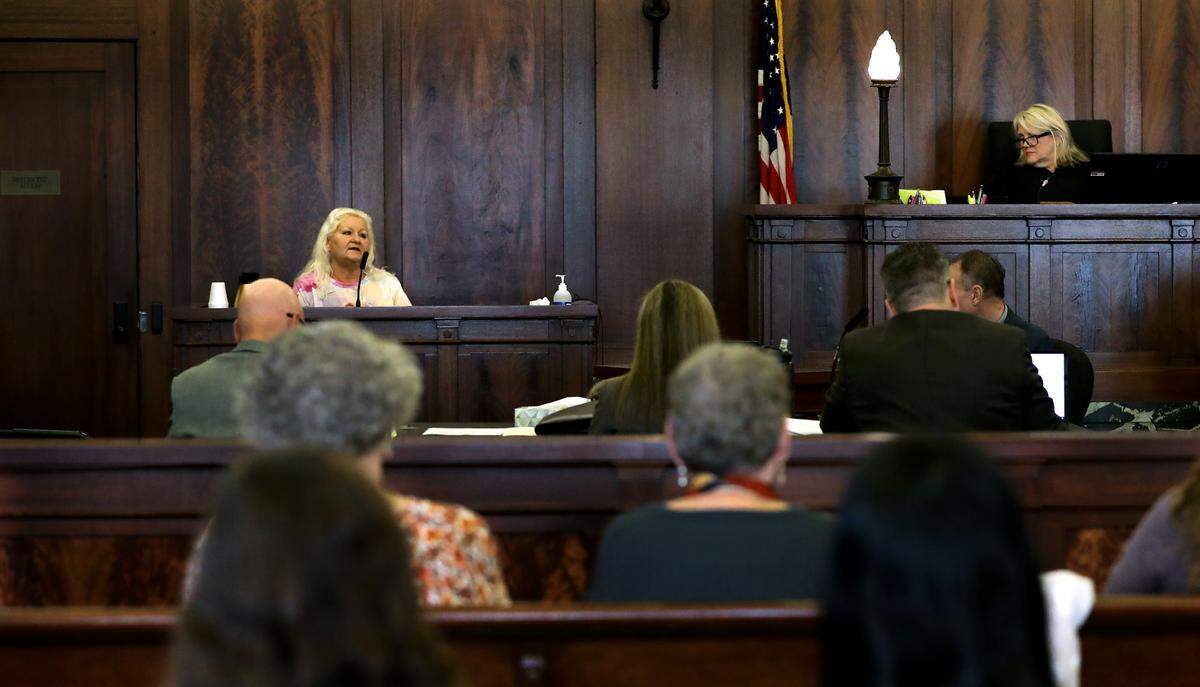
Davis’ mother Andrea Cervantes testified Tuesday that her son was a bright child who did well in school until he reached high school. Her divorce struck Davis hard, and he began isolating himself.
He dropped out of school, stayed in his room and grew angrier.
When he turned 17 or 18, she told him he needed to get a job, go back to school or leave the house. He decided to leave, starting years of sporadic homelessness.
There were periods of time when she hardly saw him, but in recent years he had been in more regular contact, though he talked about hallucinations. They included believing some group had access to his computer and were sending him audio messages.
He sent her a video of the computer, and she told him that she couldn’t hear what he was hearing.
When she suggested he seek mental health treatment, Davis didn’t want to go. He said he didn’t like the medication they prescribed because it made him feel fuzzy.
Patterson spent hours interviewing Davis, reviewing police reports and other material before coming to his conclusion.
“In my mind, it has to have been because of his mental illness that compelled him to do it because what other reason would there have been,” he said.
This story was originally published October 24, 2024 at 5:00 AM.