
Amazon bringing one of nation’s 1st new reactors to WA. Training center to open
AI-generated summary reviewed by our newsroom.
- Amazon and Energy Northwest advance Cascade Advanced Energy Facility near Richland
- Project will deploy X-energy Xe-100 advanced small nuclear reactors
- Education, simulator training planned for well-paid jobs
Amazon and Energy Northwest are moving forward with plans to start building Washington’s first small modular nuclear power reactor near Richland in the next five years. And preparations already are underway to train Tri-Cities workers for the high-paying jobs there.
Expect to hear more about the project – now named Cascade Advanced Energy Facility – between now and its planned start of operations in the 2030s as one of the first advanced small modular nuclear reactors in the nation.
At this week’s one-year anniversary of the project’s announcement, the updated information and drawings of the campus were released.
“Today marks a pivotal step forward in bringing this transformative project to life,” said Bob Schuetz, chief executive officer of Energy Northwest.
“We are proud to be at the forefront of deploying advanced nuclear technology in the region — driving next-generation solutions that strengthen energy security and position the Pacific Northwest as a clean energy leader.”
.png "CAEF 8 (2).png")
The advanced nuclear energy facility is planned for unused Hanford nuclear site land leased from the federal government 10 miles north of Richland. It will be near what’s now the Northwest’s only commercial nuclear power plant, Energy Northwest’s Columbia Generating Station.
About 1,000 workers will be needed for construction of the new Energy Northwest reactor, and then at least 100 workers will be employed during plant operations.
The Cascade project will be built, owned and operated by Energy Northwest using X-Energy’s advanced nuclear reactor design. Amazon is paying for the initial feasibility study.
“This historic partnership is leading a new era for energy in the United States,” said Clay Sell, chief executive officer of X-energy.
What nuclear project will include
Over the past year, with Amazon’s support, X-energy has accelerated progress on its nuclear technology and expanded its workforce.
The project is planned to start with four modules that can generate 320 megawatts of energy capacity. Amazon will have the right to buy that electricity to help power its artificial intelligence and cloud services.
However, the project could be scaled up for broader use with eight additional modules for a total generating capacity of up to 960 megawatts.
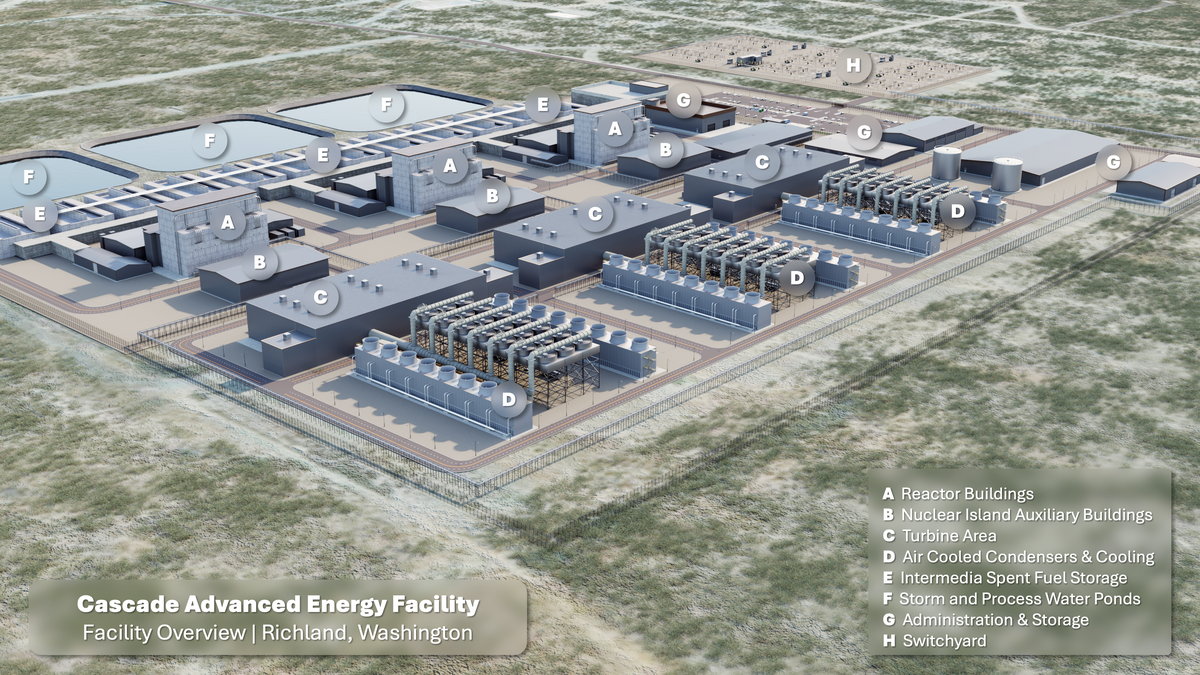
.png "CAEF Marked 3 (1).png")
By comparison, Columbia Generating Station has a total generating capacity of up to 1,207 megawatts, or enough electricity to power about 1 million homes.
The project will be about the size of a few city blocks, a significantly smaller footprint than traditional nuclear plants that can take up a square mile, according to Amazon’s description.
“It’s kind of like building Legos offsite,” with reactors transported to the Cascade campus as the project is expanded, said Jackie Eutsey, the new nuclear development strategic outreach manager for Energy Northwest, at a Tri-City Development Council information session this week.
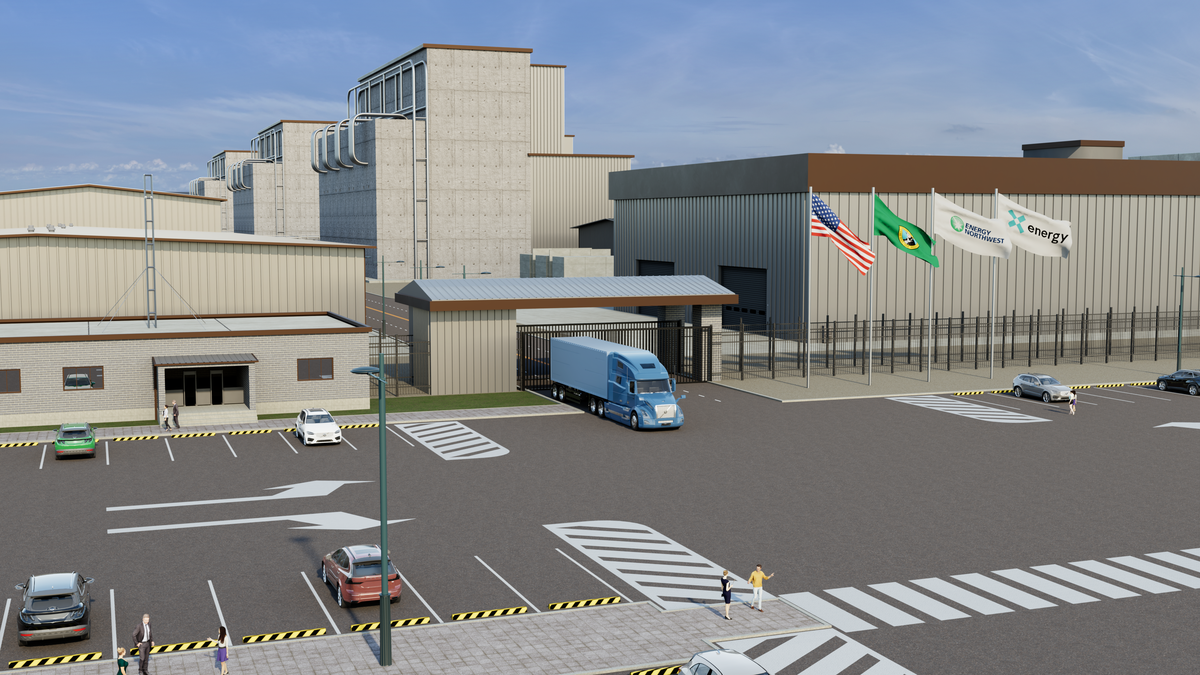
Just-released drawings show a campus that includes reactor buildings, a turbine area, air cooled condensers and cooling, a spent fuel storage area, three storm and process water ponds, and other facilities.
“Seeing these renderings is truly inspiring and a reminder that innovation and sustainability go hand in hand,” said Kara Hurst, Amazon chief sustainability officer. Amazon has more than 600 renewable energy projects worldwide.
1 year of X-energy project progress
Since the project was announced a year ago, Energy Northwest has selected AtkinsRealis as the project’s technical advisor.
Energy Northwest has also discussed the project with tribes and other interested parties and worked on environmental reviews, a safety evaluation, permitting, licensing and risk analyses to prepare to apply for a construction permit from the U.S. Nuclear Regulatory Commission.
“It’s important to know that this is carbon free, safe, reliable energy, and it’s a 60- to 80-year investment for our region,” Eutsey said.
Among the advantages of the X-energy small modular reactor is the ability to adjust its output based on need, such as scaling back if the weather is favorable for wind and solar production, she said.
It also will not require a refueling outage like the one that shuts down Columbia Generating Station for several weeks every other spring, she said. Fuel can be checked and replaced as needed without stopping production.
Advanced small modular reactors have a simpler design, faster deployment and lower construction cost than traditional nuclear reactors, Amazon said.
Nuclear power education
Columbia Basin College, in collaboration with Energy Northwest, successfully applied for a $2 million grant from the Department of Energy that it received about a year ago.
Part of the grant will be used to pay for an educational simulator based on X-energy’s Xe-100 small modular reactor, which will be used at the Cascade reactor project.
An Energy Learning Center is being created at Washington State University Tri-Cities that should be available as soon as next month for WSU and CBC students.
Amazon compares it to a flight simulator, but for a nuclear facility.
Students in nuclear education programs can get hands-on experience with the controls for an X-energy reactor.
“This interactive experience helps demystify nuclear energy and goes beyond the textbook, showing students that a viable, meaningful career in clean energy is within reach,” Schuetz said.
The DOE grant also is being used to expand CBC’s two-year Nuclear Technology Program, which offers three different degrees. It has grown from 10 to 20 students previously to 46 students this semester, said Sarah Fussner, the workforce development program coordinator for Energy Northwest, at the TRIDEC event.
It is one of just 12 nuclear training programs in the nation, she said.
The simulator being installed in Richland will create a valuable education pathway for local students to enter high-paying jobs in the growing advanced nuclear energy sector and strengthen the region’s role in America’s transition toward a more sustainable energy future, according to Amazon.
Energy Northwest is already hiring students from the CBC program at pay that starts at $39 an hour and can climb to $65 an hour, plus overtime, Fussner said.
This story was originally published October 17, 2025 at 5:00 AM.