
WA’s largest proposed wind farm could shrink. Key decision expected
AI-generated summary reviewed by our newsroom.
- EFSEC may add hawk buffers that could cut dozens of Horse Heaven wind turbines.
- Scout’s Horse Heaven project offered 147–222 turbines, solar arrays and storage.
- Proposed 2 mile nesting buffers could limit turbines most visible to Tri-Cities.
More limitations may be placed on where wind turbines can be built along the Horse Heaven Hills, cutting the number of turbines visible from the Tri-Cities, under a proposed plan to protect endangered ferruginous hawks.
More than 60% of the nesting habitat of ferruginous hawks in Washington state is near the Tri-Cities in Benton and Franklin counties.
The Washington state Energy Facility Site Evaluation Council (EFSEC) appeared to be generally in agreement at its last meeting on the proposed plan that could slash dozens of turbines from the project, but delayed a possible vote until its meeting on Wednesday, Oct. 15, in Lacey, Wash.
Scout Clean Energy was given approval in late 2024 when Jay Inslee was governor to build what could be the largest wind and solar project in the state, stretching along 24 miles of the Horse Heaven Hills just south of the Tri-Cities.
Scout has proposed installing either up to 222 turbines about 500 feet tall or 147 turbines that are 670 feet tall, plus solar arrays and battery energy storage at the Horse Heaven Clean Energy Center.
But the approval granted last fall placed limits on where the turbines could be built. That incudes restrictions on how close they may be to Webber Canyon to protect cultural resources there and where they may be built in fire-prone areas near Benton City that have sometimes depended on aerial firefighting.
Those restrictions would eliminate 29 turbines, according to a Scout document, unless Scout could find another place on the project for them.
That could increase to as many as 82 turbines eliminated with the addition of ferruginous hawk protections, according to a Scout document.
The approval that Scout was given required that a technical advisory group be formed to give recommendations about what restrictions are needed to protect ferruginous hawks, which are an endangered species in Washington.
The advisory group includes a wide range of representatives, including from federal and state agencies, Scout, tribes, labor, Benton County, landowners and the Lower Columbia Basin Audubon Society.
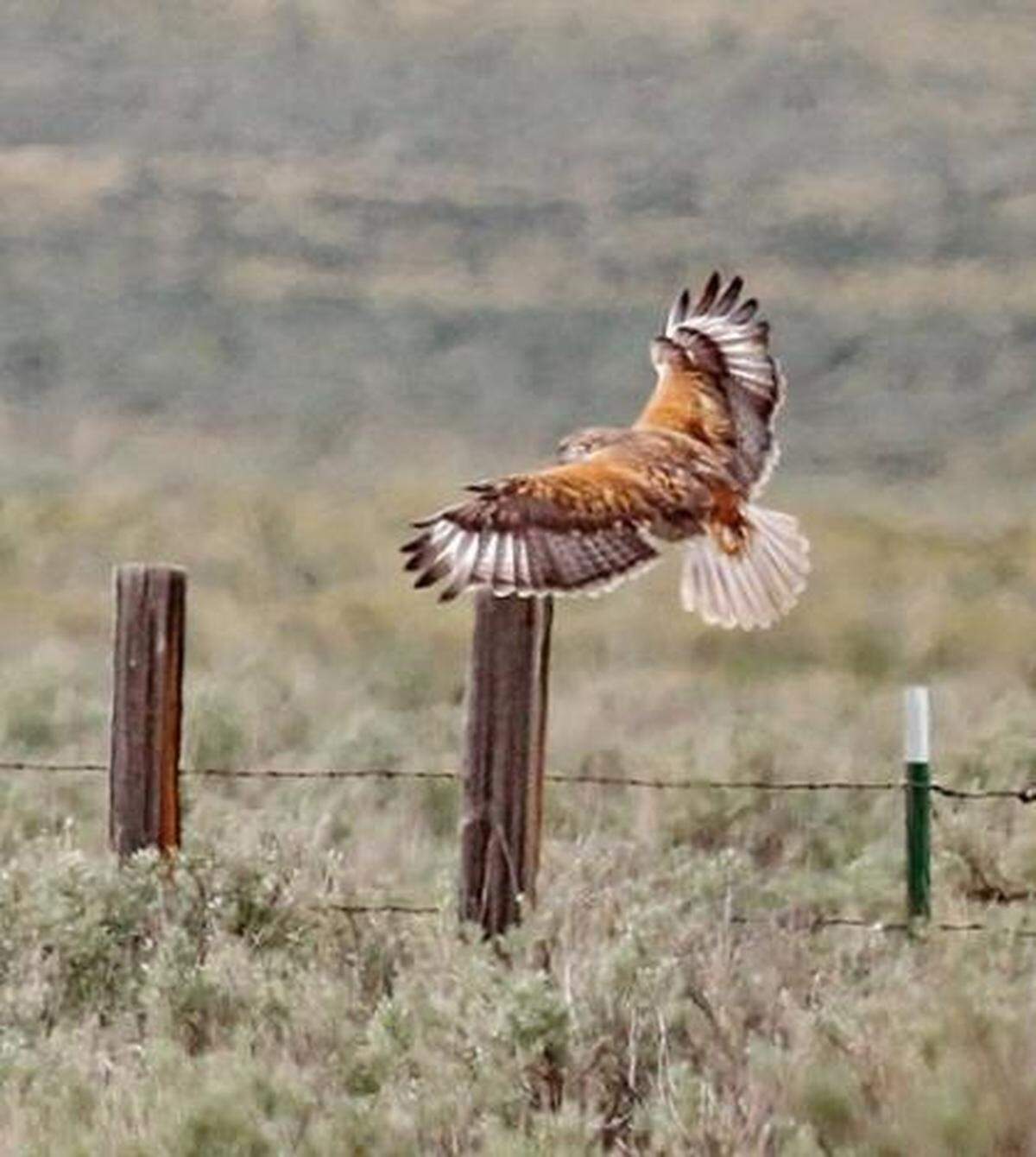
On Wednesday EFSEC is scheduled to consider a draft proposal prepared by staff that would require only the smallest buffer area allowable of 0.6 miles extending around 39 of 45 nesting sites that may have once been used by the hawks.
That buffer area was found to be adequate because foraging habitat within two miles of a nest was largely no longer viable — mostly because of land use for crops, homes or industry — and the technical advisory group agreed to the minimum of a 0.6 buffer area.
A 40th nesting site is in an area where no turbines or other major facilities are planned, leaving five additional nesting sites.
5 ferruginous hawk nests
The draft proposal to be considered by the council has a larger buffer area, 2 miles in all directions, around five remaining nesting areas. It is a recommendation that was not supported unanimously by the technical advisory group.
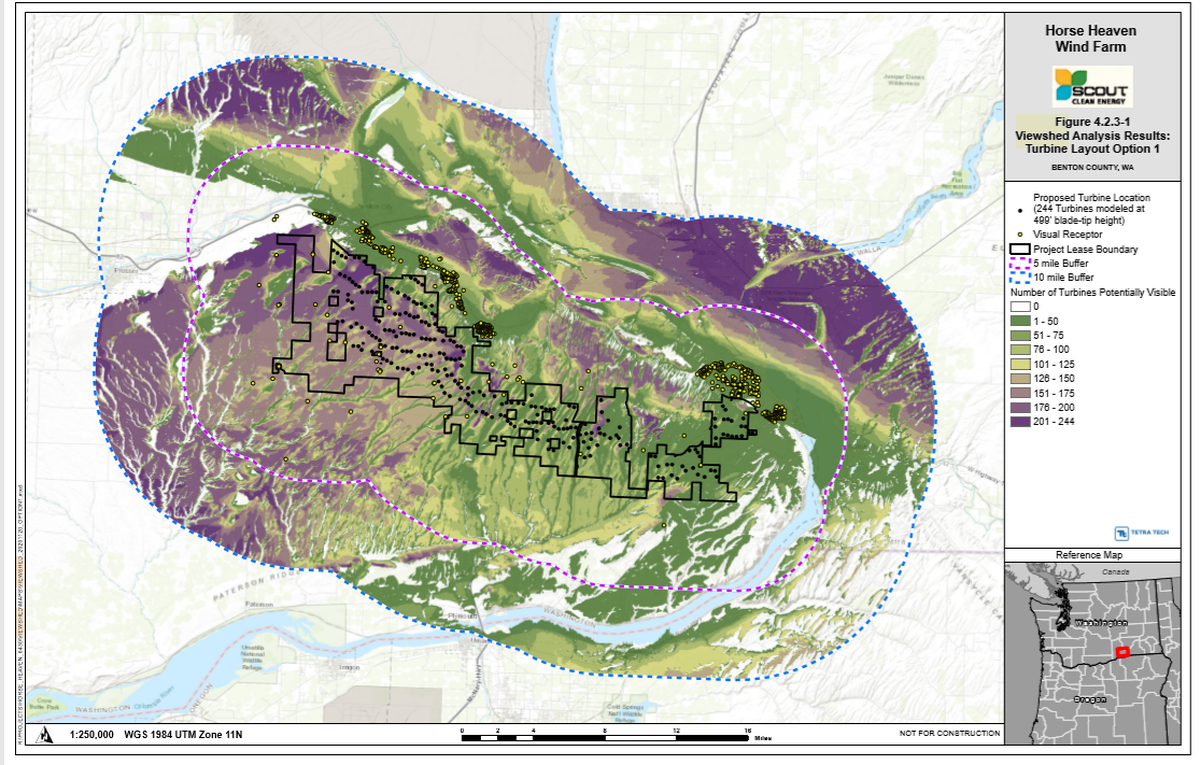
Although the nesting sites have not been made public and Scout has not provided a plan for where its turbines would be located, the larger buffer zone would appear to eliminate some of those that are most visible from the Tri-Cities along the top of the Horse Heaven ridgeline, according to Tri-Cities CARES, a nonprofit that has opposed the project.
Tri-Cities CARES has estimated that between the Horse Heaven wind farm as originally proposed and the nearby and smaller Nine Canyon wind farm, just over 100,000 residents of Benton County would live within six miles of a turbine.
That’s five times more than the estimated 20,000 people living within six miles of a wind farm across the rest of Washington state, it said.
Scout has argued that ferruginous hawks are only in Washington state during their breeding season and are not considered endangered in the rest of their range in western United States and Canada.
Fewer ferruginous hawks are nesting to the north of the wind farm due to development, leaving small groves of trees planted by farmers in the south part of the project. Most of those nesting sites are dead black-locust trees and their viability for nesting will be short-lived, Scout said in a document.
In the last 10 years there has not been more than one ferruginous hawk nest observed per year in the project area, acccording to Scout.
However, there was a breeding nesting pair of ferruginous hawks discovered this year for the first time in a nest that was formerly occupied by Swainson’s hawks.
Three of the other nesting sites proposed for two-mile exclusion zones were used by ferruginous hawks in 2019, 2015 and 2006 and a fourth nest was nearby and shared the same habitat area.
Scout says the construction of the Horse Heaven project would support 930 jobs and that the project would contribute $260 million in local taxes over its 35-year lifespan. The wind farm would be built with union labor following a 2022 agreement with Tri-Cities unions.
It would have a nameplate energy generating capacity of up to 1,150 megawatts, according to Scout. In comparison, the Columbia Generating Station near Richland, the Northwest’s only commercial nuclear power plant, has a generating capacity of 1,207 megawatts, but can operate around-the-clock regardless of weather conditions.
The Wednesday meeting will be streamed at tvw.org.
This story was originally published October 14, 2025 at 5:00 AM.