
Why are 2 ‘gravity-wave’ sculptures being removed from busy Richland roundabouts?
The Portland firm that created gravity wave-inspired sculptures for two Richland roundabouts is questioning plans to move them to a gallery at Howard Amon Park.
The city hired Rhiza Architecture + Design as part of a $5 million project to upgrade Queensgate between I-182 and Keene Road. The project included creating roundabouts at the freeway and at Columbia Park Trail and art to fill them.
Rhiza installed “Waves of Viticulture” and “Fishing For Gravity” in 2019, about a year after the unadorned roundabouts opened to traffic.
But the city reconsidered the wisdom of placing sculptures in roundabouts after a 2020 survey indicated people want public art they can approach on foot, not zoom past in cars.
It made tentative plans to move them to the Allied Arts Gallery, at the entrance to Howard Amon. The gallery leases the site from the city and its president, Mary Jecha, has long nursed a dream of turning its small yard into a sculpture garden.
The city views the move as a way to give the sculptures a setting they deserve. Jecha said the gallery’s intimate garden space is the perfect scale for the roundabout works, which would be moved separately.
The designers disagree.
Ean Eldred, principal with Rhiza, said the city approached the firm a year ago about the relocation plan. He tried to dissuade it, saying both were created for the spots they occupy, whirling traffic and all.
A commission for a park setting would have yielded a different sculpture, he said. One example: the Washington Department of Transportation has rules to protect motorists from being distracted by art near roadways. That includes no moving parts or mirrored surfaces.
A different commission would have had different rules.
“A lot of time and a lot of effort and a lot of thought and a lot of people’s input went into getting those sculptures just right for that particular site,” he told the Herald.
He’s not angry and acknowledged the city owns the works and can move them as it wishes.
However, Rhiza is considering taking its name off the work, which cost about $80,000 to create. Eldred said it has not decided if it wants to take that step.
Inspired by science
Rhiza sought the commission after Eldred learned of the gravity wave research conducted at the Hanford Laser Interferometer Gravitational-wave Observatory or LIGO. The LIGO team shared the 2017 Nobel Prize for physics by detecting gravity waves passing through earth, confirming a theory of Albert Einstein.
He found it mind-blowing and sought to learn more about LIGO’s Hanford station and its community. The more he studied, the more he learned about the region, from its tribal fishing history to its agriculture to its innovative science.
Both pieces fuse elements of fishing, agriculture and gravity waves.
Rhiza designed the sculptures as well as the roundabout bases to echo waves of gravity and waves of agriculture. Removing the sculptures would literally remove them from context.
“Those sculptures really speak to celebrating the city of Richland and the whole (Tri-Cities) region in terms of amazing natural resources and its technical resources. They’re very much about that location,” Eldred said.
He called it a fun commission and said he would happily work with the city to make the works more accessible, including installing a plaque at the nearby park-and-ride lot.
“It is hard,” he said.
Approachable art
Jeff Kissel, former chairman of the Richland Arts Commission and a LIGO engineer, told the city council this month that a 2020 community survey convinced the group that roundabouts aren’t the best spots for public art.
“People want art just to have art and to feel like they live in an inspired community,” Kissel said. Richland residents want murals and architectural features and prefer work they can walk up to.
“They want to be able to explore it on their own pace and that’s where the roundabouts didn’t work for us because you were only driving them in two seconds and you didn’t really get a chance to appreciate it,” he said.
Moving the roundabout sculptures is a “win-win-win” he said, calling the Rhiza designs “too complex” for the setting. The commission is considering how to replace the two sculptures.
There is no safe way for pedestrians to access the islands in the roundabouts, but the sculptures can be viewed from sidewalks on Queensgate.
Park at the Southwest Richland Park and Ride, on Columbia Park Trail and head west.
Wave sculptures
“Waves of Viticulture,” is the shorter of the two sculptures and occupies the roundabout at Queensgate and the freeway. It would be the first to move. The art, according to the narrative, connects rows of leaves and vines to the space-time grid and star clusters. The metal leaf motif is based on locally-grown grape varieties.
“Fishing for Gravity” is the taller of the two and occupies the roundabout at Queensgate and Columbia Park Trail. It borrows the form of a tribal fishing basket, but tilts skyward to draw the eye to the stars.
“The region began as a basin for fishing and all these years later with all this amazing technology, we’re still fishing,” Eldred said when asked to describe the work.
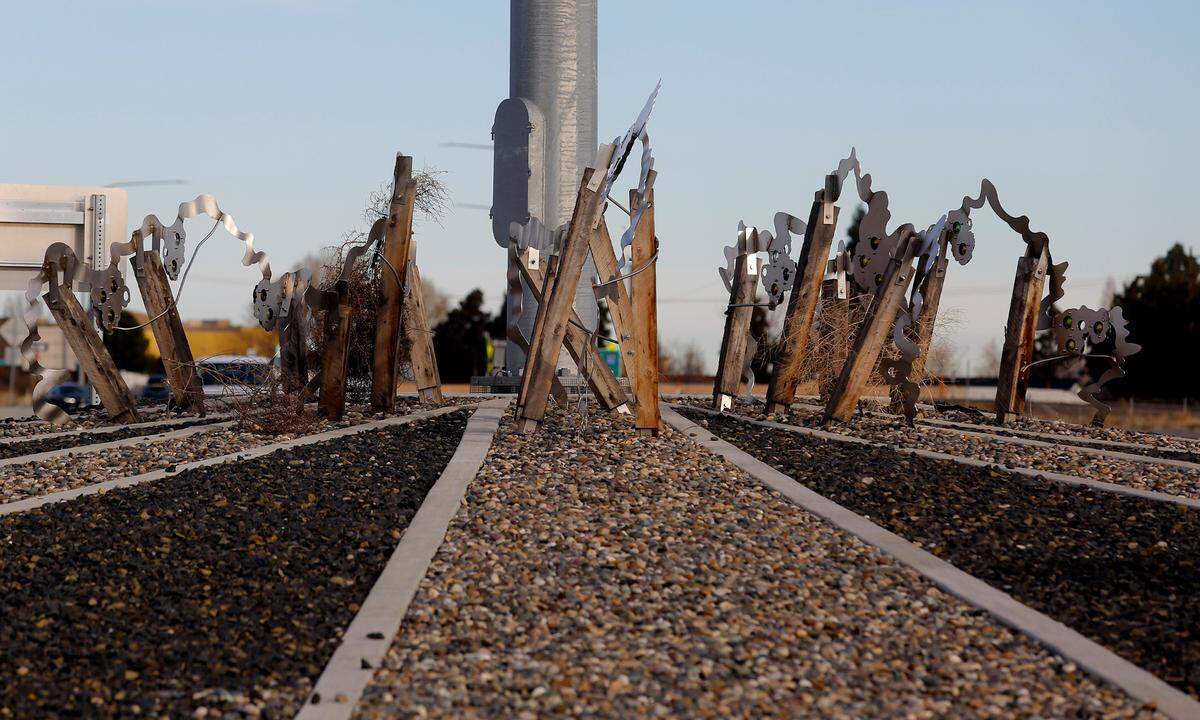
Both sculptures were made with metal, juniper and repurposed wine bottles. The roundabouts themselves were sculpted to display the sculptures to passing motorists, going in and out of view as the driver circles the intersection.
Sculpture garden
Mary Jecha, president of Allied Arts, said she’s long wanted to transform an area outside the gallery into a sculpture garden. She saw one while traveling and thought it would suit Richland.
Since the gallery leases the site from the city, it wanted to work on landscaping and other steps. The first of the two sculptures won’t move until that work is complete.
She envisioned a revolving collection of professional sculpture. Artists could display works for sale, or just put them on temporary view.
The plan hit a snag when the gallery realized the “wonderful” sculptors of the Tri-Cities are so busy with buyers and commissions that they don’t have work to place in the garden.
“As we moved along, we found out it’s a great idea to have a sculpture garden, but that we have a very limited number of sculptors and they are up their ears in commission jobs and don’t have art setting around,” she said. “Their work sells.”
The gallery welcomes the Queensgate works, as long as the city pays for them. A city official confirmed it will retain ownership.
“I think it will be a good addition,” she said.
Allied Arts is at 89 Lee Blvd. Go to galleryatthepark.org.
This story was originally published March 18, 2023 at 5:00 AM.