
How to help growing number of homeless Tri-Citians? Inslee hears concerns, solutions
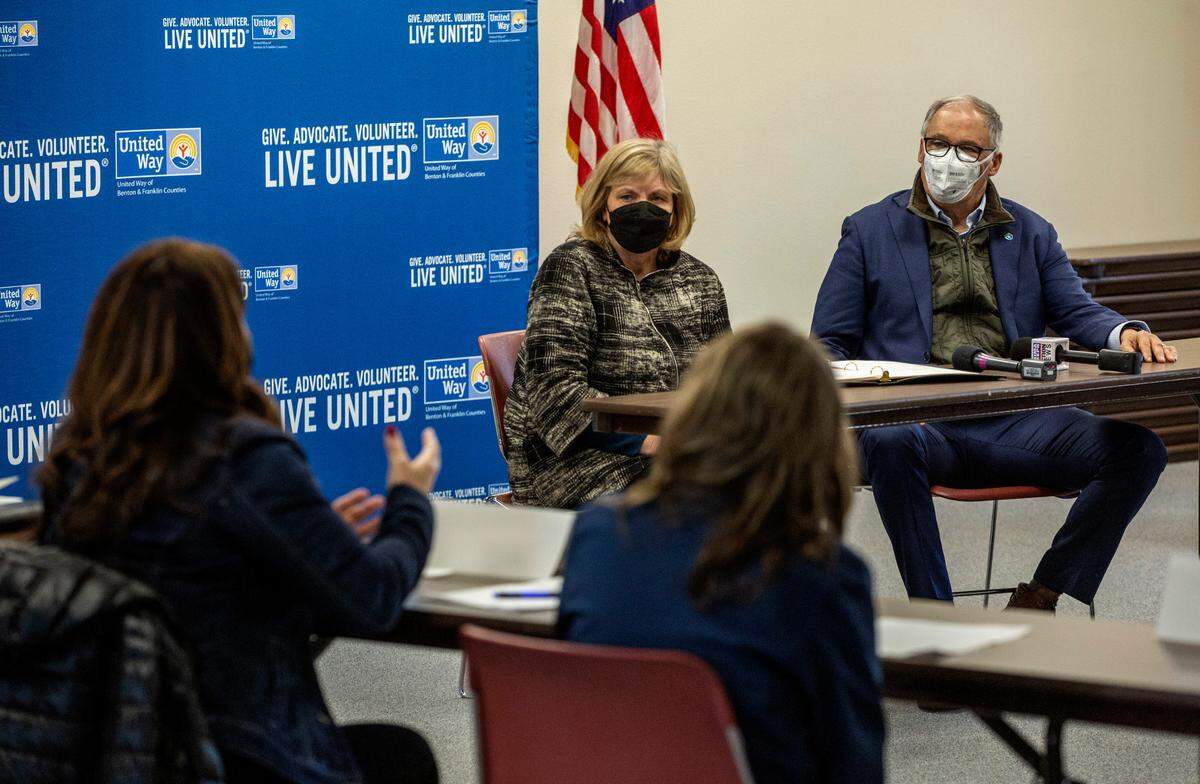
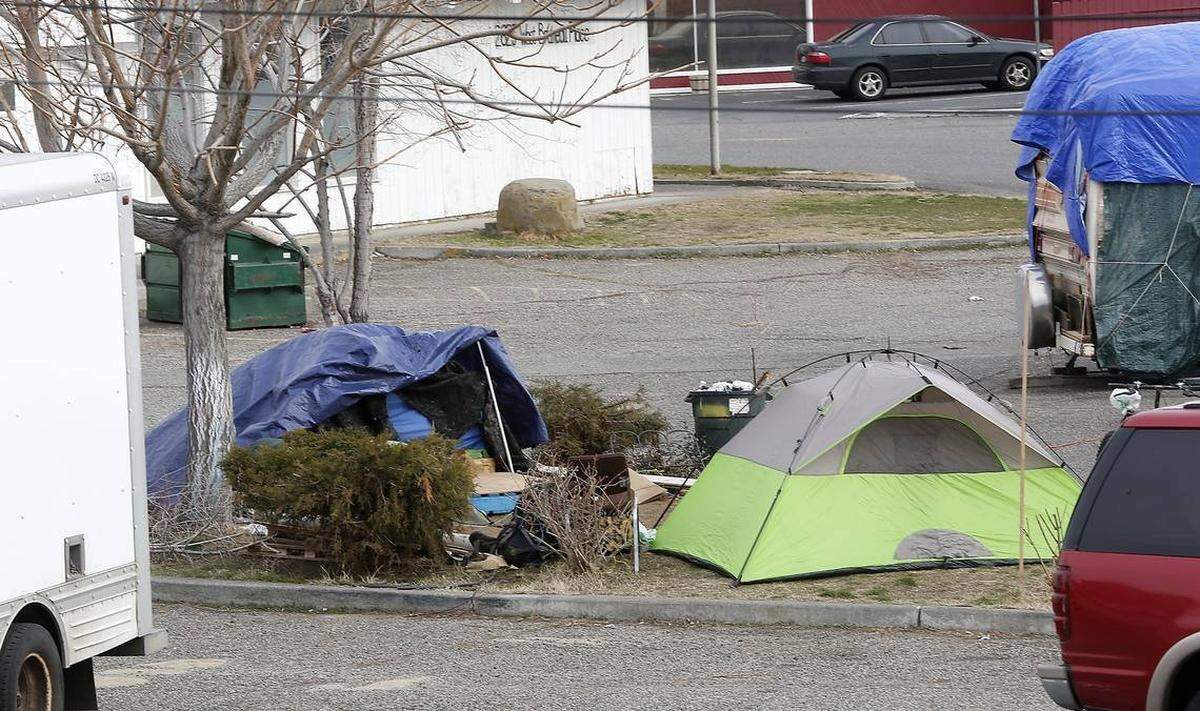
There is no simple solution to the Tri-Cities growing homeless problem, Washington Gov. Jay Inslee heard this week from civic, business and social service leaders.
Resources are not adequate for people who are homeless due to a range of circumstances — families losing housing, foster children aging out of the state system and people who need extensive mental health and addiction treatment, the governor was told.
In one school year there has been a 338% increase in homeless children as counted in the school districts of Benton and Franklin counties, according to the United Way of Benton and Franklin Counties.
The Kennewick School District has counted about 300 homeless students so far this year, said Yesenia Chavez of the district.
“We are seeing a lot of families that are coming to us due to everything that happened with COVID,” she said.
Resources were found to get hotel vouchers for short stays and start applications for permanent housing for an influx of families needing help in January, she said. It works with the Kennewick Housing Authority and the Kennewick Police Department Foundation.
But the extra money available now to help homeless families is quickly running out and it is getting more challenging to get a family a hotel room for a night, she said.
When eviction moratoriums lapse or rents increase, people are coming from rural areas into the Tri-Cities to find help, said LoAnn Ayers, president of the Tri-Cities based United Way.
Gloria Caldwell, with Benton and Franklin counties Human Services, said that a high occupancy rate is making it difficult to find housing for people who qualify for behavioral health and disabled subsidies that pay for 70% of their rent. Among those she is concerned about are senior citizens.
Now Human Services is having to triage the many people who are homeless and in need of help.
But she said that providing subsidies saves money in the long run.
One client who was frequently at hospital emergency departments, had multiple stays in jail and 50 psychiatric admissions, has been to the hospital only once since getting housing with $500 a month to help with rent.
Preventing homelessness
Tobaski Snipes of Empower Life Tri-Cities said money is also needed to help prevent young adults who don’t have behavioral health issues or criminal histories from falling into a life of homelessness.
The teens and young adults his organization helps may have been kicked out of their home after revealing that they are gay or may not have a home for other reasons beyond their control.
In one current success case, the organization has helped a high school student born in the United States, whose family was deported to Mexico. He was at risk of becoming homeless and likely having eventual run-ins with law enforcement.
The student now is on track to graduate high school while working two jobs and join the military in the fall, after getting some adult mentoring and help with housing, Snipes said.
Children aging out of foster care also are at risk of becoming homeless.
They are provided a year of subsidized rent but that “does not undo a lifetime of trauma,” said Kendra Palomarez, director of Catholic Charities of the Tri-Cities.
Finding a place that will rent to an 18 year old aging out of foster care can be difficult, and the young adults often cannot afford rent when their subsidized year ends, she said.
“They come to us with very little — no adult support, nothing to their name except maybe the homeless community friends that they made,” she said.
In some cases Catholic Charities will help them transition back to their families, which is not ideal given the circumstances that may have led to their placement in foster care, or will try to pair up roommates, she said.
Inslee estimated that about a third or more of people in criminal custody in the state were at one time in foster care.
“I can’t image the foster care experience ... the experience and anxiety of coming out of that at 18 and just on the streets,” he said.
Giving foster children a better bridge to adulthood would save criminal system costs, he said.
Human trafficking also is a growing problem in the Tri-Cities, Ayers said.
“Many times they are desperate young adults who have no other way to feed and house themselves,” she said.
Nono Viera, owner of Viera’s Bakery with one shop in downtown Pasco, says he calls the police once or twice a week because of an issue with a homeless person, often someone appearing to have a substance abuse or mental health issue.
He’s had his Pasco bakery since 2004 and the homeless problem is getting worse, he said.
But now police say they have nowhere to take them but to jail, where they are soon released, he said.
Addiction help essential
The Tri-Cities desperately needs the substance abuse detox center and inpatient treatment that Benton County is working on, several Tri-Cities representatives at the round table said.
The original Kennewick General Hospital building may be purchased for the treatment center.
The Tri-Cities is the only metro area in the state without an inpatient detoxification center, said Michele Gerber, founder of the Benton Franklin Recovery Coalition.
The coalition gets calls from desperate parents picking up young adult children from hospital emergency departments after they have overdosed.
She tells parents to start driving west and making calls.
“I have been one of those parents driving through the night making phone calls and ending up on I-5 going south to California. This is the wrong answer,” she said.
Her family was lucky enough to be able to pay for private treatment for their children. Treatment centers that do not require payment are overwhelmed and have long waiting lists, she said.
Treating mental health issues and addiction is essential to reduce the number of homeless people, she said.
Providing housing without those services “will just bring the problems under a roof but will not solve them,” she said.
Andrew Porter, executive director of the Union Gospel Mission in Pasco, said he’s seen an increase in drug addiction in the last decade, with high potency drugs becoming easily available at low cost, even in schools.
“If I could go all the way upstream and stop or greatly reduce the amount of drugs coming into this country, homelessness would look quite different,” he said.
The mission offers an addiction recovery program, but for the program to be effective people first need an inpatient detox and mental health program in the Tri-Cities, he said.
Homeless count planned
Inslee said he expects the Washington state Legislature to provide hundreds of millions of dollars for local communities, including the Tri-Cities, to address homelessness.
On Thursday, Feb. 24, a count of the homeless in the Tri-Cities was done.
Benton County Department of Human Services staff and volunteers went to places where those experiencing homelessness might be — cars, RVs, parks, bus stations, libraries, shelters — and requested they complete a survey.
A backpack with essential goods was provided to individuals and families during their conversation with staff and volunteers.
Data from the surveys will be forwarded to the Washington state Department of Commerce to provide an estimated number of individuals and families experiencing homelessness in Benton and Franklin Counties.
This data can then be used by local governments and community organizations to secure grant funding in the fight against homelessness.
This story was originally published February 24, 2022 at 10:18 AM.