
This is what saved the Tri-Cities area from rolling blackouts in historic heatwave, says BPA
The Bonneville Power Administration is crediting one of the lower Snake River dams with preventing power outages and rolling blackouts in the Tri-Cities during the record-breaking late June heatwave.
Without all four of the lower Snake River dams in Eastern Washington, powering through the heatwave would have been much more expensive and challenging, said BPA officials.
“As the region continues to discuss the future of these facilities, we believe it is important to provide data and information about their performance as a solid foundation for discussion,” said BPA Administrator John Hairston.
Breaching or tearing down the dams has been proposed as a way to help threatened and endangered salmon species and steelhead recover and also to help the endangered southern resident orca whale population that feeds primarily on chinook along the Washington coast.
Tri-Cities area utilities warned their customers on June 28 that rolling blackouts were possible as extreme heat puts stress on its transmission system.
Thousands of Spokane-area customers of Avista utilities lost power periodically on June 28-29 as the utility was required to reduce electric load on its distribution system and turn off power temporarily.
But the Tri-Cities area weathered the heat wave without rolling blackouts as record heat in the Northwest led to record demand for electricity.
“BPA relies on Ice Harbor to relieve stress on our transmission system in the Tri-Cities area,” said Michelle Cathcart, BPA vice president of transmission operations.
“During the recent heatwave, Ice Harbor provided voltage stabilization and helped increase the amount of energy our system could provide to parts of the Tri-Cities,” she said.
If it had not been operating an unplanned loss of one of the key transformer banks would have led to the grid exceeding its operating limit, according to BPA.
Had Ice Harbor not been generating, it is likely BPA would have had to work with local customers to shift electric loads, which can take time and require some power outages or rolling blackouts in selected areas in the Tri-Cities to protect the system from wider, cascading outages, according to BPA.
“It’s hard to imagine getting enough additional relief from moving loads around to keep the lights on everywhere with the plant offline,” Cathcart said.
Ice Harbor dam is the Snake River dam closest to the Columbia River near Burbank, just east of the Tri-Cities.
4 dams balance grid
At all four of the lower Snake River dams — Ice Harbor, Lower Monumental, Little Goose and Lower Granite — operators kept river flows at or above the minimum levels needed for juvenile fish migration during the heatwave.
Dams were filled overnight so there was enough water both to flush migrating fish downriver and also to be used for power production during the peak hours of the day for electricity use.
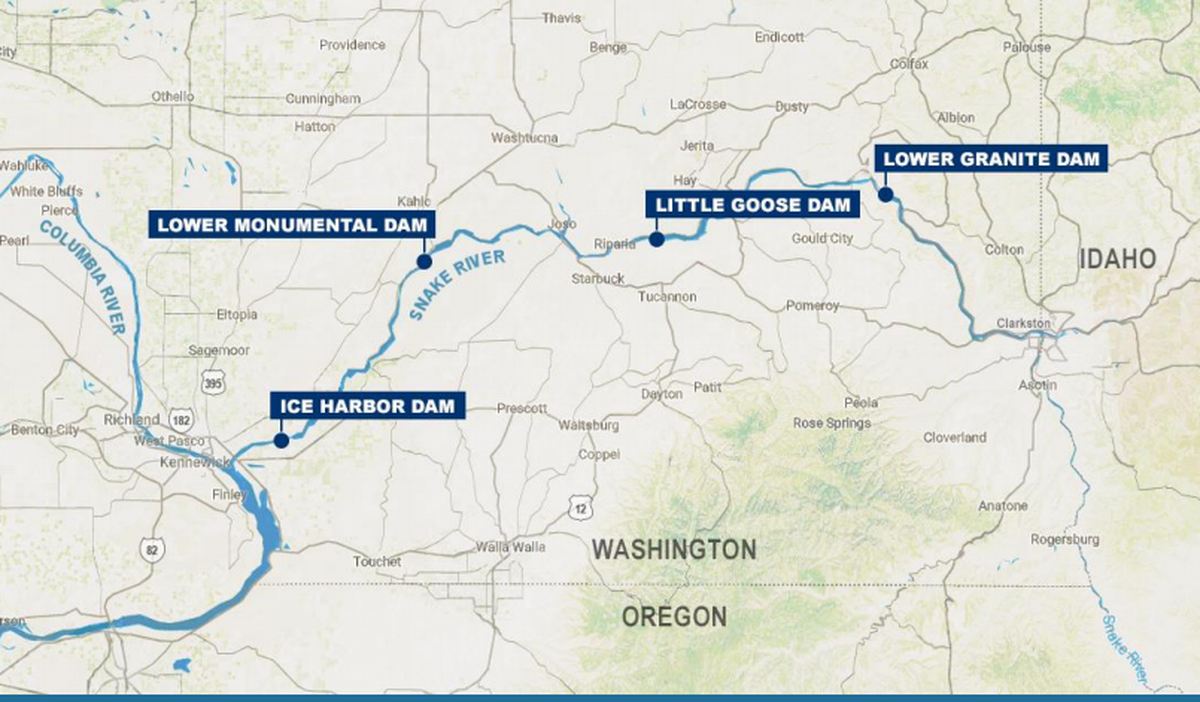
During the heatwave, electrical generation on the four Snake River dams ranged between 439 and 1,009 megawatts. At the upper end of production, it was enough electricity to power a city the size of Seattle.
The dams also were relied on for balancing reserves. They were prepared to increase their power output to ensure grid stability should other electric generators fail to provide their planned output.
At times during the heatwave the four lower Snake River dams held 15% of BPA’s total required reserves, peaking at 220 megawatts. At their highest output, the dams provided 1,118 megawatts of combined energy production and reserve capacity.
Nuclear plant ‘no touch’
Columbia Generating Station, the Northwest’s only commercial nuclear power plant, also played a role in keeping Northwest homes and businesses cooled during the heatwave.
BPA put the plant near Richland under a “no touch” order from June 25 to 30, just as it was coming online after a planned outage. The plant was down for about 40 days for maintenance and to load fresh fuel into the reactor.
Columbia Generating Station has the capability to produce 1,207 megawatts of electricity and is the third largest electricity generator in the state of Washington.
BPA occasionally requests a “no touch” order for the nuclear plant when unusually hot or cold weather causes demand for electricity to peak.
The order restricts maintenance activities at the nuclear reactor and related facilities that would either require a reduction in power or would pose a risk to sustaining 100% production.
BPA is a nonprofit federal power marketer that sells wholesale hydropower from 31 federal dams in the Columbia River Basin and also markets the output of the Columbia Generating Station.
This story was originally published July 23, 2021 at 5:00 AM.