
Tired of all the dust in the Tri-Cities? The state has a plan for better air
You don’t have to live in the Tri-Cities long to know that dust is a problem.
The area is blessed with few rainy days in the summer and fall. But, oh, does the wind blow, picking up the very fine, dry soil of the region.
A new draft report by the Washington state Department of Ecology says much of the dust that fouls the Tri-City air comes from farmland in the Horse Heaven Hills southwest of residential areas.
Farmland to the northeast of the Tri-Cities also contributes, when the wind blows from that direction.
You can expect to hear more about dust in the next few years as Ecology finalizes and puts into practice a new plan to reduce wind-blown dust.
.JPG "Hi_j0001(24).JPG")
A draft of the plan calls for a better way to warm people when dust storms are looming. Additionally, Ecology will invest $163,000 with the Benton Conservation District to help farmers use no-till or other erosion mitigation methods in their fields.
Dust storms are not as frequent as they once were.
In the early 1990s, the Tri-Cities had as many as seven severe dust storms in a year, according to Ecology.
But in the six years from 2011 to ’17, that dropped to seven severe dust storms total.
One was on Aug. 14, 2015, when wind speeds hit a maximum of 56 mph as the Tri-Cities was in the midst of a drought.
Ecology’s air monitor in Kennewick recorded a 24-hour average reading of 589 micrograms per cubic meter of small pollutants, according to ECOconnect, an Ecology blog. That’s far above the standard of 150 set by the Environmental Protection Agency.
Because of the region’s history — too many days out of compliance with federal standards for air quality due to dust — the area is required to have a plan to prevent backsliding.
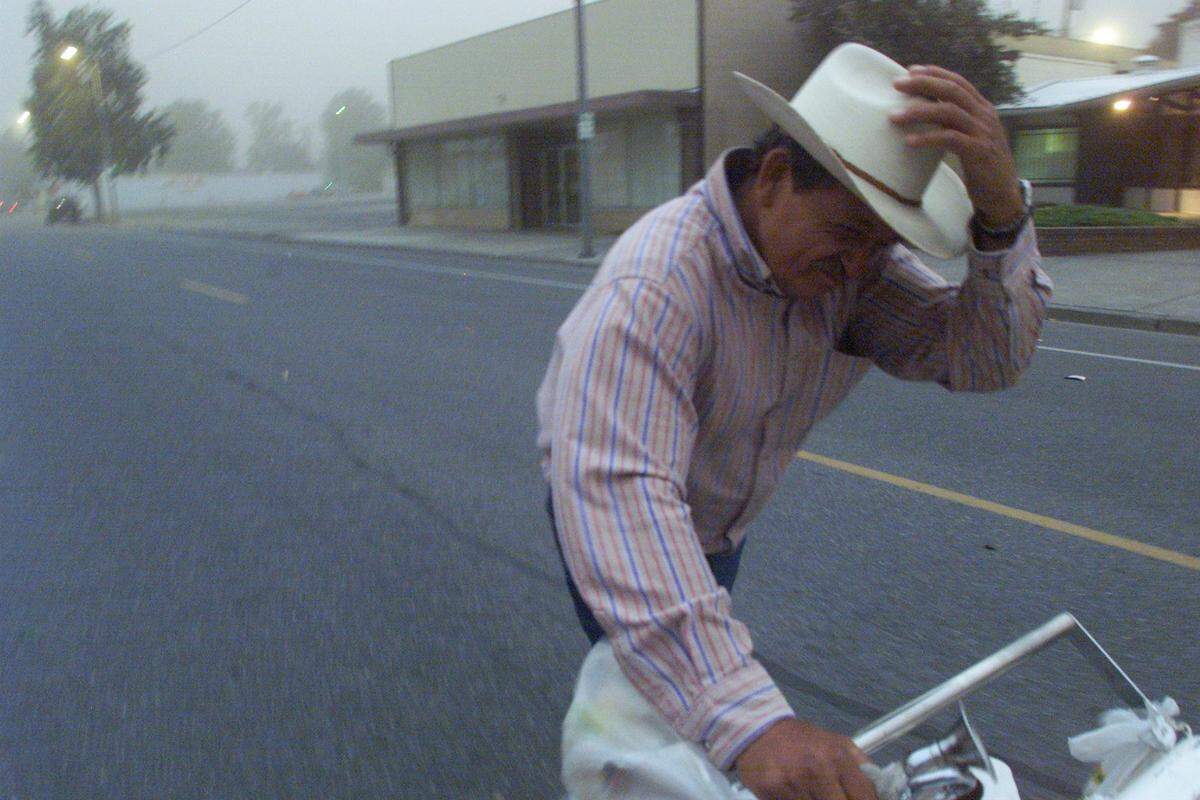
Not only does dust turn the sky a murky brown, reduce visibility for drivers and make dusting furniture a too-frequent chore, it’s a health hazard that concerns EPA.
Some of the Tri-Cities dust is too fine to be filtered out by the human nose and can be breathed deep into the lungs to cause structural and chemical changes, according to the Department of Ecology.
It can worsen asthma and heart disease, and is particularly dangerous for small children and the elderly.
Ecology’s draft High Wind Fugitive Dust Mitigation Plan calls for putting together a working group that includes the Benton Clean Air Agency, the Benton Conservation District and the U.S. Department of Agriculture.
It will coordinate with the Washington state Department of Health to improve public notification on dust storms and to provide more education on the hazards of dust.
.JPG "Hi_j0124(37).JPG")
It also will be encouraging farmers to use additional measures to reduce soil erosion.
The Benton Conservation District already has worked with wheat farmers — wheat fields are a major source of wind blown dust — to test a harvest method that strips grains from wheat heads but leaves stalks standing up to 10 inches tall.
The taller stubble helps reduce wind-blown dust.
The Franklin Conservation District has partnered with Washington State University to test prototypes of deep furrow conservation drills that reduce the soil disturbed on the ground’s surface. The method can reduce erosion by 40 percent, according to Ecology’s draft report.
The public can read the draft report that outlines the dust control plan and comment on it until Dec. 12 at bit.ly/WallulaDust. Comments also can be mailed to Laurie Hulse-Moyer, Washington Dept. of Ecology, Air Quality Program, P.O. Box 47600, Olympia WA 98504-7600.