
‘We’re exhausted.’ Tri-Cities nurse warns of COVID fatigue as cases surge
Brad Prior has seen one or two patients die in a normal week over his 21-year career as an intensive care unit nurse at Kadlec Regional Medical Center in Richland.
But at the summer peak of the coronavirus epidemic in the Tri-Cities, he often saw three people die each day, he said.
“I’m afraid that is going to happen again,” he said on Friday, as the number of new COVID-19 cases reported daily in the Tri-Cities began rising sharply even before Thanksgiving and Christmas.
Another 153 new confirmed cases of COVID-19 were reported by the Benton Franklin Health District on Friday.
Nurses already are struggling, Prior said.
They are not only physically tired from the work of caring for very ill patients since the pandemic reached the Tri-Cities in March, but dealing with the death of those patients also has taken a toll, he said.
Families can’t be with highly contagious sick relatives in the ICU, leaving nurses to offer patients the physical comfort family members cannot.
“We’re the ones holding their hands,” Prior said.
“We’re exhausted. We’re emotionally tired,” he said. “It’s like nothing I have ever had to deal with before. We’re normally the people who help other people. It’s tough for us to ask for help.”
Health care workers across the Tri-Cities have appreciated the support of the community, from kind words to meals and treats dropped off at work.
“We can’t get enough of it,” Prior said.
But what medical professionals really need now is for the public’s support to stop the wave of the coronavirus hitting the community.
Prior and other medical professionals at a Benton Franklin Health District news conference on Friday implored the public to overcome their own “COVID fatigue.”
People need to continue wearing masks, social distancing, staying home when even a little bit sick and gathering as little as possible with nonhousehold members, even over the holidays.
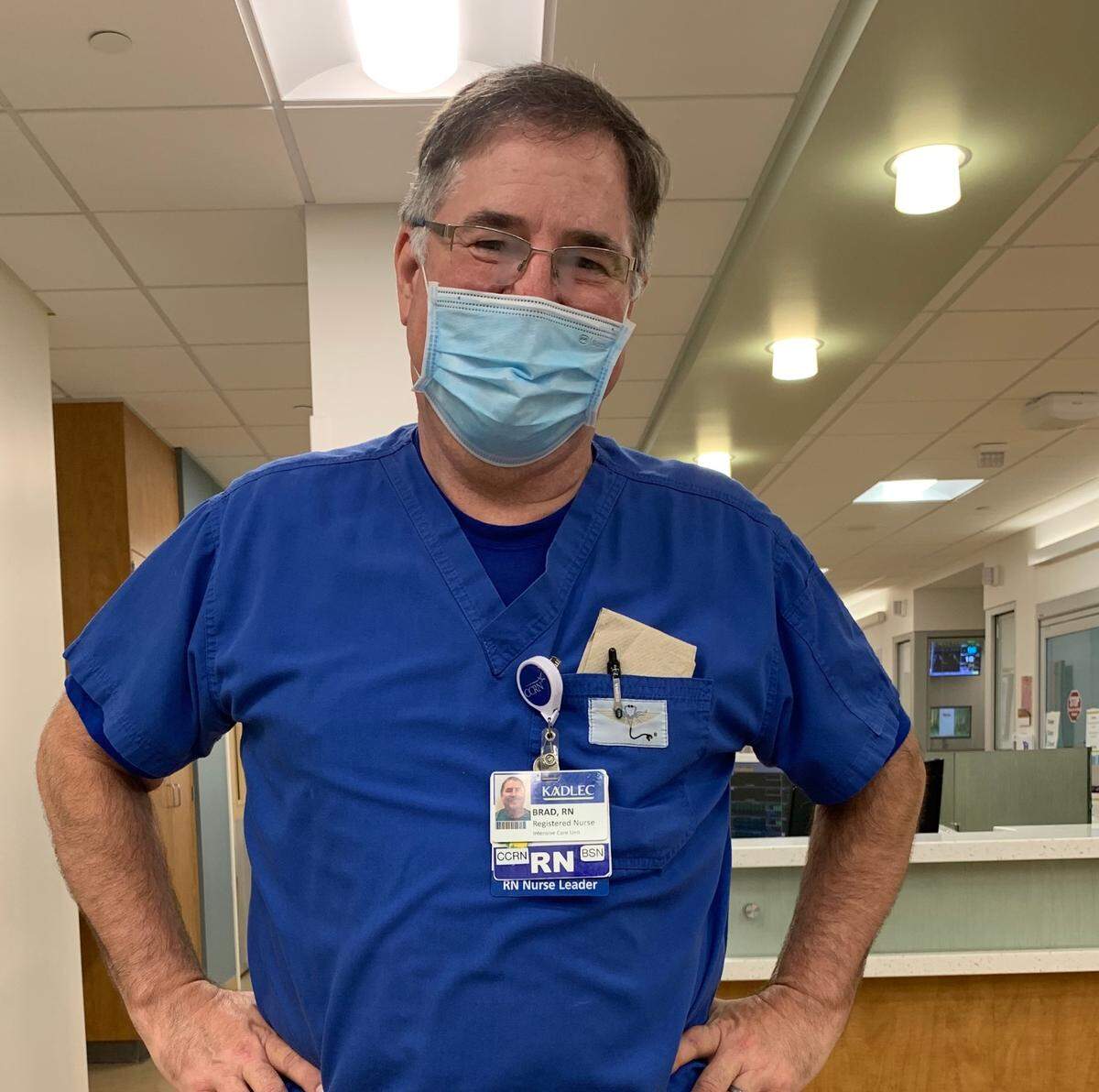
Prior said he’s canceled his plans for Thanksgiving and Christmas to protect his loved ones and make sure he does not unknowingly spread the coronavirus.
People infected with the coronavirus may have no symptoms or can spread the virus before symptoms develop.
Hospitals urge compliance
Health care workers are dealing with all the same stresses of the pandemic in their personal lives as the rest of the public, but have the added burden of providing care for those with the disease, said Reza Kaleel, chief executive officer of Kadlec.
“We’re looking for any help we can get from the community,” he said.
Kadlec has adequate personal protective equipment now for its employees and no shortages of beds or ventilators, Kaleel said.
“The bad news is we are starting to see more staffing shortages as we go into the holidays,” he said.
As the coronavirus spreads in the Tri-Cities, health care workers are among those infected in the community.
“It’s not a good combination — numbers in the community going up and ability to staff going down,” Kaleel said.
Although there is promising news nationally on vaccines being developed, it will be months before the impact of the vaccines will be seen. In the meantime, steps must be taken to prevent the spread of the virus, he said.
A surge of cases has the potential to overwhelm the Tri-Cities health care delivery system, said John Solheim, chief executive officer of Trios Health in Kennewick, who also spoke on behalf of Lourdes Health in Pasco. Both are owned by LifePoint Health.
Trios and Lourdes are prepared to handle the influx of patients and expand the capacity of facilities, if needed, he said. They have adequate personal protective equipment.
“We continue to closely monitor the prevalence of the virus in our community and build upon our hospitals’ emergency operation plan, which maps out ... our escalation plan in the event of a surge of patients,” he said.
But everyone must do their part to protect themselves, health care workers and the rest of the community, he said.
“It is going to take all of us being extra cautious and taking every possible preventive measure to change the course of the pandemic and avoid a greater health care and economic crisis,” he said.
This summer the community stepped up and started to take more precautions, such as wearing face coverings in public.
It resulted in a reduction in the spread of the virus, and a loosening of state restrictions, Kaleel said.
“We’re hoping for that level of commitment and support in the community for our health care workers who are continuing to put themselves in harms way ... and of course for the broader community so we can get back to a semblance of normal life,” he said.
Tri-Cities cases, deaths
The 153 new cases reported Friday in the Tri-Cities area brings the average number of new cases daily this week to 163.
It compares to 122 cases per day on average last week, 82 per day the previous week and 42 per day the week before that. Local cases are reported on a weekly schedule of the weekend through Friday.
Four Tri-Cities area residents were reported this week to have died recently of complications of COVID-19, with no additional deaths reported on Friday.
Since the start of the pandemic there have been 197 local deaths from complications of COVID-19, including 133 residents of Benton County and 64 residents of Franklin County.
The rate of new cases per 100,000 people over two weeks has topped 600 in both Benton and Franklin counties. The most recent complete data is for the two weeks ending Nov. 13.
The rate in Franklin County is 638 new cases per 100,000 over those two weeks, and in Benton County it is 613.
A week ago the rate was 405 in Franklin County and 411 in Benton County.
The local health district reported that 45 patients were being treated for COVID-19 at local hospitals on Friday. That’s up from 21 a month ago.
The 45 COVID patients amounted to 12% of all patients in the hospitals in Richland, Kennewick, Pasco and Prosser.
The Washington state Department of Health says the goal to maintain adequate hospital capacity requires COVID patients to be less than 10% of all hospitalized patients.
Washington state
The Washington state Department of Health reported 1,987 new confirmed cases of COVID-19 and 11 deaths on Thursday.
Statewide totals from the illness caused by the coronavirus are at 137,411 cases and 2,603 deaths, up from 135,424 cases and 2,592 deaths Wednesday. Washington’s population is estimated at about 7.6 million, according to U.S. Census figures from July 2019.
Thirty-four people were admitted to Washington state hospitals on Oct. 31, the most recent date with complete data. Average daily hospitalizations peaked in early April at 78.
On Nov. 8, the most recent date with complete data, 7,486 specimens were collected statewide, with 10.1% testing positive. The average positive test rate for the seven days prior was 7.4%. More than 2.8 million tests have been conducted in Washington.
The test numbers reflect only polymerase chain reaction tests, which are administered while the virus is presumably still active in the body.
King County continues to have the highest numbers in Washington, with 36,471 cases and 846 deaths. Pierce County is second with 13,912 cases and 261 deaths, by the state’s tally.
Yakima has 12,710 cases and 291 deaths, Spokane has 13,331 cases and 224 deaths and Snohomish had 12,002 cases and 258 deaths.
Benton County ranks sixth for cases, followed by Clark and Franklin counties. If Benton and Franklin counties were considered together, they would rank fifth, according to the most recent data complete for all counties in the state.
All counties in Washington have cases. Six counties have case counts of fewer than 100, including Columbia with 26 cases.
For the past seven days, Washington had a case rate of 29.2 per 100,000 people. The national rate for the same period is 49.7 per 100,000, according to the Centers for Disease Control and Prevention. North Dakota has the highest rate in the United States, at 177.4. Hawaii is the lowest, at 5.
There have been more than 11.6 million confirmed coronavirus cases and 251,970 deaths from the virus in the United States as of Thursday afternoon, according to Johns Hopkins University. The United States has the highest number of reported cases and deaths of any nation, although some countries have a higher rate based on population.
More than 1.3 million people have died from the disease worldwide. Global cases exceed 56 million.
Craig Sailor of The (Tacoma) News Tribune contributed to this report.
This story was originally published November 20, 2020 at 2:19 PM.