
New Horse Heaven wind farm proposal picks tallest turbines. Tribe objects
An update to the plan for a 24-mile wind farm south of the Tri-Cities is already drawing sharp criticism from the Yakama Nation.
A Washington state council should reject a revised plan for a 24-mile-long wind farm just south of the Tri-Cities, said the Yakama Nation as a public comment period on it related to changes that could be required for its environmental review opens.
Only one of the six Washington state Energy Facility Site Evaluation Council (EFSEC) members who considered the original plan approved for the Horse Heaven Clean Energy Center remain on the board, and the “new council” likely does not grasp the gravity of the harm proposed by the revised plan, said Chairman Gerald Lewis, chairman of the Yakama Nation Tribal Council.
The council has held extensive discussions on the project over the past five years before twice recommending that the Washington state governor agree to it.
The revised plan includes updates since former Gov. Jay Inslee approved the Canada-based Scout Clean Energy project in November 2024 with some details and restrictions then yet to be worked out for the project with wind, solar and battery storage components.
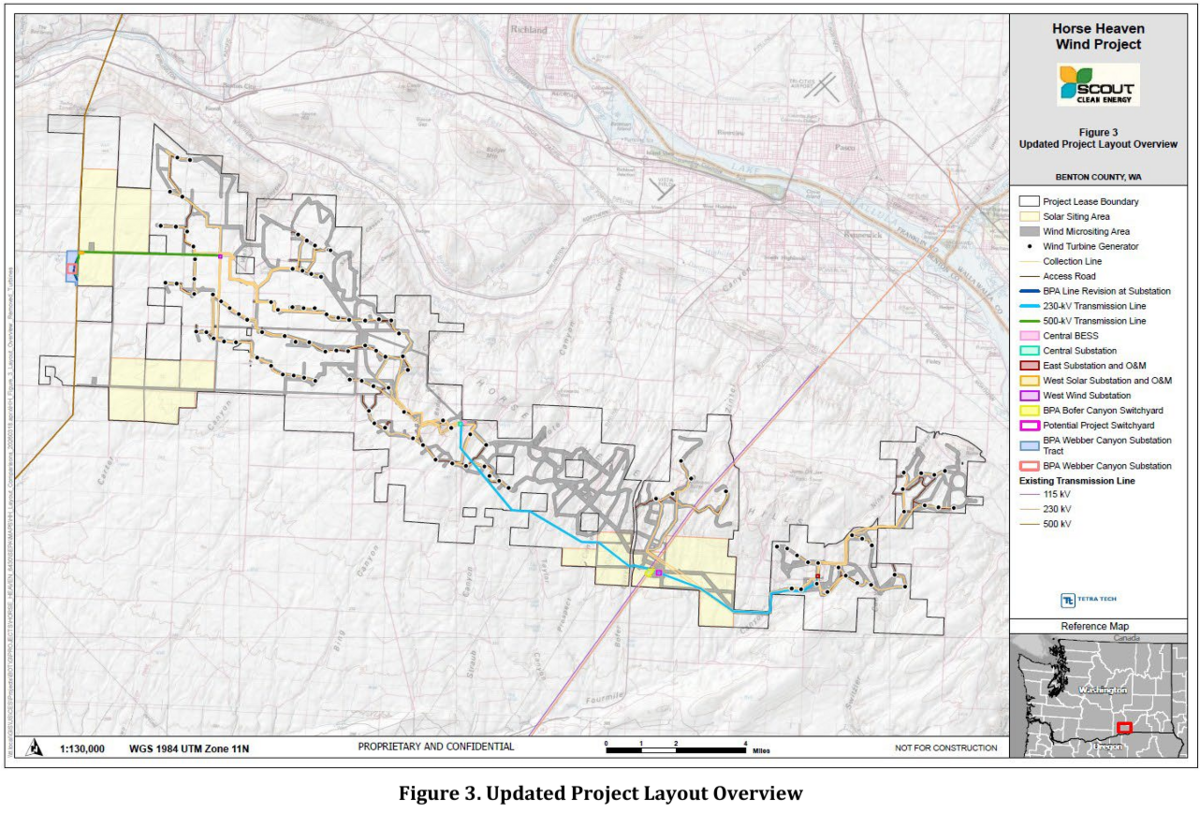
Among new details released are the size and allowed number of turbines.
Scout now has committed to using the tallest of the wind turbines it had proposed at up to 670-feet-tall, which is taller than the Seattle Space Needle.
However, due to endangered ferruginous hawk nesting areas and Yakama cultural resources, no more than 116 of the 147 turbines proposed would be built.
The alternative would have been to use up to 222 turbines standing about 500-feet tall, with some reduction in number to protect hawk populations and cultural resources.
The preliminary layout information Scout Clean Energy gave EFSEC for the 116 turbines proposed could still be modified as it works on a more detailed design, Scout told EFSEC.
The updated design available now also includes power line changes, including a transmission line crossing Interstate 82 just north of Beck Road. A proposal to bury the line did not prove feasible, according to EFSEC staff.
In May 2024, then Gov. Inslee rejected EFSEC’s first recommendation to approve the project after eliminating about half the proposed turbines.
It recommended at the time reducing the turbines after considering endangered ferruginous hawks, Yakama cultural resources and the southern view from the Tri-Cities of the Horse Heaven ridgeline.
But Inslee said the restrictions were excessive, and the council instead needed to prioritize the state’s pressing clean energy needs. The council complied.
The process and outcome for approving the Horse Heaven Clean Energy Project is being challenged in the Washington Supreme Court, with EFSEC continuing to work through required steps before start of construction as the court considers whether the project was lawfully approved.
Arguments in the court case were heard June 11, and a ruling is expected this summer.
EFSEC staff says the proposed design updates will result in less visual impacts overall because of the reduced number of turbines.
But an initial comment filed on Monday, June 29, by Tri-Cities CARES, a community group opposing the wind farm, said that visual representation had not been done on what would now be some taller turbines than previously considered in part of the wind farm closest to the Tri-Cities.
Tri-Cities CARES has previously said that the turbines would be visible from most of the Tri-Cities.
“We strongly recommend that the ‘final’ completed project design be brought before the council and with public comment opportunity,” said a comment on behalf of Tri-Cities CARES.
EFSEC plans to consider public comments received on its proposed supplement to the final environmental impact statement as its new executive director considers what EFSEC says are “non-substantial” changes in the analysis of environmental impacts.
Yakama Nation objects
The Yakama Nation says that the revised plan perpetuates EFSEC’s decision to allow devastating impacts to the Yakama Nation’s cultural resources within what it says is the sacred Horse Heaven Hills landscape.
The Yakama Nation appreciates the care and time that was used to analyze habitat protections for endangered ferruginous hawks, Lewis wrote.
“At a minimum, that same level of care should be taken to address the project’s well-documented harmful impacts to Yakama Nation’s cultural resources,” he wrote.
He called for the council to stop the project from moving forward until the plan is modified. EFSEC need to re-engage with the tribe to ensure the present council becomes fully aware of the project’s impacts before making any further decisions, Lewis wrote.
Public comments addressing the environmental review are due July 9, and the review will be discussed at EFSEC’s meeting July 15.
Comments may be submitted electronically at comments.efsec.wa.gov or mailed to The Energy Facility Site Evaluation Council; PO Box 47250; Olympia, WA 98504-7250.