
Mr. Movie: ‘The Trial of the Chicago 7’ is done with a masterful sense of history
Before I get into the reviews, I want to note that Governor Jay Inslee has moved Benton and Franklin counties to Phase 2 of his COVID recovery plan. That means you can not only bump into each other at a big box store or eat at a restaurant, you can also now go to a movie theater.
For someone like me who has practically lived in movie theaters all of his life, this is incredible news. I’ve had conversations with Fairchild Cinemas and they will soon open their theaters. This is written on Thursday morning and by the time I submit to my editor, they may have decided to open this weekend.
I hope so.
Fairchild Cinemas is a small business and they’ve — no doubt — been seriously hurt financially by the pandemic. I wish them well and look forward to grabbing a seat at one of their theaters very soon.
As for Kennewick’s AMC Classic theater, I have not been able to reach corporate officials. Whether they’ll open soon — or at all — is anybody’s guess. I hope they can and do open but I’ve seen stories that say AMC is going to fold. Time will tell on that one.
In the meantime, Tri-Cities, we can go to movie theaters again!
The Trial of the Chicago 7
In 1968 I was 19. In the 1960s and pushing into the 1970s, not enough people were volunteering to go into military service. So the government drafted young men and forced them to do two years in the Army. With the war in Vietnam growing bigger by the day, the U.S. government began a massive campaign to draft young men to serve that war effort.
Thousands were drafted.
In 1968 Lyndon Johnson was president. He escalated the war. The point was to stop the spread of communism. His successor, Richard Nixon, had a “secret plan” to end the war. That plan also involved drafting me and thousands of others my age.
Many in my generation complained. Loudly. Our fathers — who ran the country — didn’t really care. In fact, no one cared. A guy with long hair was automatically a subversive and a police target. Long hair meant you obviously had drugs on you or they were hidden somewhere in your car. Police would follow you, harass you, ticket you and sometimes arrest you.
For nothing.
The police could get a bit violent. It was okay. We were in the wrong. And don’t be black. If you were black and wanting civil rights and fair treatment then bad people wanted bad things to happen to you.
If you were counterculture and protesting against the war, or protesting for civil rights, you were a target of people who thought you were totally against the American way of life and some — not all — but some, would attack you, physically harm you and no one really cared. Not your family, not your neighbors and certainly not the justice system.
Sorry, but this is an area that makes me laugh.
Many of today’s younger citizens want safe spaces, dialogue, an explanation and even an apology. In 1968 there were no safe places. Instead of patting our little heads and telling us everything is okay, and that we’re all really special and — by the way — you can have a trophy, our fathers, mothers and the authorities they sanctioned, pushed back.
Often violently.
History shows the decisions of Johnson — and later, Nixon — to expand the war in Vietnam didn’t sit well with a large percentage of young people. A bunch of us burned our draft cards. Like that mattered. You got drafted anyway. Some smuggled themselves into Canada. Others hid overseas.
Many did the flower power thing and adopted a make love not war philosophy. A number of others got kinda violent, took over college campuses and battled police in the streets and in parks.
That didn’t work all that well either. Many still got drafted.
Then there are those like the Chicago 7. They allegedly started a riot. No. Not allegedly. They actually did start one. Maybe not on purpose, or maybe on purpose. No one really knows for sure. The fact is that one started. And it started at the Democratic Party’s national convention in Chicago.
The August 1968 convention was a show to behold.
“The whole world is watching,” was the outcry as protesters — many attracted by the public outcry of the leaders of a number of counterculture factions — flooded the area around the convention. Naturally, the Democrats — who were then leading the war effort — didn’t like the idea of all those kids knock, knock, knocking Sen. Hubert Humphrey. With the death of Bobby Kennedy in June of 1968, Humphrey was a shoo-in for the nomination.
Chicago Mayor Richard Daley made sure the protestors got a warm welcome to the Windy City.
That led to a riot and the arrest of Tom Hayden, Abbie Hoffman, Jerry Ruben, Black Panther leader Bobby Seale and several others. A bit over a year later they were tried in the court of federal Judge Julius Hoffman. The charges were federal since the defendants were accused of crossing state lines with the intent to cause a riot.
As an aside, Hoffman several times during the trial made sure those in his courtroom knew he was not associated with, nor related to Abbie Hoffman. Those scenes are among the funniest in an often, and ironically, funny movie.
And here we are, 500-plus words into this and I just reminded myself that I am actually reviewing one.
The humor is classic for writer turned writer-director, Aaron Sorkin. Biopics are his thing and Sorkin’s films are serious but the inclusion of some comedy gives them interesting dimensions. Those unique dimensions got Sorkin an Oscar and a Golden Globe for writing the tale of how Mark Zuckerberg founded Facebook. “The Social Network” was much more entertaining than “Steve Jobs.” Sorkin’s ripping of the life of the Apple founder is a very good, and very revealing, script. It won a Golden Globe and put actor Michael Fassbender on the map.
Sorkin’s best work — “Moneyball” — got lots of nominations but didn’t win anything at all.
Outside of it being a fascinating story, a big plus for “The Trial of the Chicago 7” is the casting. Oscar and Golden Globe winner Eddie Redmayne (“The Theory of Everything”) plays Hayden. Sacha Baron Cohen gets the nod as Hoffman. That’s Abbie, not Julius.
The judge — as noted — will have none of that.
Rounding out the defendants most in focus in Sorkin’s script are Jeremy Strong as Jerry Rubin, John Carroll Lynch who plays David Dellinger and Yahya Abdul-Mateen II, the actor cast as Bobby Seale.
They’re all very, very good. Redmayne’s Hayden is an uptight control freak who wants to make a political statement but is scared to death that Hoffman — who is a loose cannon — is going to screw things up and get him sent to prison for a long, long time.
Hoffman — as Cohen sees him — wants to play games with the system, and with much humor points out the tragedy of all those young lives lost in Vietnam. He won’t entertain anything resembling compromise and has no respect for the system. Hoffman believes he is right and is willing to risk it all to prove his point.
And he’s very funny getting to that point.
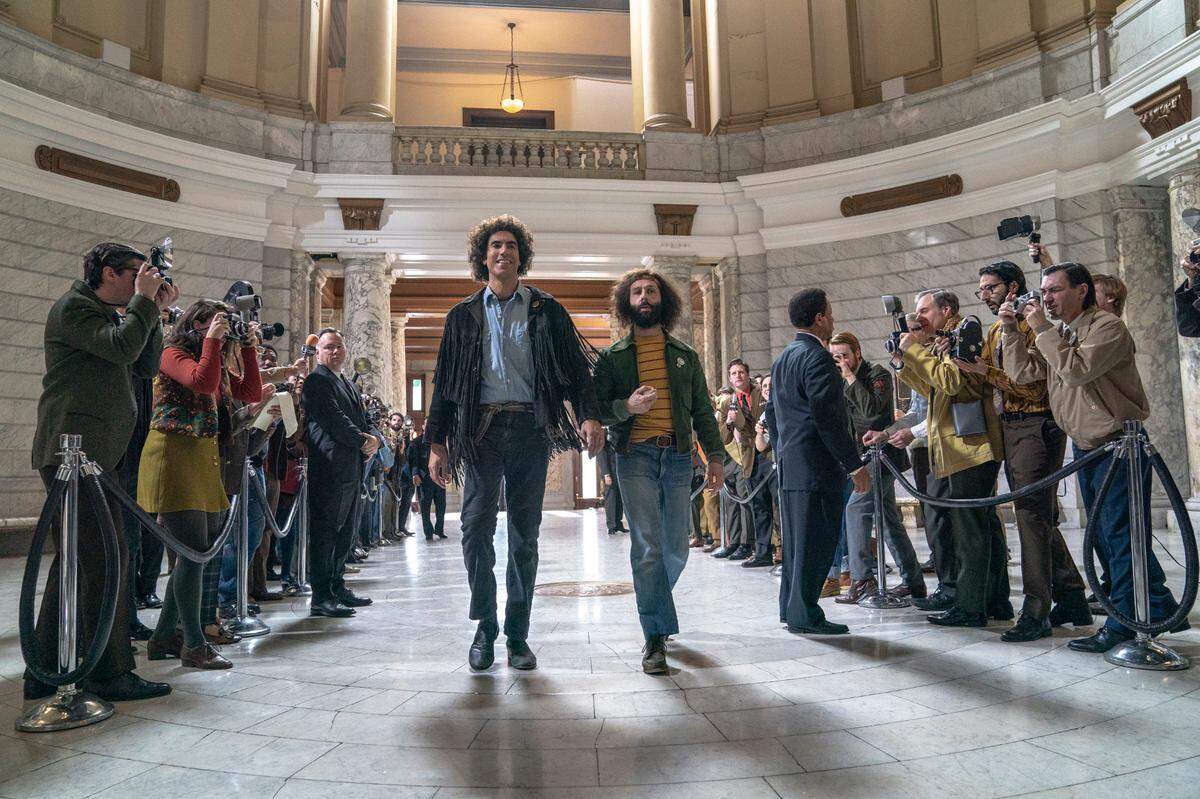
Cohen plays Hoffman perfectly and throughout the movie he and Strong do what is almost a standup comedy routine. Another great performance comes from Strong who plays Rubin as not quite playing with a full deck.
Also very good in supporting roles are Joseph Gordon-Levitt who underplays prosecutor Richard Schultz and Michael Keaton who has a small part as former attorney general, Ramsey Clark.
The accused are the fulcrum. Everything balances on those men and the plot weaves in and out of the actions they took in Chicago in the summer of 1968. What they don’t do is all the heavy lifting.
That task falls to Oscar winner, Mark Rylance (“Bridge of Spies”) and to Frank Langella’s Judge Hoffman. Rylance plays defense attorney William Kunstler. He is a patient actor who — as we saw in “Bridge of Spies” — is a master of the low key. Kunstler reluctantly winds up with the job of babysitting his sometimes out of control clients and a judge who is a brick shy of a full load.
And we are now at the film’s finest performance. Frank Langella has a blast as Judge Hoffman. The fun in this casting is Langella’s Oscar and Golden Globe nominations in 2008. He played disgraced president Richard Nixon in Ron Howard’s film, “Frost/Nixon.”
Here he plays a now-disgraced judge.
In real life Hoffman’s rulings, courtroom demeanor and antics matched those of the defendants. His rulings were so outrageous that they have become legend. Hoffman stretched the law all kinds of ways to benefit the prosecution and sees the defendants in front of him as lawless hoods out to destroy the country and his way of life.
Langella does the judge like an angry father chastising his unruly children.
This is the best supporting actor performance I’ve seen in years and if Langella doesn’t take home an Oscar and a Golden Globe, then both groups — in my book — will lose all credibility. And they don’t have much credibility in my eyes these days anyway.
Even in a year when things are “normal,” Langella’s performance would top them all. It’s fantastic work.
And so is the movie. Sorkin blends real life acting with actual footage from the streets and the park around the convention site. It gives you a sense of history and a sense of the time in which the trial happened.
This is best picture and best director territory. Ironically, it was filmed way before what is happening now happened. The movie unintentionally reflects what is happening today.
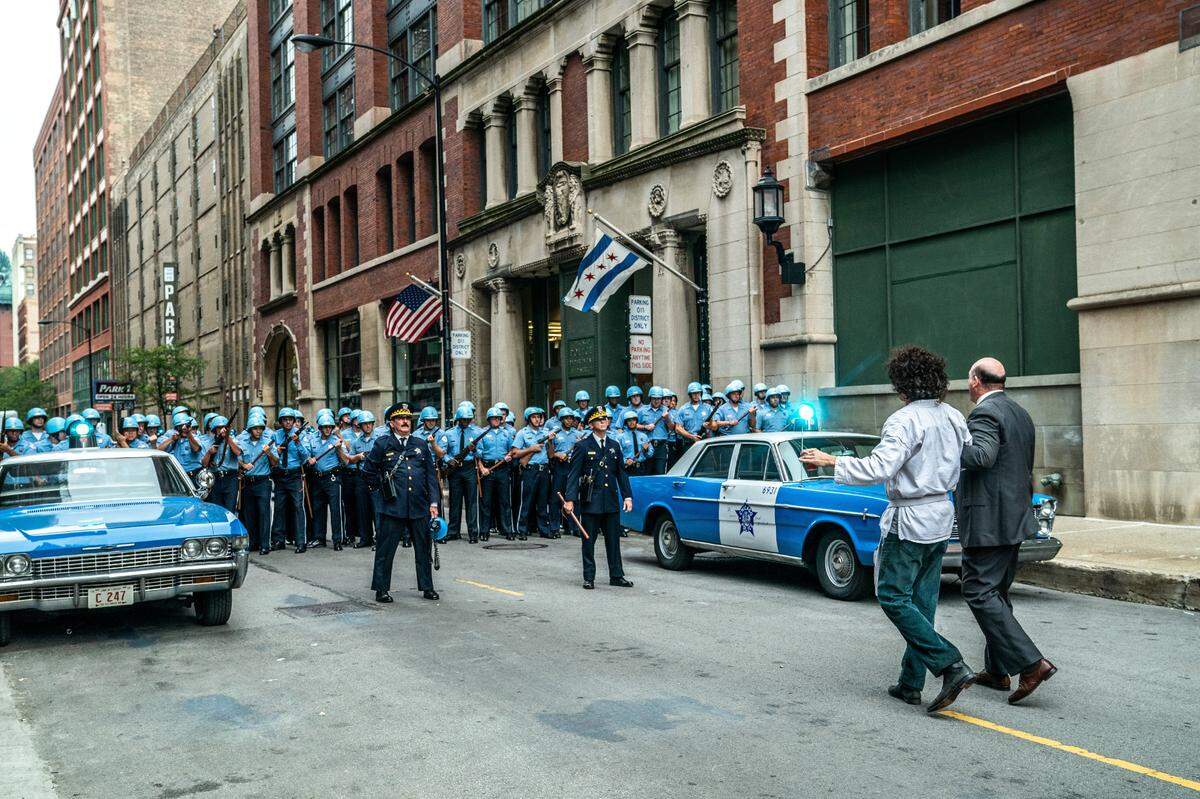
In 1968 voices wanted to be heard. In over 50-years everything has changed, yet nothing has changed and still, those voices want to be heard. The reaction of the establishment today is much like that experienced by the Chicago 7.
Misunderstanding reins. Many don’t hear the voices. Worse, these days those voices don’t have faces. In 1968 we knew Hoffman and Hayden and the others. We read about them, saw them on TV and heard what they had to say in public appearances and on radio.
Today’s voices aren’t seen. Their leaders are hidden in social media. Texting and other, more silent forms of communication are used to get the word out about a protest. Many of those attending those protests on the left and on the right, are causing violence. Sometimes it’s the police and other authorities that incite that violence. Other times it is those on the left. Often it’s those on the right.
Sadly, that violence destroys the message.
It’s a message that is very loudly made in “The Trial of the Chicago 7.” And that message is that voices just want to be heard. Those voices want change and justice from a system that too often — these days — seems to lack justice.
By the way, I did get drafted. In 1969, Uncle Sam wanted my service. I was married and had a young child and another on the way. The army would take married men but would not take married men with children.
So I didn’t serve. However, I was one of the thousands of voices who marched for civil rights and who opposed the idiocy of the war in Vietnam and the policies that put us there.
Since I made that admission, I also want to make it clear that I respect and admire the men who were drafted and who served, and those who volunteered and served. I still do. They did so because they felt the need to serve their country. The men of my generation are amazing human beings, and with great courage and sacrifice — often with their lives — they helped make this country the planet’s best place to live.
▪ Rated R for language and violence. You can find it on Netflix.
▪ Rating: 5 out of 5
Nocturne
It’s October. That month always brings a plethora of horror movies to theaters. These days it’s more via streaming sources than theaters. No matter the source, they come in bunches in October.
One of this year’s “bunch” is Nocturne.
To be kind, it’s awful. I saw the movie on Monday of this week. It was so awful, and so forgettable that I had to Google the plot to remember what I saw. That’s embarrassing. But for who? Me? Since I’m a critic and ought to remember these things. However, some blame has to sit with writer/director Zu Quirke.
This movie is a boring mess. By the way, Quirke hasn’t done anything you’ve ever heard of and, judging by the outcome of “Nocturne,” won’t likely be heard from again.
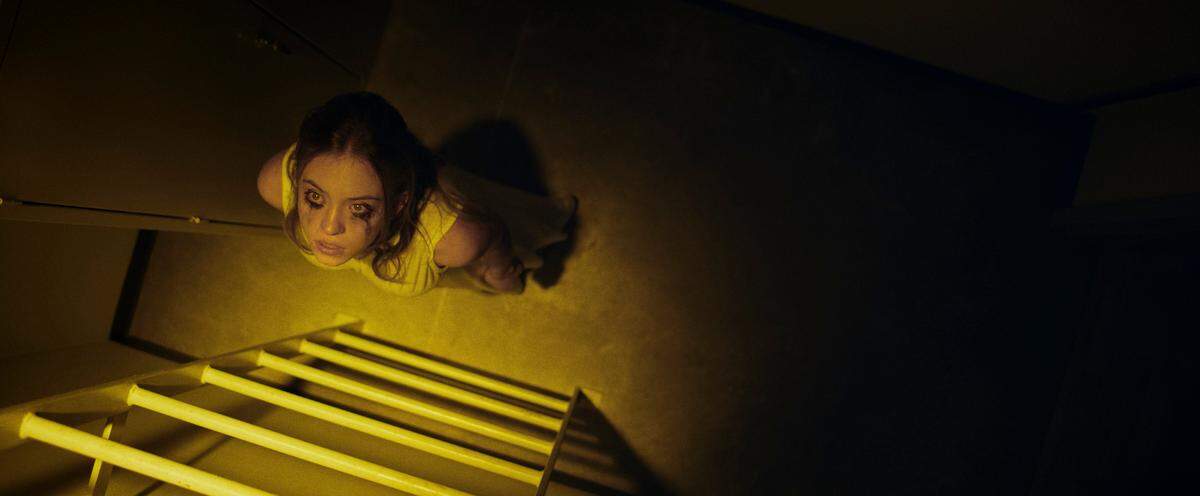
Twin girls are both pianists. One is better than the other. Sibling two discovers the book of a young woman who was to get the spotlight in the music school’s annual wing-ding. Instead, she commits suicide.
She got caught up in some sort of demonic thing. Sibling two ends up in the same bind. Though she isn’t as good at piano as her sister who is a shoo-in for the spotlight, she’ll do anything to win that place. Evil happens.
Sydney Sweeney (“Handmaiden’s Tale”) and Madison Iseman (“Annabelle Comes Home”) star as the sisters. The two actresses are very good in a film that doesn’t come close to being worthy of their acting skill.
“Nocturne” is horrifyingly horrible.
▪ Not rated but probably PG-13. It’s an Amazon picture so you’ll find it on Amazon Prime.
▪ Rating: 1 out of 5
Evil Eye
“Evil Eye” might be the slowest, most boring horror movie of all time. If the production values were better, and the actors cast in these roles better known, it could replace Francis Ford Coppola’s “Bram Stoker’s Dracula” on one of my horror movie lists.
That is my “why did they even bother to make this” list.
The film is done by Elan Dassani and Rajeev Dassani. I guess you could call it horror done Bollywood style. Sarita Choudhury (“The Hunger Games: Mockingjay”) is mother to “GLOW’S”) Sunita Mani. She wants her pushing 30 daughter to be married. After half a movie of nagging, the daughter has found someone and is in love.
It’s then mom — via some really dumb premonitions — decides this person is the wrong guy and will do her more damage than good. You know all along that she’s right because the handsome dude is way too handsome and he’s just a little bit weird.
That’s a good fit because “Evil Eye” is just a little bit good. All that makes this worth seeing is the colorful costumes and the typically Bollywood color-packed scenes.
Just getting to whether this guy is evil or not takes at least half of the movie’s 90-some minute length. It seems to take forever for the evil eye in “Evil Eye” to come into play.
And once it does — if you’re still awake — you won’t care.
▪ Not rated but probably PG-13. It’s an Amazon picture so you’ll find it on Amazon Prime.
▪ Rating: 1/2 out of 5
This story was originally published October 15, 2020 at 6:07 PM with the headline "Mr. Movie: ‘The Trial of the Chicago 7’ is done with a masterful sense of history."