
+$1M abandoned tire mess tied to Tri-City legislator’s record WA ethics fine
The enormous collection of discarded tires in Richland didn’t happen overnight.
It started on Oct. 31, 2000. Halloween.
That’s the day Jim Penor, manager of the Richland landfill at Horn Rapids, his wife Sherrey Hankins, and her sister, Shelley Hankins, agreed to lease a three-acre site from the Port of Benton.
The land near Stevens Drive was for their upstart business, Northwest Tire Recycling Products.
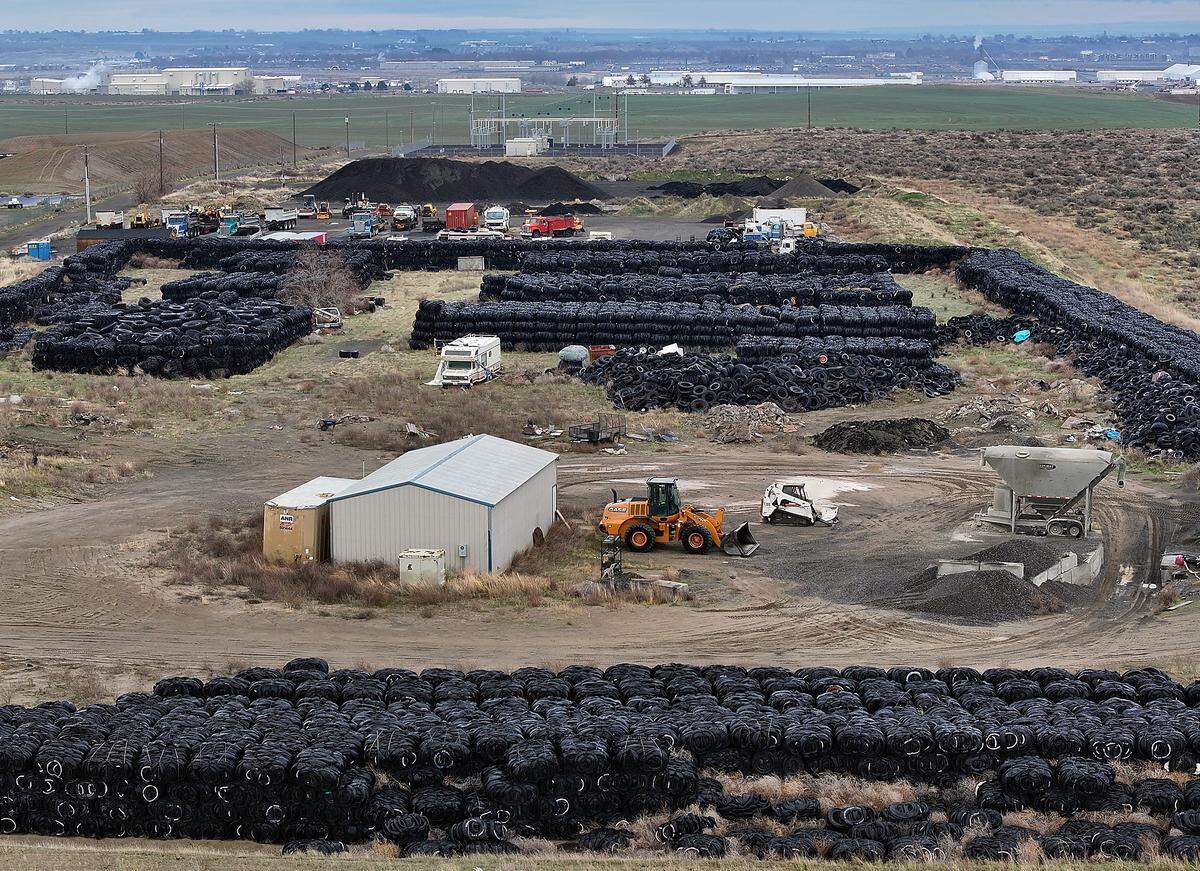
Two-plus decades later, the result is the largest accumulation of discarded tires in Washington and a $1 million-plus cleanup headache for the city of Richland.
That wasn’t the goal. Penor was a waste industry veteran with big ideas about transforming something no one wanted into something people would buy.
Northwest Tire Recycling would accept used tires, squash them into cubes and sell the rubbery blocks for use at shooting ranges, roadbeds, retaining walls and dairy drainage.
Important connection
The Hankins sisters brought an important connection. Their mom was Rep. Shirley Hankins, R-Richland, a popular local lawmaker with an interest in solving the challenge of discarded tires.
The family and the lawmaker weren’t the only enthusiasts. The Benton Franklin Council of Governments loaned $178,000 to launch the venture, at 9% interest, according to reports after the project faltered.
Its mission was audacious, and its timing was good. There was growing awareness that discarded tires were a problem that needed solving.
Washington residents cast off 5 million tires a year, according to Tri-City Herald stories at the time. The Herald covered the rise and fall of Northwest Tire Recycling in exhausting detail, from its start in 2000 to its end in 2007.
As promising as it appeared, its legacy would include not only the largest collection of discarded tires in the state, but a record fine by the Legislative Ethics Board against Rep. Shirley Hankins.
Eco-friendly message
Northwest Tire Recycling touted itself as an environmentally friendly business, motivated by a desire to clean up tires that could cause problematic fires and serve as breeding grounds for West Nile virus.
It called its bales “EcoBlocks” and sold them cheap — less than $20 a bale.
Trouble arrived early, even if it wasn’t obvious at the time.
Washington Gov. Gary Locke was set to preside over Northwest Tire Recycling’s grand opening on Sept. 12, 2001.
The 911 attacks ruined the plan. The grand opening was delayed to October. Locke wasn’t able to attend on the new date.
Pressing on
Penor and the Hankins sisters pressed on.
The business model was straightforward. Northwest Tire Recycling collected a $1 fee for passenger tires and a $5 fee for semi truck tires., as spelled out in state law that was revived in a 2005 bill pushed by Rep. Shirley Hankins.
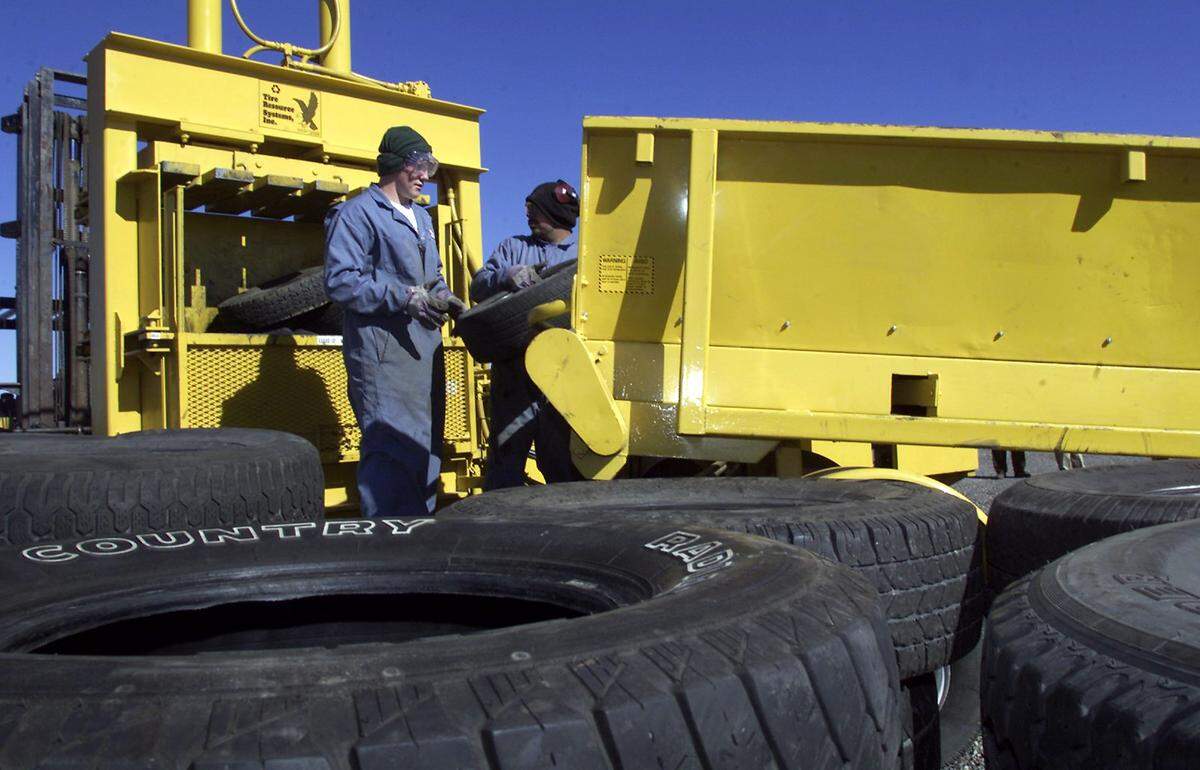
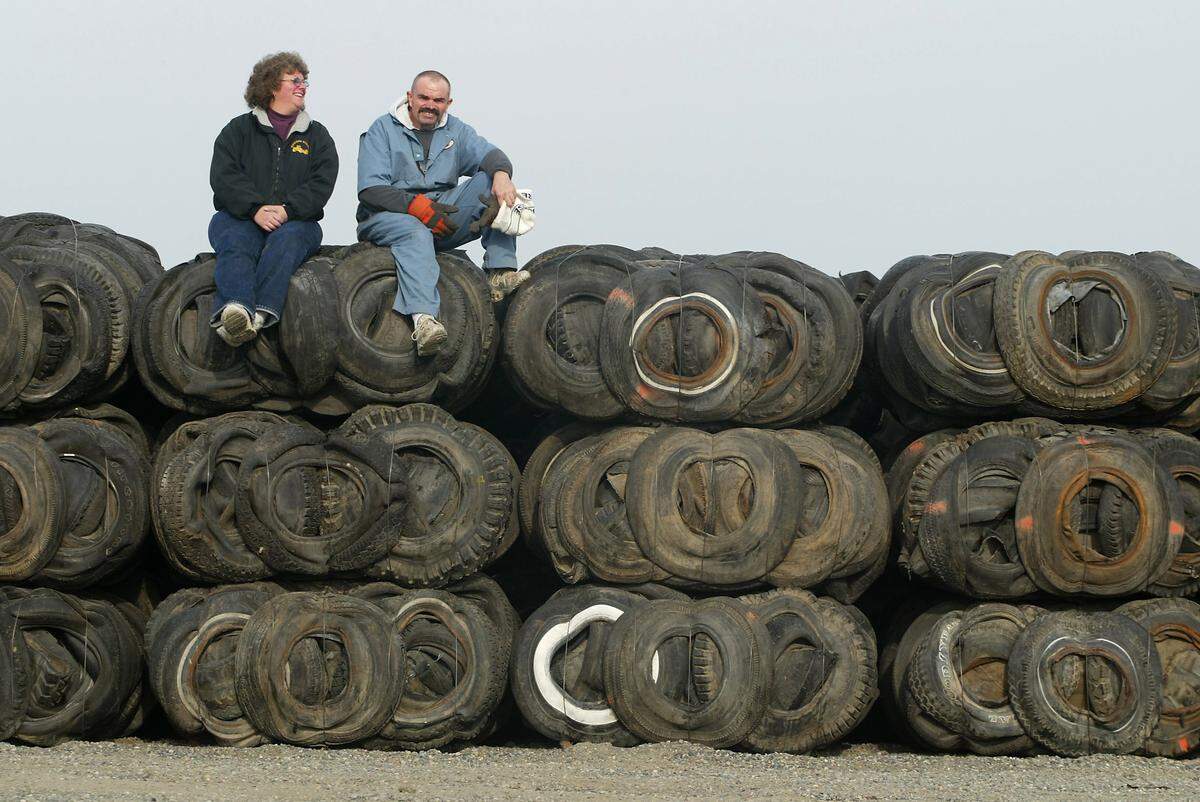
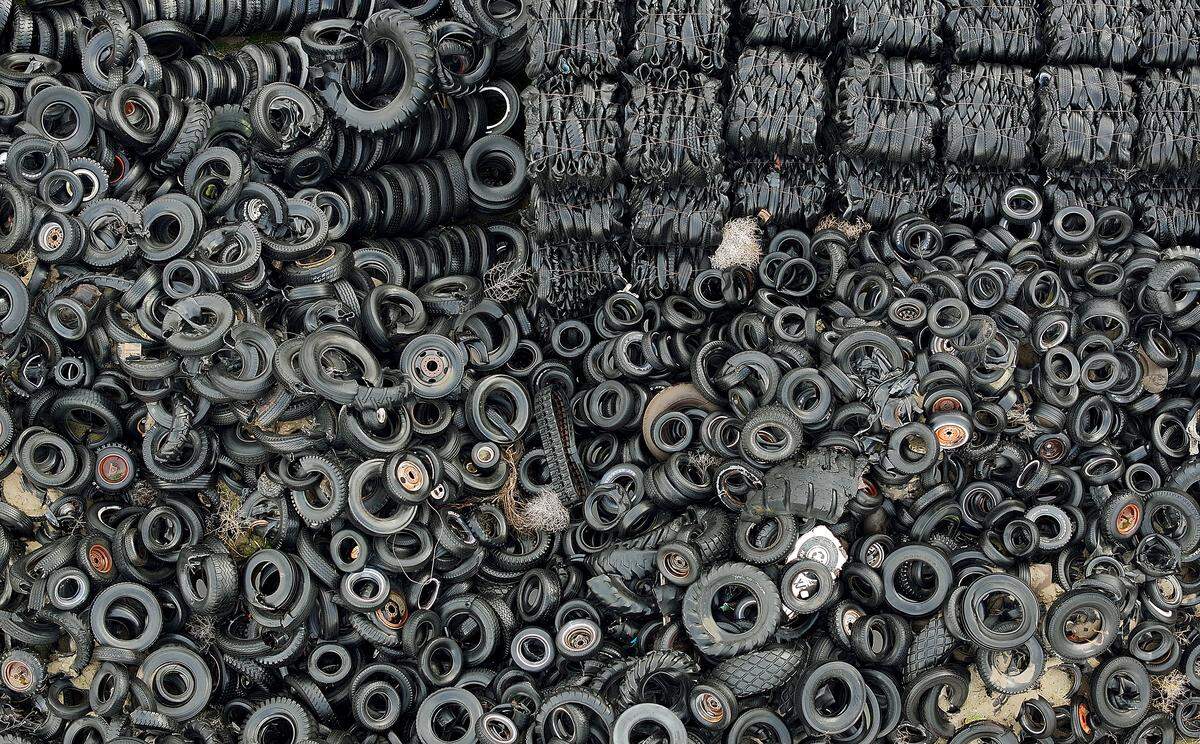
The small crew peeled tires off their rims, cut them up, and compressed them under 3,600 pounds of pressure into bales the size of a hay cube. Each weighed about a ton and contained 100 tires.
The bales were stacked neatly around the property on Stevens Drive.
The company’s stay there was short. Around 2005, it moved to its present location, 2990 Twin Bridges Road, a five-acre spot off Highway 240 at the entrance to the Richland municipal landfill.
Well before the move, Northwest Tire Recycling was prompting uncomfortable questions.
In 2002, the Tri-City Herald looped back to the young business for a “Monday Update” feature.
The news was mixed. Tires were coming in, being processed, and baled. Fees were being paid.
“We’re paying our bills,” Sherrey Hankins told the paper.
Tire bales pile up
But few were buying the baled tires. There were 1,200 EnviroBlocks stacked around the property after less than two years in operation.
Port of Benton Commissioner Bob Larson hoped the tire business would succeed. But Larson, who died this December, brought a troubleshooter’s view to the job.
He was a retired procurement director for the Department of Energy, and he feared the growing number of tire bales on port-owned property could be bad news in the future.
He sought assurances taxpayers wouldn’t be stuck with a yard full of tires if its tenant failed, the Herald reported.
Northwest Tire Recycling countered that it had posted a $10,000 bond with the state and dedicated a portion of its fees to a cleanup fund. Rep. Shirley Hankins later appeared before the commission to assure it the tire bales were marketable.
The business left the port property a few years later.
Lawmaker under fire
The new location proved troublesome from the start.
The business reportedly operated without a business license for two years and at one point was in danger of losing its solid waste permit. It tangled with both the city of Richland and with the Benton Franklin Health District, one of its regulators.
By 2007, Northwest Tire Recycling was news, and not in a good way.
That February, the Tri-City Herald published a three-part series tracing the history of the business and documenting how Rep. Shirley Hankins used her role as an elected lawmaker to advance its interests.
The first line of the first story spelled it out. Hankins used the power of her office to “muscle state and local officials into directing business to her two daughters’ struggling tire bailing company.”
The report helped inspire an investigation by the Legislative Ethics Board that determined Hankins had broken state ethics laws. It fined Hankins $4,175, more than twice the largest penalty previously levied against a legislator.
Hankins disagreed with the board’s conclusion but retired soon after.
When she died last year, she was remembered in the Herald as an “old-style Republican” with an independent streak.” The news obituary acknowledged but did not dwell on the ethics violations.
Exerting pressure
But the investigation’s results were damning.
It showed Hankins was warned by the director of the Department of Ecology that her overtures on Northwest Tire Recycling’s behalf “implied that she is pursuing tire interests on behalf of her kid’s recycling business.” His email was later forwarded to staffers.
At home, she told city regulators that the company’s licensing hurdles would be overturned in Olympia, and she told members of two Richland advisory boards she could secure grant funding for the city if they used tire bales in their projects. City leaders publicly complained that staff felt intimidated by Hankins.
She came under fire not just for advancing the business, but for actively promoting it for lucrative Department of Ecology tire cleanup work.
In one notable case, she arranged site tour at the infamous pile of 2.2 million tires near Goldendale while actively excluding other potential bidders.
Northwest received a $230,000 contract associated with the cleanup, prompting protests from rival bidders.
Benton County Commissioner Jerome Delvin, then a state senator, once advised Hankins to “stay neutral about tire stuff.” Reached this week, Delvin told the Herald the county is not involved with the current situation, which he called an eyesore for Richland.
No place to go
Struggling financially, the business had trouble repaying its Council of Governments loan.
It would eventually repay most of the balance, but only after negotiations that included selling a Richland home to fund repayment. In the end, the council did not consider Northwest Tire Recycling a win for the local economy. An officer predicted correctly it would soon fail.
“I see no future for them,” he told the Herald in 2007. “These bailed tires have no place to go.” By year-end, Northwest Tire posted a sign announcing it was no longer accepting tires because of a licensing dispute. It never reopened.
Benton County property records indicate Northwest Tire Recycling Products conveyed it interest in the five acres on Twin Bridges Road to “Beneficial Reuse Solutions LLC” via quit claim deeds in January and July 2008.
Beneficial lists a post office box in “Juneneau” Alaska as its home base. There is no business with that name listed in the corporation records for either Washington or Alaska.
However, Nevada records list Beneficial as a “permanently revoked” business as of 2008, identifying Sherry Hankins and an entity called Organic Energy Conversion Company LLC as its managers. The dated listing gives an address in Las Vegas.
Jim Penor and Sherrey Hankins still own a home on Troon Court, in Richland’s Horn Rapids, county property records show. It is not clear if they live there, and a phone number has been disconnected.
Story isn’t over
The business may have folded, but the story didn’t end there.
Today, the former Northwest Tire Recycling Products site holds the distinction of being the largest tire dump in Washington, according to a 2023 report by the Washington Department of Ecology.
There are an estimated 7,100 tons of tires on the site or more than 700,000 tires.
No other site in Washington comes close, though there are arguably more difficult challenges owing to ill-advised efforts to boost Puget Sound aquatic life by dumping tires in the water and calling them “reefs.”
A Department of Natural Resources survey found 14 significant tire sites that collectively represent 275 to 780 tons of tires covering 42 nautical acres.
This winter, DNR revisited one when it removed thousands of tires that had been discarded in the water off Olympia.
City of Richland officials, long concerned about the potential for a catastrophic fire, has taken steps to secure the site, including creating fire brakes in the wall.
The city is treating the Twin Bridges property as an especially challenging private nuisance.
It cited it for code violations, then sued in Benton County Superior Court. The court declared the property a nuisance and granted the city the warrant of abatement it needs under the Fourth Amendment to the U.S. Constitution to enter private property and remove items.
That leaves the city free to act, except for one issue – the price.
Too many tires, too few dollars
The Richland Public Works Department previously estimated the cost to clean it up at $1.1 million to $1.6 million.
Normally, the city would file a lien against the property to recover the expense. The Twin Bridges Road property has an assessed value of about $215,000, according to property records.
The Washington Department of Ecology has a $600,000 annual budget to clean up tires, funded by disposal fees paid when people buy tires.
The 2025 Legislature quintupled the fee to $5 per tire. The $2 million it will generate is chiefly earmarked for general transportation and road costs. The tire budget was not increased beyond $600,000.
Ecology officials said the agency is ready to lend technical assistance to Richland.
Richland officials say they are studying the issue and will submit a plan to the judge when they come up with one.
This story was originally published January 26, 2026 at 5:15 AM.