
Facing fears one story at a time
NEAR ROYAL CITY -- As we drove through the vast farmlands of the Columbia Basin, the source of my anxiety grew closer and closer.
My biggest fears were all about to be realized. Claustrophobia: check. Heights: check. Pitch-black darkness: check.
Craving a cigarette for the first time in months, I wondered just what had I been thinking when I enthusiastically volunteered to write a story about scuba diving in an abandoned Titan I missile complex.
One of the best parts of my job is experiencing situations, people and events that pique my interest. That's why I called up UnderSea Adventures, a scuba shop in Kennewick, and told them I'd like to go into the missile complex they lease and write a story about the experience.
As we hurtled ever closer to the subterranean complex, my stomach churned, my palms sweated and — if you read my blog about the train tunnel in Kahlotus -- I worried I would choke under the pressure.
But this experience was about conquering fears, rather than giving into them. Herald photographer Rich Dickin admitted to being nervous beforehand, which helped assuage my fears. It also didn't hurt that UnderSea Adventures owner Gene Bruns looks like Ernest Hemingway, complete with a white beard and a physique that belies his 66 years. How could anyone be nervous with Papa Hemingway to guide you?
So into the belly of the beast we went. And what an experience it was. As I descended the 15 steps down the ladder into the missile complex it felt like a trip through a time machine. Above ground it was a hot, breezy day, and underneath it was so cold you could see your breath.
Walking down the tunnels filled with waist deep water, I tried not to trip on the myriad pipes, jagged edges and holes that would have plunged me to unknown depths. A couple of times as Rich was setting up the perfect photo, our group of four — master diver Brett Butcher, Bruns, Rich and I — would turn off our flashlights, leaving us in a darkness so complete it was surreal.
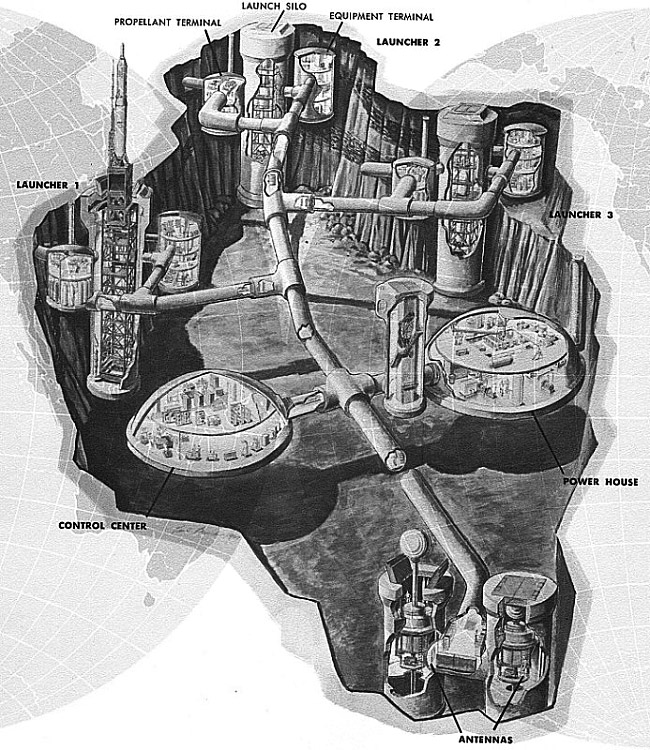
As we continued through the tunnels, eventually reaching one of the silos, the enormity of this structure becomes apparent. Standing on a metal grate, 107 feet above the bottom of the silo, it was easy to imagine what this place must've been like 50 years ago. A giant nuclear missile would've been just feet away from where I stood.
The history -- both seen and imagined -- helped to override my neuroses.
Clearly I'm not the only one who is enthralled by the history of the place, based on the graffiti covering nearly every inch of the walls inside: Tags from the early '80s to as recent as 2009, as well as every curse word, name and school you can think of are represented inside, creating their own history.
Oh, and there are beer cans everywhere. Keystone, Budweiser, Schlitz, Schmidt, Olympia, Coors — a who's who of yellow beer. I snapped a couple of photos of some of the cans, thinking maybe I could use Google to try and figure out just how long people had been going down there to party.
Google wasn't very helpful, but Kevin Logan, the curator for The Beer Can Museum, was. Logan figures the Olympia and Schlitz cans are definitely post 1979, because that is when bar codes were introduced. He thought perhaps the Schlitz can was from around 1980, since it has a pull tab opening, and the Olympia can is from the mid-80s or so.
The story of the silo didn't end when the military left in 1965 or when the salvage company stripped the copper out. It continues through the partying of modern-day explorers and divers who descend into the bowels of history.
This story was originally published May 6, 2012 at 2:00 AM with the headline "Facing fears one story at a time."