
Floating mass of weeds clogs Columbia Cup return to Tri-Cities
The star — actually, more like villain — of Friday’s HAPO Columbia Cup qualifying session was something called sago pondweed.
The official name is stuckenia pectinata, with its leaves all submersed, thinly linear and threadlike. Its stem is abundantly branched near the top.
It has been growing unabated for two years, since the last race was held in July 2019.
And there is your botany lesson for today.
Enough of it was above the water line on the Columbia River race course, near the back side on the Franklin County portion, that race officials couldn’t allow boats to be out on the water.
The pondweed was about a football field long and impeded lanes 1 through 4.
So for the first time in recent memory, boats weren’t allowed on the course during the Columbia Cup weekend.
The only other situation that comes close was in 2006.
On race day Sunday of that year, the winds coming from the west were strong enough that racing was delayed for at least three hours.
With a contract that said the race had to be done by midnight of Sunday, it was either run that day or pack it in.
Eventually, the winds died down and the race was completed that day.
But on Friday, teams and drivers spent the day waiting to take to the course.
“It’s kind of a shame,” said U-12 Graham Trucking driver Andrew Tate. “You have your drivers suit on, ready to go. And then you can’t. It gets mentally draining. But it’s part of the job. It’s just how it is.”
The H1 Unlimited fleet is used to delays. Water levels on the Ohio River in Madison, Ind., seem to annually affect the racing schedule there.
When the fleet raced in Detroit up until a few years ago, weather always seemed to delay things.
It just seemed weird Friday, because Tri-Cities usually always runs right on time.
Rachel Little is a biologist and outreach coordinator for the Benton Conservation District. She was helping advise the Water Follies organization on the situation.
Little said people had been calling the mass milfoil.
But she got Collin Hastings — the executive director of the Pasco Chamber of Commerce — to cut her a sample and get it to her for testing.
“It is actually sago pondweed,” Little said. “It is a native plant, but there is no resource concern there. It’s not invasive, and it’s not protected.”
Little said she verified the identity of the pondweed with Damian Walters, a biologist with the U.S. Army Corps of Engineers — which is the main regulatory agency in this region of the Columbia River because it is part of the McNary Dam reservoir.
The fact that the pondweed isn’t protected is key.
That meant the water operations people could get rid of the pondweed — although they’re not allowed to use a mechanized harvester because it could harm any endangered plants that are near the pondweed.
Hastings is part of the Water Follies executive board who oversees the water operations team.
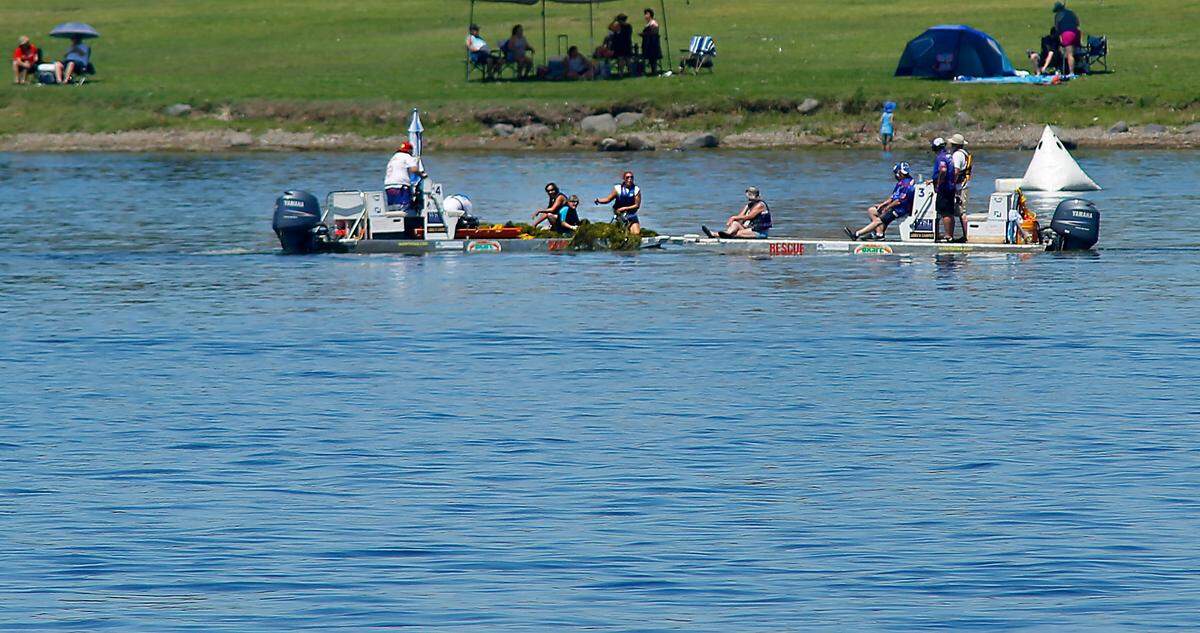
He said the water ops team, 12 to 15 of them on four sleds, were using heavy chains tied between two boats to drag or cut the pondweed.
The Port of Kennewick has a mechanized harvester, Hastings said, but it can only be used near boat launches and shore — not in the middle of the river.
So the water ops team is doing things manually.
“It looks like it’s going well,” Hastings said about 6 p.m. Friday. “The first swath, they’re killing it.”
Hastings was confident the water ops team would get the situation handled, and they would stay overnight if needed so that racing could get going.
“I’m thinking they’ll only need a couple hours,” Hastings said. “The water ops guys, they’re very key to all of this. We’re expecting an action-packed Saturday.”
One race team owner said it seemed the level of the river had been lowered 5 feet overnight.
But no one could confirm that.
Hastings said his water ops team had noticed the pondweed situation Thursday, but it wasn’t bad and didn’t look like it’d be a problem.
“It was worse (Friday) morning,” Hastings said.
It became more pronounced out of the water and would easily affect boats coming through it. The plant could easily get sucked into a boat’s intake and cause overheating.
Columbia Cup race director Aaron Stephens wouldn’t comment on whether or not the water level had changed.
What Stephens does know is that he met with officials from H1 Unlimited, the American Power Boat Association, and the Grand Prix of America to re-do the weekend schedule so the hydroplanes could test and qualify for the Sunday races.
This story was originally published July 23, 2021 at 8:29 PM.