
7-foot-4 former Richland High center finding his place as a UW Husky
Richland High graduate Riley Sorn has been out of high school now for two years.
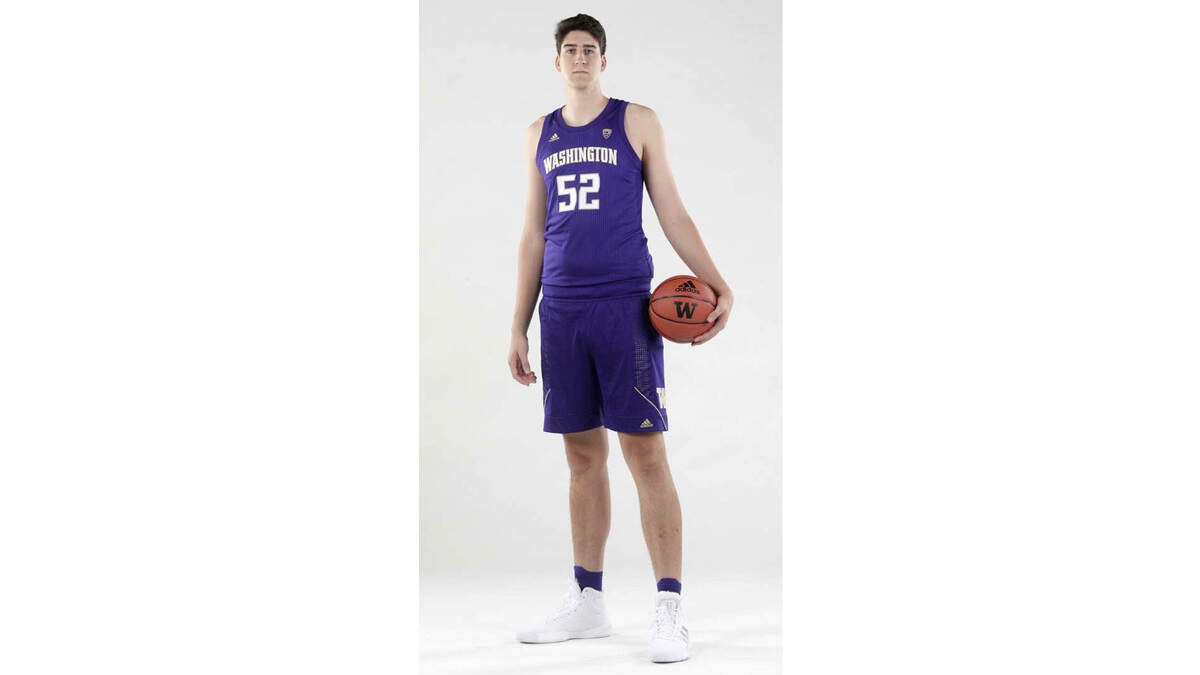
The 7-foot-4 center who was a big reason the Bombers went to the Class 4A state basketball tournament in both 2017 and 2018 has settled into life at the University of Washington.
Sorn joined the Huskies in 2018 as a preferred walk-on for head men’s basketball coach Mike Hopkins. And, thought he redshirted his freshman year and played in just one game this past season, Sorn is glad he moved to Seattle.
Especially since he was rewarded with a full-ride scholarship by the UW coaching staff about two months ago.
“Full-ride baby!” Sorn exclaimed on the phone conversation. “Originally, when I signed with them, it was gonna be pay your way for a while. Depending on how you play, we’ll eventually give you a scholarship.”
But the Huskies did it ahead of schedule, Sorn said.
“The plan was it wasn’t until next year they were gonna put me on scholarship,” he said. “But they liked the way I had been progressing.”
What Sorn has done is put on some much-needed muscle (and weight), and he’s improved with his post play.
“I was 230 pounds when I graduated from Richland,” said Sorn.
Now, he’s listed at 270 pounds. He says 270 is the heaviest he’s been.
“At 260 right now, I’m chilling,” he said. “They want me at 280.”
Gaining weight and muscle was the big project his freshman year.
“Meredith Price is our dietitian, and she’s great,” said Sorn. “They never put me on a calorie count. She gave me a list and told me, ‘Here is everything you should be eating. I’ll go grocery shopping with you the first couple of times so you can understand what you should be eating.’”
Sorn said the biggest part was nutrition.
“They provide two meals a day but include a lot of snacks and encourage us to eat 3 or 4 per day,” he said. “It’s about eating right.”
When they bring in lunch for the players, Sorn usually gets twice as much as the other players.
“A lot of guys just don’t want to eat,” Sorn said. “They’d give us great food to eat. I had no problem with it. You know me. I love to eat.”
Bulking up
OK. That helped him gain weight. But how do you turn that into muscle?
“I bulked up around 255, gained 25 pounds my first year. It was easy to gain,” said Sorn. “The hardest part was getting the extra 10 to 15 pounds of muscle.”
Todd Tuetken, the men’s basketball team’s Director of Olympic Strength/Conditioning, took care of the muscle part.
“I’ve been lifting every day, working with the weights coach,” said Sorn. “He’s tailored a plan for me.”
Then there are the practice sessions.
Sorn took his lumps from guys like senior Sam Timmons and 6-9 freshman Isaiah Stewart, who left the team after the season to enter the NBA Draft.
“Timmins is 260 (and 6-11), and I’d get beat around the court during workouts,” said Sorn. “He helped me a lot in how to be physical. Both him and Isaiah. Isaiah learned to get short hook shots up over me. We made each other better. I was able to stop him in the post pretty effectively, but it allowed him to learn how to score on other big men in games. I know he helped me so much.”
Sorn said he felt he moved pretty well up and down the court in high school. But as he gets used to his bigger body, he feels he can move even better now.
Post coaching
Perhaps the guy that helped Sorn the most was Huskies assistant coach Cameron Dollar.
College basketball fans may remember Dollar as a standout point guard at UCLA. At UW, he handles the post players.
That may seem odd, but Dollar has plenty of coaching experience, including eight seasons as head coach for Seattle University.
“Coach Dollar has helped me so much,” said Sorn. “Dollar is one of the best at being a post coach. He really has a feel of the game. He has a great mind for the game all-around. He has made me so much better as a post player. And he doesn’t take any crap out there from anyone.”
It’s Dollar who worked day-in and day-out with Sorn, Timmins, Stewart and 7-foot center Bryan Penn-Johnson, a redshirt freshman.
Because of that daily routine with Dollar and the other big guys, “I have a lot more confidence in using more post moves. I can be a threat. The biggest thing is having a couple of post moves, and then some counter moves. But the biggest thing is confidence.”
That confidence has helped his game, he says. Asked to compare his game today to his Bombers days, he says, “I’m so much better now. I would watch some old tape of me playing at Richland now and just cringe.”
Changing majors
One of the drawing cards for Sorn going to the UW was the chance to get into aerospace engineering. That was going to be his major.
But like many college students, changing majors once or twice can happen.
“My academic counselor tried to work with me for months on the (aerospace engineering) program,” said Sorn. “But a lot of the labs are at 5:30, 6 o’clock at night, right when we were practicing. It was never gonna work out.”
Now, he’s changed his major to architecture. He enjoys it, and thanks to a mentoring program, Sorn is getting a first-hand look at the industry.
“Hop (Hopkins) is really into life after basketball, because not many guys will get a chance to play in the NBA,” said Sorn. “In the program, every player has a guy who mentors them in their major. Hop wanted us to reach out to these guys ourselves.”
Sorn has, and he loves it.
“That was huge,” he said.
Busy routine
As an athlete at a major university, there’s not much idle time for Sorn.
He offered up a typical day — which in reality is never typical.
“In the spring, we have 6 a.m. workouts,” he said. “I dread those, but because of the quarantine we don’t do them right now. If you have classes in the morning, you get up and lift weights at 7 a.m.”
Classes are 4-6 hours a day. Sometimes you have class until 12, 1 or 2, and maybe lift after that.
“We’ll have lunch in the locker room, then go to the training room to get taped up,” added Sorn.
Practice usually starts at 4 p.m.
“Practices are 1½ to 3 hours, depending on the situation,” Sorn said. “We might watch film until 7 p.m., or 7:30. If you don’t have homework, you might stay out on the court and shoot. But generally, you have homework and do that until around 11 p.m. Then go to bed and start all over again.”
Coronavirus and fall sports
With the coronavirus starting to affect fall sports — the Huskies football team just lost their opener against Michigan this past week — no one knows what to expect this school year.
That includes classes.
“It’s supposed to be a hybrid, with small classes to be on campus,” said Sorn. “The 600- to 700-person classes will be online. Athletically, its up in the air.”
All he knows is he’s headed back to Seattle when voluntary workouts begin on July 20.
“Right now, with the current phase, they’d be like 4 or 5 guys together, open-air workouts, with a lot of conditioning,” said Sorn.
With Timmins done with his eligibility, Stewart leaving for the NBA, and Penn-Johnson entering the transfer portal, there is a chance Sorn could see a lot of playing time this coming season.
And he’ll do it as a scholarship player.
“I was one month into the quarantine and was looking to get a job this summer when they told me I was on full scholarship,” said Sorn, who has an off-campus apartment in Seattle. “It was huge, especially living in Seattle. It covers most of my needs.”
It allows him to concentrate more on his studies, his basketball game and juggling everything as a busy college student.
“It’s a lot to try to balance, but it’s great to see the improvements in your game,” said Sorn. “And I love the different schedule each day. I look forward to looking at what’s next, thinking, ‘I have this to do today.’ By no means is anything ever mundane.”